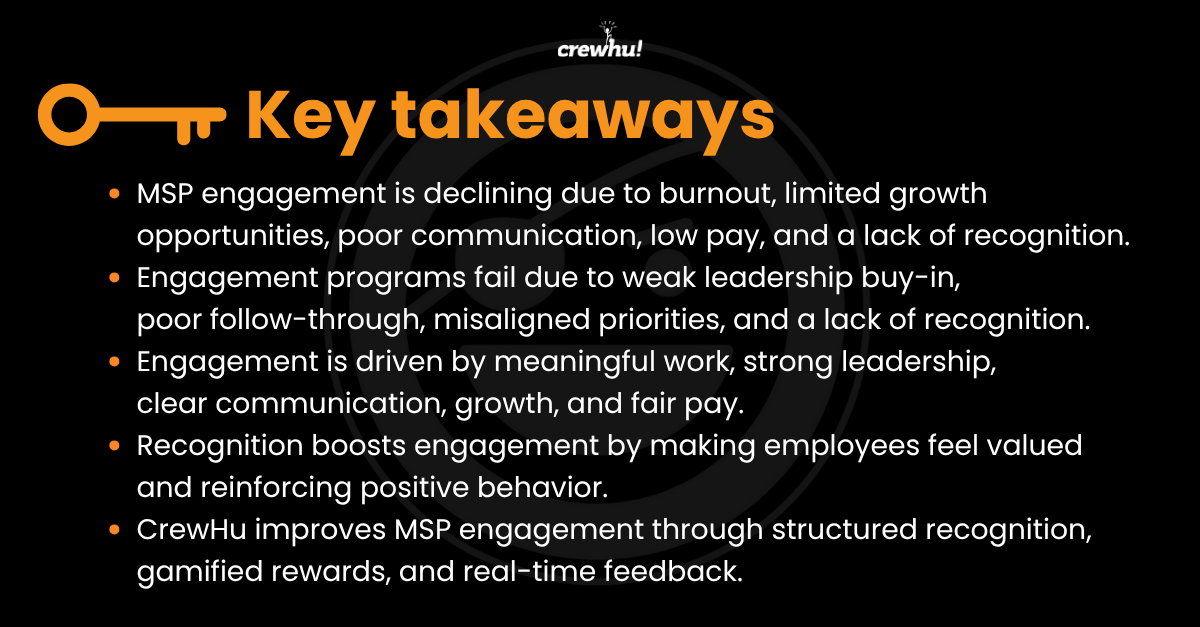
Employee engagement for MSPs does not break overnight. It fades quietly, showing up first as slower responses, lower energy, and reduced ownership across the crew. Many leaders only notice the problem once performance starts slipping or turnover increases.
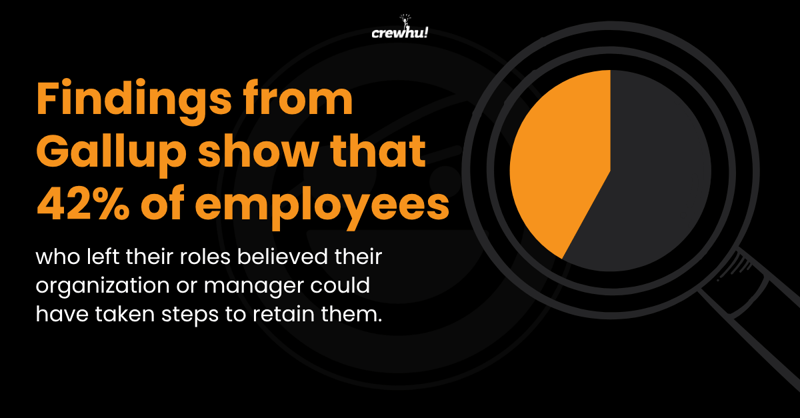
Findings from Gallup show that 42% of employees who left their roles believed their organization or manager could have taken steps to retain them. That gap points to a deeper issue. Engagement is not lost because people suddenly decide to leave. It declines when effort goes unseen, progress feels disconnected from outcomes, and recognition becomes inconsistent.
In MSP environments, the pressure is constant. Crews operate in a reactive cycle of tickets, escalations, and client demands. Without systems that reinforce performance and acknowledge impact in real time, even strong performers begin to disengage. Fatigue builds, motivation drops, and what once felt like a high-performing operation starts to lose momentum.
Most MSPs do not lack tools or good intentions. The real issue is a disconnect between what leaders believe drives engagement and what actually makes crews only 31% of employees accountable, and motivated to perform at a high level.
Continue reading to understand why employee engagement for MSPs is declining, what drives it, and how to improve it across IT teams.
Why is employee engagement for MSPS declining?
According to Gallup, only 31% of employees are engaged. For MSP leaders, this is not just a workforce issue; it directly impacts performance, retention, and client experience.
Engagement does not drop suddenly. It builds over time when effort goes unnoticed, expectations feel disconnected from reality, and employees lose sight of how their work contributes to meaningful outcomes.
When employees are asked the reasons why they’re not fully engaged, several common themes emerge. Let’s take a look at the 5 most cited reasons:
1. High stress and burnout
The nature of MSP operations places ongoing pressure on crews to respond quickly, resolve issues efficiently, and manage multiple client demands at once. Over time, that constant demand begins to take a toll, especially when there is no structured way to balance workload or recognize sustained effort.
Where this becomes visible:
- Excessive workloads: High ticket volumes and overlapping responsibilities leave little room to focus, making it harder to maintain quality and consistency over time.
- Work-life imbalance: On-call rotations and after-hours incidents make it difficult to disconnect, gradually affecting energy levels and long-term motivation fully.
- Unrealistic expectations: Speed is often prioritized without sufficient consideration for complexity or resource constraints, creating a cycle in which pressure keeps increasing.
This kind of pressure does not cause immediate disengagement. It builds gradually until fatigue begins to affect performance, and motivation starts to drop.
2. Career stagnation
Employees stay engaged when they can see progress. When that progress is unclear or unavailable, motivation tends to decline much faster than expected.
Where the gap appears:
- Limited growth paths: Remaining in the same role without a clear next step makes it difficult to stay invested, especially for high performers who expect progression.
- Lack of training: As tools and technologies evolve, the absence of continuous learning creates uncertainty and reduces confidence in day-to-day work.
Once employees stop seeing how their roles evolve, their connection to the work itself begins to weaken.
3. Compensation and benefits disparities
Employees in IT and MSP environments often take on high-pressure responsibilities, from handling critical incidents to supporting demanding clients. They expect compensation that matches that level of effort. When this balance feels off, motivation drops, and resentment can quietly grow over time.
Beyond salary alone, benefits also play a major role in engagement. Limited perks and a lack of flexibility can make employees feel undervalued, even if the base pay is competitive.
Over time, this mismatch between effort and reward causes employees to disengage and explore better opportunities where they feel their contributions are truly recognized.
4. Poor leadership and communication
Clear direction and consistent communication are essential for maintaining engagement, yet both are often overlooked in fast-moving MSP operations.
Where this breaks down:
- Misaligned priorities: When employees do not understand how their work contributes to broader goals, it becomes harder to stay motivated or take ownership.
- Weak feedback loops: Without regular, specific feedback, employees are left to interpret their own performance, which slows improvement and creates uncertainty.
When communication becomes inconsistent, trust begins to erode, and engagement follows suit.
5. Under appreciation
Recognition plays a direct role in reinforcing performance, but in many cases, it is either inconsistent or completely absent.
Common patterns include:
- No incentives tied to performance: When additional effort does not lead to meaningful acknowledgment, employees naturally reduce the level of effort they put in.
- Work going unnoticed: Consistent contributions without recognition create frustration, especially for employees who are performing at a high level.
When recognition is missing, employees start to question the value of their work, and disengagement becomes a gradual but predictable outcome.
Why do employee engagement programs fail?
Employee engagement programs rarely fail because of bad intent. They fail because they are disconnected from how work actually happens.
Most initiatives look strong at launch but struggle to influence day-to-day performance, which is where engagement is either reinforced or lost.
Here are the most common reasons they fall short:
- Lack of leadership commitment: When leaders are not actively involved, engagement becomes a side initiative instead of a priority. Employees quickly pick up on this and disengage from the program.
- One-size-fits-all approach: Treating every role the same ignores how different responsibilities and pressures shape motivation. What works for one group rarely works for another.
- Poor follow-through: Many programs start with energy but fade over time. Without consistency, they feel temporary and lose credibility.
- Misaligned priorities: Focusing on perks instead of performance drivers like workload, growth, and accountability creates surface-level engagement that does not last.
- No measurement or feedback loop: Without visibility into what is working, programs cannot improve. Employees also lose trust when their input does not lead to change.
Engagement programs fail when they operate separately from performance. If they are not tied to how work is done and recognized, they will not hold.
What actually drives employee engagement?
Most MSP leaders ask the same question: how do you improve engagement in IT teams without adding more overhead?
The answer is not adding more initiatives. It is building systems that remove the reasons employees disengage in the first place, such as those offered by Crewhu.
Employee engagement for MSPs is driven by a few consistent factors that shape how people show up and perform:
- Fair compensation that reflects responsibility
- Leadership that provides clarity and direction
- Clear communication tied to outcomes
- Visible growth and development opportunities
- Recognition that reinforces performance
When these drivers are in place, engagement stops being something you try to manage. It becomes a natural outcome of how the business operates.
How do recognition programs improve engagement?
Recognition improves engagement when it is consistent, visible, and directly tied to performance. It shows employees that their work has an impact, and that impact is seen.
When recognition is missing or inconsistent, effort feels invisible. When it is built into daily workflows, it reinforces the behaviors that drive results.
Crewhu helps MSPs operationalize recognition by combining performance visibility, gamification, and rewards into one system that runs alongside existing workflows.
Here is how that translates into real engagement:
-
Peer-to-peer recognition (badges): Crews can recognize each other in real time, reinforcing strong behaviors and building shared accountability.
-
Leadership recognition: Managerial recognition carries weight. It connects performance to business outcomes and reinforces what matters most.
-
Automated recognition: Milestones and performance wins are automatically acknowledged, reducing the risk of contributions being overlooked.
-
Gamified rewards (Crewhu bucks): Performance earns tangible rewards for a job well done, adding a competitive edge that keeps motivation high.
-
Performance-based contests: KPIs like service quality and productivity are tied to incentives, turning performance into something visible and measurable.
Recognition works when it is not treated as a one-time action but as part of how performance is tracked and reinforced. When employees consistently see the connection between what they do and how it is valued, engagement becomes sustainable rather than forced.
Improve MSP team engagement with Crewhu
Employee engagement for MSPs does not break because people are not working hard. It breaks when performance is not visible, and recognition is inconsistent. Over time, that disconnect reduces motivation, even across high-performing crews.
If your crew is starting to lose momentum, this is the point to step in. Crewhu helps you turn recognition into a system that runs alongside daily work, so performance is seen, reinforced, and connected to real outcomes.
Ready to improve employee engagement for MSPs and build a crew that stays motivated and accountable? Book a demo today.