.png)
Key Takeaways
- A strong client acquisition strategy starts with client fit first and channel selection second. Service businesses should first identify which prospects are worth pursuing, then decide how much to invest in ads, content, referrals, outreach, or local visibility.
- Lead volume alone doesn’t signal healthy acquisition. Poor-fit inquiries tend to drain sales time, weaken margins, stretch service teams, and hide if a channel is producing profitable client relationships.
- Acquisition channels perform best when they match the buyer’s trust burden, urgency, decision path, and expected value. Search, content, paid media, referrals, partnerships, and nurture each require different proof and follow-up.
- Service quality, reviews, referrals, and reputation reduce perceived acquisition risk. They’re strongest when paired with clear targeting, sales discipline, channel strategy, and measurement.
- Customer feedback and service-quality signals strengthen the proof behind acquisition. A healthy feedback-and-reinforcement model lets teams see and repeat the client-facing behaviors that make trust, reviews, and referrals more credible.
When your service desk crew is drowning in low-margin tickets, it looks like a capacity problem. But more often than not, the real culprit is an alignment failure at the front of your sales funnel. Bringing in poor-fit inquiries drains your sales team's follow-up time, stretches your service delivery to the breaking point, and causes your top engineers to mentally check out.
Service businesses lose acquisition momentum when channel choices come ahead of client definition. A local contractor, agency, consultancy, professional-service firm, or B2B service provider could already be running ads, publishing content, asking for referrals, attending events, sending email follow-up, and investing in local visibility. Those activities start to function as a system once the business knows which prospects are worth pursuing, what proof those prospects expect, and how each channel leads to a qualified client conversation.
A client acquisition strategy gives that activity discipline. The goal is steady growth through clients who fit the service model, value the relationship, stay long enough to justify acquisition cost, and create realistic conditions for future reviews or referrals. Lead volume alone rarely proves that. A busy pipeline full of weak-fit inquiries drains follow-up time, stretches service teams, and hides poor economics.
Strong client acquisition strategies for service businesses connect fit, trust, proof, follow-up, and measurement. Channel choice remains important. It performs best when the business understands what buyers must believe to commit and which signals make the provider credible enough to contact.
What client acquisition means for service businesses
Client acquisition is the process of attracting, qualifying, converting, and onboarding new clients who fit the business. Broad customer-acquisition guidance usually treats acquisition as identifying, attracting, and converting interested prospects into paying customers. For service businesses, that basic idea has to be adapted to relationship-based buying. The customer is usually purchasing expertise, trust, responsiveness, and continuity alongside the defined service.
That broader scope changes the acquisition work. Lead generation creates inquiries or contacts, while client acquisition covers the route from visibility to a paying, onboarded relationship. A form submission is still only an inquiry. The buyer actually moves from interest to commitment through:
- Qualification
- A useful consultation
- A clear proposal
- A confident close
- An onboarding experience
Service buying also carries risk for the prospect. They worry about reliability, timing, service quality, responsiveness, price, and whether the provider understands the problem. An acquisition strategy has to reduce that uncertainty on both sides of the first conversation. General acquisition models can be used only when service businesses translate them into trust, proof, consultation, onboarding, and relationship quality.
Based on this wider path, client acquisition means building a repeatable journey from the right prospects to the right client relationships. The route attracts qualified attention, gives buyers enough proof to act, converts them through a disciplined sales process, and builds the relationship in a way that supports retention, referrals, and long-term value.
Why client acquisition strategy matters
A client acquisition strategy protects service businesses from random channel chasing. Without strategy, the owner or sales lead reacts to whatever looks urgent. One month, the business invests in ads. The next, it tries social media, then a referral push, then a new landing page. Activity increases, yet the team still lacks reliable answers about client fit, opportunity-producing channels, and sensible acquisition costs.
Acquisition strategy therefore should lead channel selection. Salesforce views acquisition as a process that moves prospects toward becoming paying customers and lists ideal-customer definition as the first step in a strong acquisition strategy. For a service business, the operator needs a clear view of prospect fit before more time or budget goes into a channel.
The core risk is poor-fit growth. A service business can win clients who increase revenue for a short period while weakening the business underneath. Those clients could have low retention potential, weak lifetime value, heavy service demands, or little chance of becoming a useful referral source. IBM also notes that high churn can point to satisfaction problems and low CLV may suggest that acquisition is targeting the wrong audience.
Economics gives the strategy discipline:
- CAC captures the cost of acquiring a client.
- CLV reflects the long-term value of that client relationship.
- Conversion rate, close rate, churn, channel ROI, and payback timing help the business judge if a channel deserves more investment.
Rather than acting as a mere financial exercise, these numbers give the operator a way to compare effort, cost, quality, and payback.
Strategy also improves follow-up. Many service businesses already have some visibility but struggle with a bottleneck that sits between inquiry and decision. A prospect asks for information, compares options, waits for proof, studies price, or hesitates prior to booking a consultation. A better acquisition strategy gives the business a clearer conversion path. The next constraint is visible across targeting, proof, response time, proposal clarity, onboarding friction, or channel quality.
Start by defining the right clients to acquire
The best client acquisition work starts with a clear target-client profile. Before channel selection, the owner, operator, or sales lead identifies which clients fit the service model. Channel choice depends on the buyer, search habits, trust burden, and likely value of the client relationship.
That sequence shapes messaging, proof, channel choice, offer framing, and follow-up across the rest of the acquisition system.
A practical service business profile covers the conditions that shape fit. Start with:
- Service type
- Geography or service area
- Budget and urgency
- Margin and sales cycle length
- Onboarding fit
- Retention likelihood
- Referral potential
Different service models weigh these criteria differently. Home service companies usually prioritize location, urgency, job size, review sensitivity, and repeat service potential. Consulting firms tend to care more about company size, decision-maker access, budget authority, implementation readiness, and the chance of a multi-month engagement. Professional service providers for their part often require stronger filters for trust, confidentiality, scope clarity, and relationship quality.
Disqualifiers belong in the profile as well. Some prospects are too small or price-sensitive, too far outside the service area, too urgent for current capacity, or overly vague about the problem. Think of the Friday afternoon “emergency” from a prospect who refuses to pay an onboarding fee but expects a dedicated engineer on-site in 10 minutes.
Clear disqualification protects sales time and service quality. Messaging improves when the business stops writing to everyone and starts answering the concerns of the clients it actually wants.
The target profile should be detailed enough to guide investment. Clients who rely on local trust direct the strategy toward local search, reviews, community visibility, partnerships, and referral discipline. Buyers who require education prior to contact, though, make content and consultation-led offers more important. A service with high lifetime value and a long sales cycle requires nurture and follow-up behind paid traffic. The profile sets the channel order.
Match acquisition channels to trust, cost, and buying behavior
Service businesses get the best return from channels that match the buyer’s urgency, trust burden, decision path, and long-term value. There’s no “best of the best” platform here. A channel earns its place when it reaches the right prospect at the right point in the decision, gives that prospect credible proof, and produces opportunities the business can convert profitably.
High-intent search works for prospects who already recognize they require outside expertise. Local search, service pages, and SEO let the business appear while the buyer compares providers. Content suits buyers who want education, confidence, or a reason to trust expertise prior to contact. Paid ads require a clear offer, a specific landing page, and tracking from inquiry to close. Referrals and partnerships fit high-trust services because the prospect arrives with borrowed credibility. Networking, events, social visibility, and direct outreach serve B2B or professional-service relationships where timing and relationship context shape the decision.
Internal capacity belongs in the channel decision. A business with weak follow-up should repair its response time and qualification ahead of buying more traffic. Pouring cash into paid ads when your internal response time looks like dial-up internet is just an expensive way to watch good prospects run straight to your competitors.
Companies with few proof assets need to strengthen reviews, testimonials, case examples, and service pages so cold prospects will trust it. Companies with limited budgets have to choose channels that match their time horizon and average client value.
Use the table as a decision aid. The goal is to match acquisition activity to trust signals and metrics so each business chooses channels by fit over popularity.
|
Channel type |
Best fit |
Trust or proof required |
Metric to watch |
|
Search, SEO, and local search |
Prospects already looking for a provider |
Clear service pages, reviews, local credibility |
Qualified inquiries and booked consultations |
|
Content |
Education-heavy buyers and longer sales cycles |
Practical answers, expertise, case examples |
Assisted conversions and lead quality |
|
Paid ads and PPC |
Faster testing and demand capture |
Strong offer, landing page, tracking |
CAC, conversion rate, and close rate |
|
Email and nurture |
Existing audience or longer decision path |
Timely, relevant follow-up |
Reply rate, booked calls, and conversion |
|
Referrals and partnerships |
High-trust service buying |
Strong service experience and relationship proof |
Referral quality, close rate, and retention |
|
Networking, events, and outreach |
Local, B2B, or professional-service relationships |
Credibility and a clear offer |
Meetings booked and qualified opportunities |
A strong channel mix usually has fewer moving parts than the owner expects. Businesses require visibility to be found, proof to be trusted, follow-up to convert interest, and measurement to identify the next investment. Adding channels while those basics remain weak just adds noise.
Core client acquisition strategies to consider
The most effective client acquisition strategies usually reinforce one another. Visibility creates attention, proof builds trust, relationships carry credibility, and follow-up keeps qualified prospects moving. A service business sees better results from a small, connected set of strategies, whereas running every tactic at low quality weakens the system.
Capture existing demand with search (including local) and service pages
Search-based acquisition suits prospects with an active problem. Local-service buyers often search for nearby providers, while a B2B-specific buyer may search for a specialist who understands a defined problem. Companies therefore require service pages that answer buyer questions clearly, include proof, and make the next step easy.
Search performance deserves a deeper check than rankings alone. A high-ranking page that brings poor-fit inquiries just looks busy. It feels good to have the number-one spot on Google, but if those clicks only fill your inbox with weak prospects who drain your sales lead's time, you basically have a costly digital waiting room.
Qualified inquiries, booked consultations, close rate, and revenue from the channel are better signals. SEO and local search also depend on proof assets; reviews, location relevance, service explanations, photos where appropriate, and specific examples reduce the buyer’s uncertainty.
Build trust with content, case examples, and educational resources
Content is strongest when buyers understand the problem before a provider conversation. For instance, a consultant who publishes decision guides, an agency explaining tradeoffs between service options, or a contractor answering cost, timing, and scope questions. Good content empowers the buyer and keeps the blog calendar from turning into filler. It also gives the prospect a better basis for their decision and the provider a credible reason to enter the conversation.
Case examples and testimonials strengthen that effect. They show how the service business thinks, what problems it solves, and what kind of client results it drives. Social media and online community visibility can have the same trust-building role when a company uses those channels to demonstrate expertise, answer questions, and stay visible to the right audience. The practical test is quality of attention. Posting frequency alone is surface-level.
Use referrals, partnerships, and networking for high-trust acquisition
Referral and relationship strategies are critical for service businesses because trust regularly travels through people. A satisfied client, adjacent provider, local partner, or professional contact lowers a prospect’s uncertainty ahead of the first call. Referral acquisition still requires discipline though. The company needs a clear ideal client profile, a simple way for partners to understand the offer, and service delivery strong enough to make referral requests credible.
Partnerships perform best when both sides serve related client requirements without competing. A financial professional could refer a legal service provider, a marketing agency might spotlight a web development firm, or a home-service business may build relationships with property managers or real estate professionals. Quality carries more weight than count here. Good referrals fit the service, budget, timing, and relationship model.
Use paid channels only when tracking and follow-up are ready
Paid ads and PPC speed up testing when the business controls spend, message, and landing-page traffic. They also expose weak economics quickly, provided the business measures the right actions. Google Ads’ conversion measurement lets advertisers define valuable actions, such as purchases, sign-ups, or phone calls, then see which campaigns, ads, ad groups, and keywords contribute to those outcomes.
Clicks aren’t clients for service companies. Your ad dashboard might be flashing green, but if those clicks turn into ghosted consultations, you're funding search engine campuses instead of your own growth.
A paid campaign could look active while producing poor-fit inquiries, unqualified calls, or consultations that never close. Prior to increasing spend, a business must have a clear offer, a specific landing page, and tracking that connects the channel to qualified inquiries, consultations, close rate, CAC, and revenue from acquired clients.
Paid channels also need messaging discipline. Google recommends specific calls to action, user-focused ad copy, and consistency between ad claims and the landing page. A vague offer, generic landing page, slow response process, or unknown close rate turn paid acquisition into an expensive litmus test to discover the conversion path is broken.
Paid media decisions improve when margin and payback logic lead the way, with vanity traffic numbers kept in the background. A service business with high lifetime value may tolerate a higher acquisition cost than a company with one-time, low-margin work. The practical question is whether the campaign produced client relationships the business serves profitably.
Strengthen follow-up and nurture
Many prospects don’t buy during the first interaction, especially when the service is complex, expensive, trust-heavy, or tied to timing inside the buyer’s own business. Email, CRM reminders, proposal follow-up, reactivation campaigns, and scheduled check-ins keep qualified prospects from going cold. Follow-up must be relevant and practical, since repeating generic sales messages weakens trust. Pinging a prospect with a lazy “just checking in” email every three days only serves to make you look desperate.
For service businesses specifically, it has to move the prospect through the decision. Useful follow-up clarifies scope, answers common objections, shares proof, invites a consultation, or confirms timing. Email volume is the wrong signal. The stronger indicator is movement toward qualified conversations, proposals, closed clients, and retained relationships.
Build a conversion path beyond the lead source
A client acquisition strategy requires a conversion path that turns visibility into a qualified client relationship. Funnel language has some worth, but service businesses get more value from the path as a diagnostic tool than as a rigid diagram. Salesforce describes a strong acquisition strategy as one that gives prospects a clear journey from interest to action and removes friction. For service businesses, that structure reveals where prospects stall and what the business has to repair.
A practical path moves through visibility, inquiry, qualification, consultation, proposal, close, onboarding, service delivery, review, and referral. Each stage has a different job. Visibility lets the prospect find the business, inquiry captures interest, and qualification protects the team from weak-fit work. Consultation then builds trust and clarifies the problem, while proposal discipline turns the conversation into a decision. At the end, onboarding confirms expectations and reduces early friction, and service delivery creates the experience that later supports reviews, retention, and referrals.
A practical path helps the business diagnose where acquisition is working and where prospects stall. At each stage, the question changes:
|
Stage |
Diagnostic question |
|
Visibility |
Can the right prospect find the business? |
|
Inquiry |
Is interest turning into a visible signal? |
|
Qualification |
Is the team filtering out weak-fit leads? |
|
Consultation |
Does the conversation build trust and clarify the problem? |
|
Proposal |
Is the offer clear enough to support a decision? |
|
Close |
Is the buyer ready to commit? |
|
Onboarding |
Are expectations clear, and is early friction reduced? |
|
Service delivery |
Does the experience support reviews, retention, and referrals? |
|
Review and referral |
Does delivered service become proof for future acquisition? |
Bottlenecks reveal the next acquisition priority:
- Low visibility usually calls for search, content, referral partners, social visibility, or outreach.
- Weak inquiries suggest message or targeting problems.
- Stalled proposals signal issues with the offer, proof, or pricing explanation.
- Clients who close and leave quickly point back to service fit and onboarding quality.
The conversion path also prevents overinvestment in the wrong areas. Buying more traffic perpetuates poor qualification, referral volume leaves a confusing proposal intact, and more content continues to encourage slow responses. A service business grows more predictably when the owner identifies the stage blocking qualified acquisition.
Use service quality, reviews, referrals, and reputation as acquisition proof
Service businesses sell trust ahead of the full service experience. Buyers look for signals that reduce risk prior to commitment, like reviews, testimonials, and referrals. Responsiveness, reputation, clear service explanations, and visible customer experience give the buyer enough confidence to decide if the provider seems credible enough to contact.
That proof layer is important because buyers actively use outside signals. BrightLocal even reports that 97% of consumers read reviews for local businesses, and the average consumer uses six different review sites when choosing businesses. Reassurance is strongest when reviews reinforce the channels, follow-up, and proof assets already bringing buyers into the path.
Responsiveness is part of that proof. Review responses shape customer trust and purchasing decisions, and it recommends that businesses respond to every review, make responses personal, and respond quickly. Among service companies, the acquisition promise has to match the experience clients actually receive.
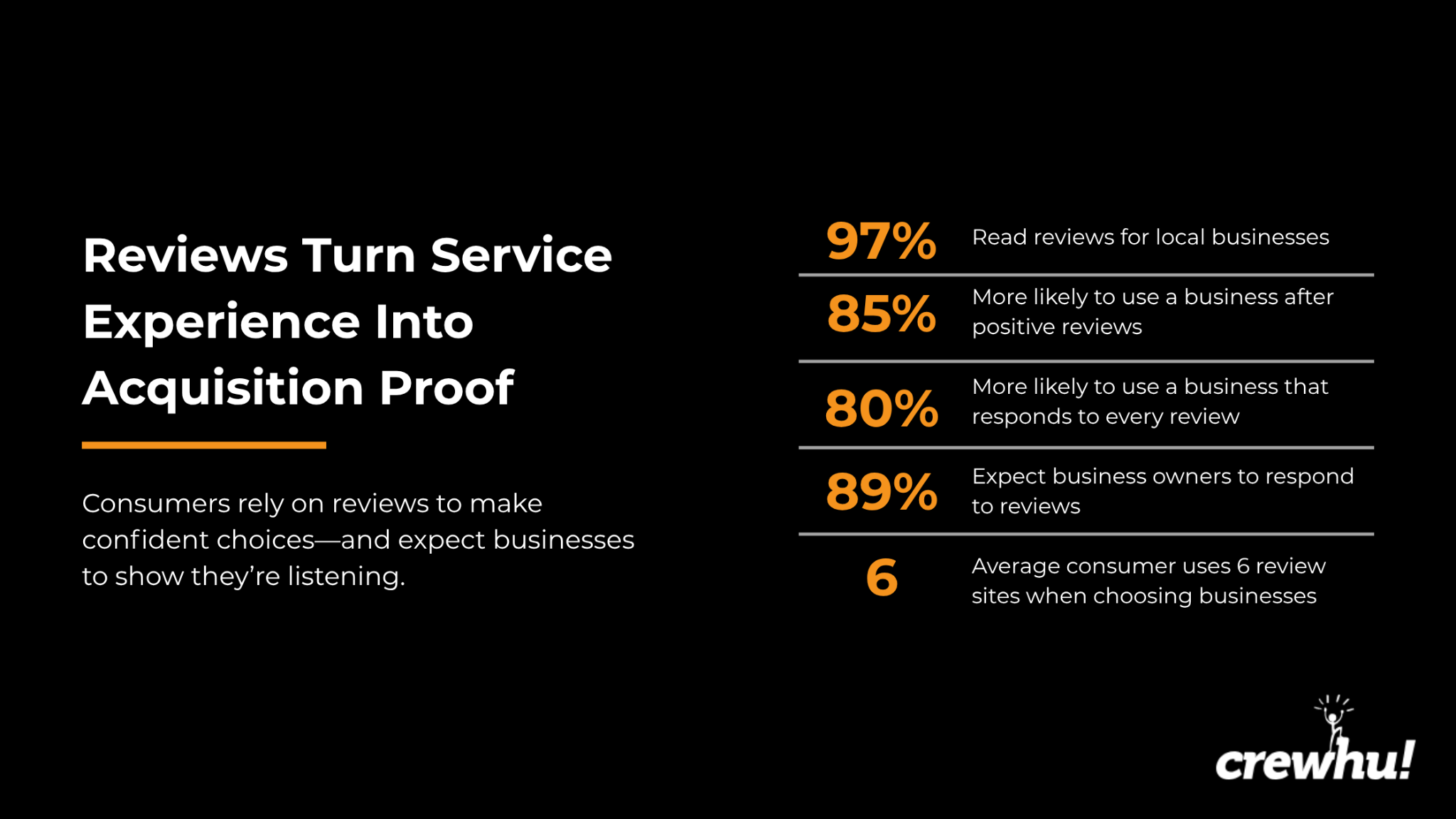
These proof signals work best when they strengthen the channels already bringing prospects into the funnel. Search, referrals, paid ads, content, outreach, and partnerships create attention and opportunity. Service quality and reputation give prospects more confidence to take the next step. A review can confirm the team responds quickly, referrals may signal the provider handled a similar problem well, and testimonials could explain what the client valued. Strong onboarding is also important, as it increases the chances that the client stays, speaks positively, or refers someone later.
The point is to use reviews and referrals as proof inside a broader acquisition system. They reduce perceived risk and strengthen credibility when they work alongside targeting, channel choice, follow-up, proposal discipline, and measurement. Reputation becomes most useful when it gives the business clearer proof to carry into search, referrals, paid campaigns, content, outreach, and sales conversations.
Customer feedback helps the business improve that proof layer. Satisfaction patterns, complaints, response quality, service recovery, and praise show whether acquisition promises match the experience clients actually receive. Those signals help leaders decide which service behaviors deserve coaching, reinforcement, or recognition.
Crewhu brings this service-proof layer into view for service businesses. Customer feedback tools let teams capture service feedback, track CSAT and NPS signals, see patterns across customers, employees, and issue types, and connect that visibility to recognition, rewards, coaching, and online reputation work.
A local or relationship-based service business needs that visibility because acquisition proof is built from the experiences clients remember, such as responsiveness, follow-through, service recovery, communication, and consistency. Acquisition channels bring prospects into the conversation, then service proof gives those prospects a stronger reason to trust what the business promises. Crewhu gives teams a way to turn customer feedback and service-quality signals into an operating rhythm the business sees, reinforces, and repeats.
Recommended Watch: How service feedback becomes acquisition proof
In the RocketMSP Podcast episode Crewhu Demo & Interview, host Steve Taylor interviews Crewhu founder Stephen Spiegel about how customer feedback, recognition, surveys, contests, and gamification help service companies turn daily service interactions into visible signals.
The conversation reinforces the central acquisition point: Proof has to come from real client experiences. Reviews, referrals, testimonials, and reputation grow stronger when the business captures service moments, recognizes the behaviors behind them, and turns feedback into something future buyers can trust.
Watch the episode to see how Crewhu connects customer feedback, recognition, and service-quality visibility into a model service businesses use to strengthen the proof behind growth.
Measure whether acquisition is profitable
Client acquisition is working when the business wins clients whose value justifies the cost and effort required to acquire them. Metrics turn acquisition from a collection of activities into a management decision. The owner or sales lead decides which channels to keep, which to repair, and which to cut.
CAC measures the cost of acquiring a client, CLV captures the long-term value of that client relationship, and conversion rate tracks how many inquiries or leads move forward. Meanwhile, close rate tracks how many qualified opportunities become clients, channel ROI compares investment with return, and referral quality, retention, and payback timing add service-business discipline because the cheapest lead may still be a poor client.
The table below ties each metric to the decision it guides.
|
Metric |
What it tells you |
Why it’s important for service businesses |
|
CAC |
Cost to acquire a client |
Tests if the channel protects margin and payback |
|
CLV |
Long-term client value |
Prevents cheap acquisition from hiding poor retention or weak fit |
|
Conversion rate |
Share of inquiries or leads that advance |
Reveals where the path may be leaking |
|
Close rate |
Share of qualified opportunities that become clients |
Tests offer fit, proof, sales process, and trust |
|
Referral quality |
Fit of referred opportunities |
Indicates if relationship proof is producing useful leads |
|
Retention |
Acquired-client stay rate |
Clarifies long-term acquisition economics |
|
Channel ROI |
Return from each acquisition source |
Guides the next investment priority |
Analyze the metrics together to gain a view picture of your process. A channel with low CAC, for example, remains weak if it brings in clients who leave quickly, resist the service model, or rarely refer. Imagine a cheap channel that pulls in clients who treat your service team like dirt and churn after 90 days. That low CAC you were so happy with is actively destroying your team culture.
A channel with higher cost, though, may be worthwhile if it attracts clients with stronger fit, higher lifetime value, and smoother onboarding. The decision is whether the channel produces client relationships that the business can serve profitably.
Avoid benchmark shortcuts during measurement. A ratio or rule of thumb has value in some contexts, but service businesses vary by margin, delivery cost, sales cycle, capacity, retention, and client value. The better question is operational. Did this channel produce clients who fit the service model, convert at an acceptable cost, stay long enough, and justify more investment?
Turn acquisition into a repeatable client acquisition plan
A client acquisition plan translates the strategy into a simple operating rhythm. Start with the target client, then choose two or three channels that match the target’s trust burden and buying behavior. Build the proof assets those channels need, define the follow-up process, and measure results weekly or monthly. Refine the strategy using client quality as the standard, with lead count as a secondary signal.
The plan has to be specific enough to guide ownership. A local service business may prioritize local search, reviews, referral partners, and fast response, while a professional-service firm might prioritize educational content, networking, partner referrals, and consultation follow-up. In either case, response time, qualification rules, proposal follow-up, proof updates, and monthly reviews of channel performance require clear ownership.
The review rhythm matters. Each month, the owner or leadership team should ask where qualified opportunities came from, how many converted, which clients fit the business, and what proof gaps appeared during sales conversations. Customer feedback reveals mismatches between acquisition messaging and delivered experience. If prospects are promised responsiveness while clients report slow handoffs, the acquisition plan has exposed an operational problem inside the marketing system.
A repeatable plan stays simple, with only a clear client profile, a small channel set, proof assets, follow-up ownership, and metrics that connect acquisition activity to profitable client relationships. The business then improves one constraint at a time without restarting the acquisition strategy every month.
A repeatable acquisition plan also has to make service proof easier to see. If a business keeps investing in channels but lacks visibility into service behaviors that create trust, feedback patterns that reveal friction, and client experiences worth reinforcing, the acquisition system remains partly blind.
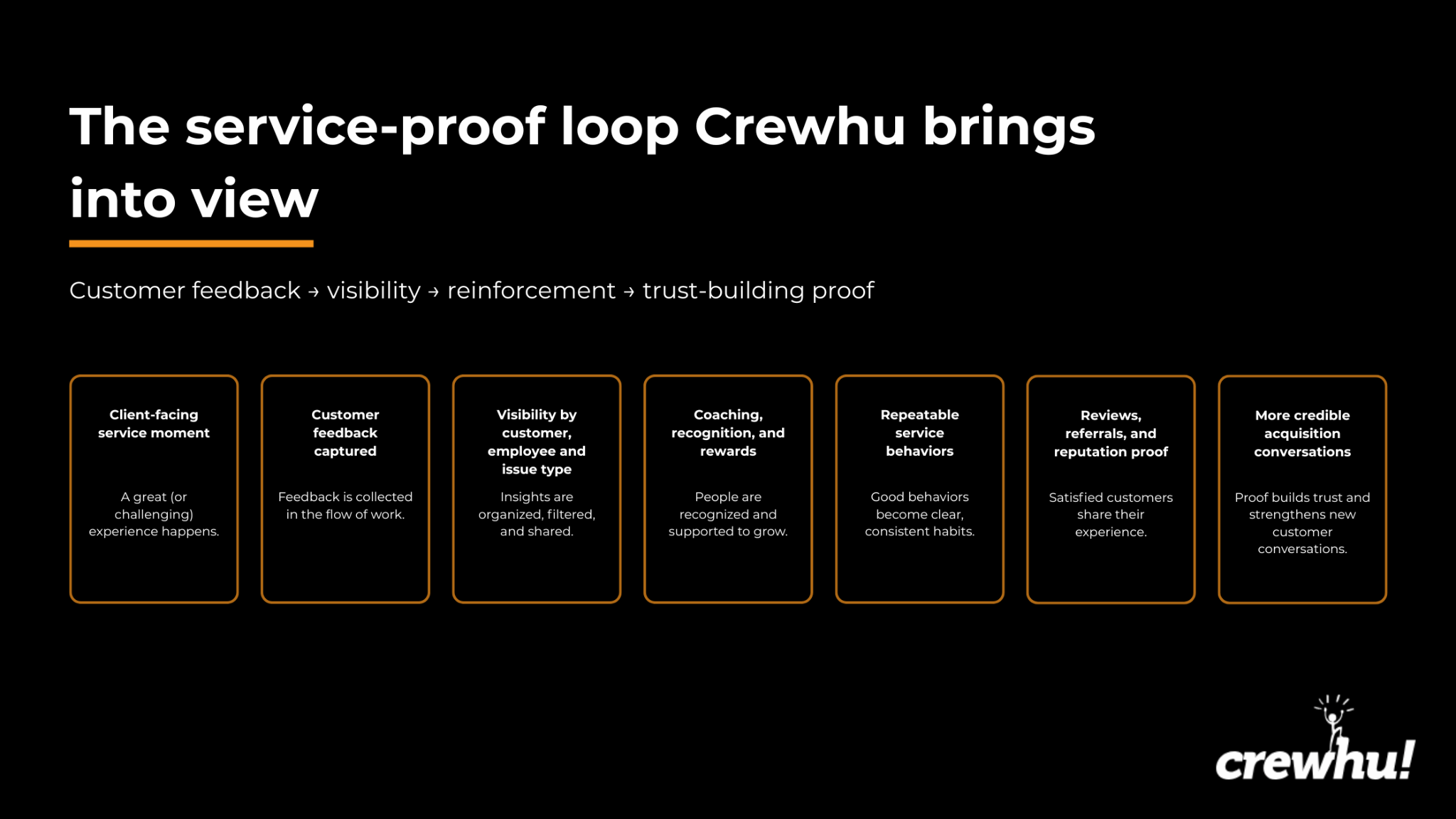
Acquisition channels bring prospects into the conversation. The next advantage is making service proof visible enough to trust, improve, and repeat. Crewhu gives service businesses a way to capture customer feedback, recognize proof-worthy behaviors, and turn service-quality signals into a stronger operating rhythm.
Book a Crewhu demo to see how your team can make the client experiences behind reviews, referrals, and reputation easier to capture and reinforce.
FAQ
What is a client acquisition strategy?
A client acquisition strategy is a plan for attracting, qualifying, converting, and onboarding new clients who fit the business. For service businesses, it connects target-client definition, channel choice, proof assets, follow-up, onboarding, and measurement so acquisition produces relationships the company serves profitably, retains longer, and improves over time.
What is the difference between client acquisition and lead generation?
Lead generation creates inquiries, contacts, or booked conversations. Client acquisition covers the full path from visibility to a paying, onboarded relationship. A service business requires both demand and a disciplined process that qualifies fit, builds trust, explains the offer, closes the right clients, and starts the relationship well enough to contribute to retention.
What are the best client acquisition strategies for service businesses?
The best strategies depend on client fit, trust burden, buying behavior, budget, and lifetime value. Common options cover search, local visibility, content, paid ads, referrals, partnerships, networking, outreach, email nurture, and disciplined follow-up. The strongest mix usually combines visibility, proof, response speed, qualification, and measurement, without relying on one channel alone.
How do you create a client acquisition plan?
Create a client acquisition plan by defining the target client, choosing two or three priority channels, building the proof assets those channels need, assigning follow-up ownership, and reviewing metrics regularly. The plan should judge success by client quality, profitability, retention potential, service fit, and repeatable conversion. Lead volume alone is too narrow.
How do referrals help client acquisition?
Referrals help client acquisition by lowering the trust burden before the first conversation. A referred prospect still needs qualification, a clear offer, timely follow-up, and a good onboarding experience. The relationship context makes the provider more trustworthy and the sales conversation easier to start with less buyer hesitation.
How does service quality support client acquisition?
Service quality strengthens client acquisition by giving prospects concrete evidence that the business delivers what it promises. Reviews, referrals, testimonials, customer feedback, responsiveness, and service recovery all turn delivered experience into trust signals. Those signals make future buyers feel safer taking the next step toward a consultation, proposal, or referral-based conversation.
Which metrics should you track for client acquisition?
Track CAC, CLV, conversion rate, close rate, channel ROI, referral quality, retention, and payback timing. Together, these metrics show whether a channel creates profitable client relationships or only produces activity. Read them together so cheap leads don’t hide weak fit, low retention, poor onboarding, wasted sales time, or poor service economics.