-1.png)
Key takeaways
- You need a system that combines inbound (SEO, content) and outbound (personalized outreach) to create a predictable pipeline.
- Vertical specialization and strong social proof are the fastest ways to stand out in a saturated MSP market.
- Consistent customer reviews directly impact your local SEO visibility and your conversion rates.
- Tools like Crewhu help you automate review collection, turning satisfied customers into a steady source of new leads.
For most managed service providers (MSPs), lead generation is a game of waiting. You wait for the phone to ring with a referral or hope word-of-mouth brings in your next big contract. While referrals often bring high-quality clients, they don't provide the consistency you need to scale in a market that's moving faster than ever. You can't build a predictable business on unpredictable leads.
Instead of crossing their fingers, the MSPs that win new business consistently build multi-channel lead generation systems designed to attract, educate, and convert ideal-fit clients over time. These systems combine inbound strategies like SEO and content marketing with personalized outbound outreach and reputation-building mechanisms like reviews and testimonials.
By building a high-trust engine, you position your business as the authority prospects turn to when they hit a trigger event, whether it's a security scare, a failed audit, or growing frustration with their current provider. Improving your online reputation and CSAT is the first step in making that engine run.
WHAT’S DIFFERENT ABOUT MSP LEAD GENERATION?
MSP lead generation builds a high-quality pipeline to convert cold prospects into long-term managed service contracts. Unlike typical B2C marketing, where emotional impulses drive quick purchases, you can't close an MSP deal without deep trust first.
That’s because the risks are incredibly high. These deals involve high-stakes, long-term contracts where the cost of failure for the buyer is catastrophic. If a consumer buys a bad pair of shoes, they lose $100. If a CEO hires the wrong MSP, they risk a total business shutdown, data exfiltration, and reputational ruin.
You can’t think of it as just selling a service. You're really asking a business owner to hand over the keys to their kingdom. To win their faith (and partnership), you have to demonstrate credible technical expertise through every digital touch point before you ever pitch a service.
This typically involves three interconnected approaches:
- Inbound: Using SEO, blog content, and webinars to attract prospects who are actively searching for IT solutions.
- Outbound: Running personalized cold email, LinkedIn outreach, and calls targeting your ideal-fit companies.
- Reputation-driven: Leveraging reviews, referrals, and testimonials to build trust before a conversation even begins.
For example, an MSP might publish a blog on cybersecurity for law firms to attract inbound traffic. They then send a personalized audit video to a specific prospect. When that prospect sees over 50 five-star Google reviews, they finally feel safe enough to convert.
The true cost of inaction
Many MSP leaders view lead generation as a "someday" project. They assume that as long as they provide good service, the business will naturally grow. But relying solely on that referral lottery is a dangerous strategy that leaves your revenue to chance.
Staying in referral-only mode is a financial drain. When you don't have a consistent lead generation engine, you face several hidden costs:
- Organizations with highly engaged systems see 21% higher profitability compared to those that remain stagnant. Without a pipeline, you lack the leverage to fire bad, low-margin clients and replace them with high-value ones.
- Industry reports show that higher customer satisfaction levels can reduce churn by up to 75%. If you aren't actively generating new leads, every lost client is a major blow to your stability.
- Gallup estimates that disengagement costs U.S. businesses up to $550 billion each year. If your team feels the business is stalling, morale drops, and the cost of replacing an employee can skyrocket to twice their annual salary.
Building a lead generation engine today protects your margins tomorrow. It's the difference between being a vendor who’s easily replaced and a trusted authority who commands premium rates.
COMMON MSP LEAD GEN CHALLENGES
Even the most technically gifted MSPs often find themselves stuck on a growth plateau. Usually, service delivery isn’t to blame. It's a failure in the systems that feed the sales pipeline.
The quality gap is wider than ever, with nearly 79% of leads never converting into sales because of poor qualification or weak nurturing, according to data referenced by Salesforce. High lead volume doesn't mean a high-growth business, just a busy, expensive one.
To stop the leak in your funnel, you need to address these four common failure points.
1. No clear niche or specialization
Most MSPs position themselves as generalists, offering "IT support for small businesses." In the crowded market, this makes you a commodity. Without a defined niche (like law firms, healthcare, or construction), your messaging becomes generic, and prospects default to comparing you solely on price.
- Specialization is a margin driver: Specialized providers enjoy 30% higher profit margins and are able to justify 10% to 20% premium pricing.
- Authority builds trust: Vertically focused MSPs see higher annual recurring revenue (ARR) because they speak the specific language of their clients' industry.
2. Weak or outdated social proof
Managed services are a high-risk purchase. Prospects rely on reviews to validate their decision, yet many MSPs treat them as an afterthought. An MSP with only a handful of reviews from two years ago creates immediate uncertainty.
- Speed kills skepticism: Thirty-seven percent of marketers say one of their biggest challenges is generating quality leads, and social proof is the fastest way to bridge that gap.
- Review velocity matters: Prospects don't just want to see that you were good; they want to see that you're excellent right now. Consistent, recent feedback is what turns a "maybe" into a discovery call.
3. Overly technical messaging
Many MSPs unintentionally market to other engineers instead of the CEOs or office managers who actually sign the checks. They list technical specs like infrastructure redundancy or security acronyms that fail to resonate with non-technical leaders.
- Sell the outcome, not the tool: Buyers aren't purchasing hours; they’re seeking responsiveness and risk reduction.
- Focus on business impact: Your messaging should highlight how you reduce downtime, lower insurance premiums, and protect productivity, rather than just listing your stack.
4. Inconsistent follow-up
The MSP sales cycle is long. A prospect who says no today may be desperate for a new provider in six months after a major outage. However, nearly half (44%) of sales reps give up after just one touch point.
- The rule of five: Eighty percent of sales happen after five or more touch points.
- Automation is the standard: Relying on manual tracking or memory leads to ghosted prospects. You need automated nurture sequences that keep your brand top-of-mind until a trigger event occurs.
10 PROVEN MSP LEAD GENERATION STRATEGIES
To dominate the SERPs and the social feeds, you need a multi-channel approach that balances long-term SEO with short-term outbound wins. You can't rely on just one tactic. You have to build a web of authority that captures leads wherever they're looking.
1. Robust and up-to-date reviews and testimonials
The first thing most prospects do is check your Google Reviews, website, and Reddit mentions before they ever reply to your pitch. In a high-stakes industry, social proof is the ultimate risk mitigation tool. MSPs that treat reviews as an afterthought often lose perfect prospects to competitors who simply have more recent feedback.
Don't settle for "Great service!" reviews. Use the P.S.R. framework to coach your clients: Problem (the crisis they faced), Solution (the specific stack you implemented), and Result (the quantifiable uptime or cost savings).
Reviews also need to be recent. Having a GBP review from years ago as your most up-to-date social proof is a red flag for most prospects. A strong benchmark is earning 5–15 new reviews per month, depending on client volume.
To keep your review velocity high, integrate your PSA tool with a review platform. This ensures that every time a high-priority ticket is closed with positive feedback, the user is automatically prompted to share that win on Google or G2.
2. LinkedIn authority building
About 70% of the B2B buyer's journey happens silently before they ever contact a vendor. They're reading your reviews and checking your LinkedIn presence without you knowing it. If you aren't on their radar during this phase, you're fighting an uphill battle.
Build a personal brand that positions your leadership as consultants rather than vendors. Instead of sending pitchy connection requests, share relevant insights like "3 ways hackers are using AI to bypass your current firewall." Spend 45 minutes a day commenting on the posts of your Top 50 prospects.
Don't sell, just provide a technical perspective. By the time you reach out, you'll be the security expert they've seen in their feed for months.
3. Hyper-local SEO
Local search leads often convert at much higher rates because these prospects are already actively looking for a provider. To dominate the "Near Me" search intent, you have to optimize your site for every major city or suburb you serve. Create dedicated landing pages that feature local landmarks, local client testimonials, and photos of your team in that specific area.
Your Google Business Profile (GBP) is arguably more important than your website for local leads. Optimize it for "Managed Service Provider [City]" intent and keep it populated with weekly Google Posts about local IT trends.
4. Cold calling and personalized email
Standard cold emailing response rates sit between 1% and 5%. That means if you send generic blasts, you'll just get flagged as spam. To break through, lead with an audit-first approach. Provide a "mini-consult" for free to prove your value before you ever ask for a meeting.
Use tools to evaluate a prospect’s public-facing infrastructure. If they’re on an outdated version of a server or a specific legacy software for instance, your outreach should focus on the risks associated with that specific setup.
Try recording a two-minute Loom video for a prospect. Use a script like: "Hi [Name], I noticed a security gap in your digital footprint that could lead to [Specific Pain Point]. Here's exactly how to fix it." Rather than pitching a sale, you're consulting.
If gatekeepers (like an office manager or an internal IT lead) are blocking you, bypass them by sending a physical tech health kit via direct mail. When you call two days later, the gatekeeper is much more likely to put you through because you're calling about the package you sent.
5. Niche ecosystem networking
Networking entails more than simply handing out cards at a local mixer. It's a systematic approach to becoming an authority within a specific vertical. If your ideal clients are law firms, you should do more than attend their events and become a permanent fixture in their digital and physical spaces.
This means joining niche-specific Slack groups or Reddit communities (like r/lawfirm) to provide technical clarity without pitching. You should also aim for "Gold" sponsorships in state-level industry associations to secure speaking slots at their lunch-and-learns.
Finally, join MSP peer groups like IT Nation Evolve to swap leads for clients with offices in other states. This expands your footprint without increasing your overhead.
By focusing on an ecosystem of influence that positions you as a part of the industry rather than just a vendor, you build a reputation moat that makes it nearly impossible for a generalist competitor to unseat you.
6. Inbound content marketing
Content marketing is the long-term play of owning the conversation. While SEO can take months to gain traction, it eventually becomes your lowest-cost lead source because traffic compounds over time.
To establish authority, create blog posts, white papers, and case studies that address the specific IT concerns your prospects are asking during discovery calls, such as reducing downtime or enhancing the security of remote work.
Adopt a pillar-and-cluster content model. Build one massive pillar page (like a 3,000-word guide on cybersecurity for fintech) and surround it with 10 to 15 "satellite" posts that dive into the details. Interlinking these tells search engines you have topical completeness.
Don't write generic posts about "The Benefits of the Cloud." Instead, focus on specific problems like "Latency Optimization for High-Frequency Trading Firms in Chicago."
Every blog post should also be atomized into a LinkedIn carousel, a 60-second YouTube Short, and a newsletter snippet. That’s how your expertise finds the prospect where they already spend their time.
Over time, you’ll stop chasing leads, and high-intent prospects will discover your content, spend their time consuming your expertise, and arrive at your first sales call familiar and convinced of the value you provide.
7. Precision retargeting (PPC) ads
Retargeting involves showing ads only to people who've already visited your site or engaged with your content. These campaigns can deliver a 150% increase in conversion rates compared to cold traffic because you're targeting high-intent visitors.
If someone visits your "Cybersecurity Services" page but doesn't book a call, use LinkedIn pixels to show them a case study from a client in their exact industry. This creates an echo effect that keeps your brand top-of-mind during their long B2B decision-making process. It also keeps your ad spend low by only targeting a few high-intent visitors rather than hundreds of strangers.
8. Vendor referrals and partnerships
Partnering with non-competing vendors is an undervalued lead source for MSPs. The key is to find partners who deal with businesses during trigger events. Commercial insurance brokers (cyber insurance renewals), real estate brokers (office moves), and office furniture suppliers are perfect partners.
Don't ignore your tech stack either. Hardware and software giants like Microsoft or Cisco have massive marketing budgets but can't handle implementation. By becoming a Certified Platinum or Gold Partner, you position your MSP as the local "feet on the street" for these global giants.
9. Engaging micro-webinars
Webinars should focus on urgent, timely threats rather than your services. Try B2B micro-webinars: 15-minute high-intensity teaching sessions followed by 5 minutes of Q&A. Because they're short, the viewing rate is significantly higher than traditional 60-minute sessions.
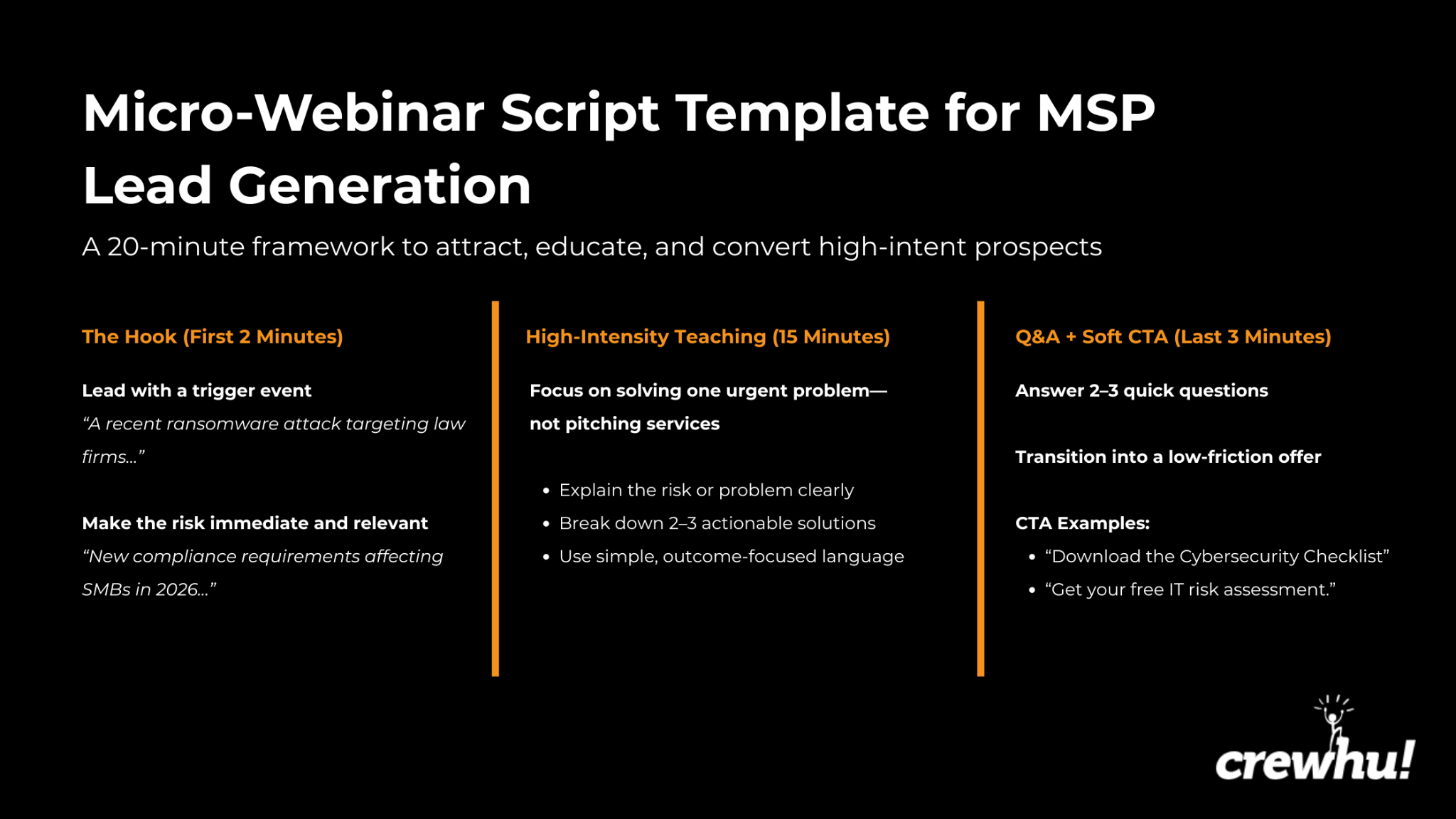
The goal isn't to convince them to buy your services at the end but to get them to download a low-friction resource like a readiness checklist. You can then chop the webinar into 60-second value nuggets for LinkedIn to create a content multiplication effect.
10. Podcast guesting
You don't need to build your own podcast. You just need to be a guest on the ones your customers already listen to. This bypasses the skepticism phase because the host has already vetted you for their audience.
Avoid IT podcasts where you're only talking to other MSPs. Find industry-specific shows instead like “The Medical Management” or "The Modern Lawyer." Talk about business outcomes, like how you helped a client scale production by 20% through automation, rather than technical specs like IOPS or server latency.
Even a single podcast appearance can generate long-tail inbound leads for months, especially when paired with a targeted CTA.
Lead generation is a multi-touch ecosystem that earns trust long before the first discovery call.
5-STEP PROCESS TO BUILDING AN MSP LEAD GENERATION SYSTEM
Before you start investing in paid ads or scaling your outreach, you need a solid foundation. A high-performing MSP lead generation system is built on structure, clarity, and consistency. Use this step-by-step framework to guide your approach:
Step 1: Define your ICP
Trying to market to every business that needs IT support is a recipe for generic messaging and intense price competition. MSPs that want to command high margins and lower their customer acquisition costs (CAC) take the opposite approach and for specialization.
Start by identifying specific verticals like healthcare or finance, company sizes between 25 and 250 employees, and technographic triggers such as companies still using legacy on-premise servers. Specialization makes it easier to build topical authority with hyper-specific content that speaks directly to the architecture of your target audience.
For instance, building a content cluster around HIPAA-compliant cloud architecture signals to search engines that you’re a specialist. During the pitch, mentioning industry-specific terms like "PACS imaging latency" builds immediate trust because it shows you actually understand their world.
Step 2: Optimize your website for conversion
Your website is your 24/7 sales representative, so it should never be treated as just a digital brochure. Technical buyers will judge your ability to manage their infrastructure based on your site’s performance. You don't want to spend money on SEO and ads only to have your site fail to convert that traffic.
To optimize for conversion, prioritize these elements:
- High-speed, mobile-responsive pages: If your site is sluggish, prospects will assume your managed services are too. Slow sites are also penalized by Google's algorithms, which drags down your rankings for relevant keywords.
- Social proof above the fold: Display SOC2 logos, ISO certifications, and partner badges like Microsoft or Cisco in the portion of the screen visible without scrolling. Place real-time review feeds near every CTA button to mitigate risk instantly.
- Clear homepage CTAs: Replace "Contact Us" forms with integrated, real-time scheduling tools like Calendly to let prospects book a 15-minute discovery call immediately.
- Intent-matched CTAs: If someone is on your "Cybersecurity" page, the CTA should be a "Free Security Audit," instead of a generic quote request.
You can also use interactive tools like a downtime calculator to capture high-intent data while providing value. When a tool shows a prospect they lost $25,000 in productivity last year, your managed service plan suddenly feels like a profit protection plan. This also gives your sales team the data they need to enter the first call with a pre-qualified strategy.
Step 3: Choose the right lead generation channels
You can't and shouldn't try to implement all 10 strategies at once. Instead, prioritize a strategic mix of timelines:
- Short-term (outbound): Use personalized, audit-first emails and targeted calling to generate meetings within 30 to 60 days.
- Medium-term (authority and social): Leverage LinkedIn content, podcast guesting, and webinars to build trust and visibility over time.
- Long-term (inbound): Invest in SEO, content marketing, and local search optimization to create a sustainable, compounding lead source.
Your focus should depend on your current monthly recurring revenue (MRR). Startup MSPs should focus on high-activity outbound tactics. Established firms with over $1M in annual revenue should shift toward inbound and brand authority to lower their long-term CAC.
Step 4: Build a multi-channel campaign system
A campaign is a structured effort across multiple channels over a defined period, typically 60 to 90 days. When your marketing is omnipresent, it builds familiarity so that by the time you call, the prospect feels like they already know you.
- Ensure your messaging is consistent across LinkedIn posts, cold emails, and landing pages.
- You should also implement a lead scoring system to prioritize your sales team's outreach. For example, a prospect who downloads a "Cybersecurity Checklist" is a higher-intent lead than someone simply reading a blog post.
- Use nurture sequences to keep your brand top-of-mind. If a prospect isn't ready today, your CRM should automatically send them a monthly technical briefing tailored to their industry until the timing is right.
Step 5: Implement CRM, automation, and feedback systems
Without the right systems, even the best strategies become difficult to scale. A high-performing MSP tech stack must include a CRM to track every interaction, prospecting tools to identify targets based on technographics, and automated follow-up systems to ensure no lead goes cold.
Feedback automation is a revenue driver, so consistent social proof is critical to conversion. Platforms like Crewhu automate review collection by prompting satisfied customers at the right moment, turning positive experiences into visible trust signals that support every stage of your funnel.
COMMON LEAD GEN MISTAKES TO AVOID
Even the most robust marketing strategies will fall flat if your team is making critical execution errors. For many MSPs, lead generation stalls out not from a lack of effort but from preventable procedural gaps that drain your marketing budget and frustrate your crew.
Avoiding these common pitfalls will protect your margins and keep your pipeline moving forward seamlessly.
Purchasing cold email lists
Bulk-buying generic, unverified lists is a marketing shortcut that quickly traps your domain in spam purgatory. This practice routinely ruins your sender reputation and ensures your emails never even reach the inboxes of your ideal clients.
Instead of throwing money at dead-end data, your sales crew should use targeted prospecting tools like Apollo.io or ZoomInfo to build highly filtered, verified lists. This allows you to target companies based on specific technographics, such as prospects currently running Microsoft 365, so your messaging is always relevant.
Falling into the "one-and-done" content trap
Publishing a brilliant, deeply technical blog post and never sharing it is the digital equivalent of throwing a massive corporate party but forgetting to send out the invitations. Writing the content is only 20% of the battle.
For every hour your team spends creating content, your marketing crew needs to commit at least four hours to active distribution. You can maximize your content investment by atomizing a single blog post into an email newsletter snippet, five distinct LinkedIn posts, and a short video script for your leadership team.
Letting inbound leads cool down
In a fast-moving digital market, speed to lead dictates your conversion success. Inbound leads can go ice-cold in a matter of minutes, meaning a delay in response can destroy your marketing campaign ROI.
If you don’t have an automated system to handle the first touch, your busy crew will inevitably lose conversions while troubleshooting everyday technical tickets. You need to automate your initial outreach. For example, when a prospect downloads a compliance guide, your system should instantly send a personalized email featuring a direct link to book a discovery call.
Ignoring the "invisible" marketing funnel
Modern B2B decision-makers don’t follow a straight, easily trackable path to your sales team. A qualified prospect might quietly read your LinkedIn post, hear your tech experts speak on an industry podcast, and then finally type your exact brand name into Google to contact you.
If your analytics tools only track the final click, you’ll misjudge the true drivers of your business growth. You can fix this tracking blind spot simply by adding a mandatory "How did you hear about us?" field to your website contact forms.
Over-indexing on a single type of social proof
It’s an exciting milestone when your MSP lands a major enterprise client, but showcasing only giant corporate logos on your website can backfire. A testimonial from a massive Fortune 500 company might actually scare away a 30-person local dental practice or law firm.
Smaller prospects need to see social proof from companies that look like theirs to feel your solution is attainable and relevant. To build immediate trust, group your case studies, reviews, and testimonials by both industry vertical and company size.
START BUILDING YOUR LEAD GENERATION ENGINE TODAY WITH CREWHU
Lead generation for modern MSPs involves engineering a multi-touch ecosystem that earns deep buyer trust long before a prospect ever joins your first discovery call. By layering your technical foundation with consistent, educational content across multiple channels, you create a powerful positioning vortex that pulls high-value prospects directly toward your business.
The strongest marketing results come from pure consistency. You don't need to try and master all 10 digital marketing tactics today to see your sales pipeline fill up. You can start small by picking just three core strategies that naturally align with your team's current operational strengths, such as LinkedIn authority building, hyper-local SEO, and personalized cold outreach, and execute them with clinical precision.
Business owners only purchase high-stakes IT infrastructure solutions from humans they trust, not from faceless corporations. Corporate buyers have too much to lose from choosing the wrong partner to take a blind plunge with an unproven provider. They won't risk their operational uptime unless you provide clear, credible evidence from other businesses like them who’ve used your services and expertise and are completely satisfied with the results.
Engagement isn't a luxury; it's a strategic imperative.
This is where Crewhu helps you turn daily customer feedback into a self-sustaining engine for building and sustaining that crucial marketplace trust. Our platform automatically triggers a clean customer satisfaction survey the exact moment a service desk ticket is closed in your PSA. If your client leaves a positive feedback, Crewhu instantly presents a targeted pop-up or automated follow-up email asking them to cross-post that exact feedback directly to your Google Business Profile.
This automated workflow ensures that by the time your service technician has moved on to their next technical task, a fresh five-star Google review is already live online. That rapid review velocity consistently boosts your local SEO visibility and provides bulletproof social proof to cold prospects checking out your brand. Crewhu turns standard customer service interactions from fine to fueled, capturing micro-moments of appreciation in real time.
The scale-focused MSPs that win aren't the ones burning through massive advertising budgets, but the ones that successfully leverage their hard-won five-star reputation to build consistent, authority-driven systems. Stop relying on unpredictable, passive referrals and start engineering a predictable lead generation pipeline.
Ready to transform your client reputation into your absolute best sales tool? Book a demo today to see how Crewhu turns customer feedback into your best lead generation tool.
FAQS
Is cold calling dead for MSPs in 2026?
No, but completely cold outreach won’t take you far. Successful modern outreach is entirely "warm," meaning it’s backed by deep research, strategic technographic triggers, and a bulletproof online reputation. If a busy prospect looks your company up right after a call and sees over 50 five-star reviews, that initial cold call instantly turns into a highly productive warm conversation.
How much should an MSP spend on lead gen?
A healthy, sustainable growth budget for a scaling provider is typically 10% to 15% of your target monthly recurring revenue (MRR) growth. For example, if your ultimate goal is to bring in $10,000 in brand-new monthly recurring revenue, you should expect to invest anywhere from $1,000 to $1,500 directly back into your active lead generation engine.
What is the best lead magnet for IT services?
Short, high-utility checklists and actionable tools consistently perform the best in this technical industry. For instance, a concise, highly relevant resource titled "The 2026 Cyber-Insurance Readiness Audit" is far more likely to out-convert a dense, 30-page guide on cloud infrastructure. Modern decision-makers value immediate clarity and highly focused micro-moments of insight over long walls of text.
How do I get more Google Reviews without annoying my clients?
You can leverage automated feedback collection platforms like Crewhu to handle the heavy lifting for your team. Our platform prompts a client to share a public review only after they’ve already confirmed their explicit satisfaction through a simple, internal one-click survey. This smart approach ensures you only ask for public reviews when a positive service experience is actively confirmed and client trust is at an all-time high.