-1.png)
Key Takeaways
- MSP marketing should make the provider simple to understand, safer to trust, and easier to evaluate before a buyer books a call. That starts with clear positioning on who the MSP serves, what risks it reduces, and why its service quality is credible.
- Because switching MSPs affects uptime, security, compliance, productivity, and daily operations, buyers need proof before they engage. Recent reviews, specific testimonials, referrals, case studies, customer feedback, and sales-support examples can reduce perceived risk.
- MSPs should identify whether visibility, conversion, or proof capture is the highest leverage fix before adding more tactics. More channels won’t fix weak positioning, thin evidence, or strong service that disappears after the ticket closes.
Many MSPs do solid work but still struggle to create predictable growth because much of their value (the disruptions that never happened, the audits that went smoothly, the ransomware attempt that got blocked at 2 a.m.) stays hidden until something breaks. If buyers can’t see the difference between one MSP and another, they fall back on what’s visible, namely, price, website clarity, reviews, referrals, and context-specific credibility.
As research from Datto shows, MSPs are under pressure to win new customers, protect profitability, and manage internal operations. SMBs rely on them for technical expertise, hybrid-work support, and cybersecurity risk management, so marketing has to make that value easier to see before a crisis reveals it.
MSP marketing works when positioning, channel focus, and captured service proof operate as one system. The goal is to make service quality concrete enough to build trust, improve conversion, support referrals, and create repeatable growth.
WHY MSP MARKETING IS DIFFERENT, AND HOW TO MAKE IT WORK
Unlike typical advertising, MSP marketing succeeds when the provider translates invisible service quality into clear positioning, focused channels, and proof buyers can inspect. Prospects are naturally slow to purchase because they’re choosing something intangible: who will protect critical systems, reduce technological risk, support employees, and respond when something breaks.
The obstacle here is that good MSP work is often preventive. When it works, there’s no disruption. The server stays online. The migration doesn’t derail the workday. The client gets a clear explanation early enough to avoid a messy escalation. MSPs can deliver real value and still look interchangeable if they fail to translate that service quality into positioning, channel consistency, and evidence buyers can evaluate.
MSPs sell trust, continuity, and risk reduction
MSP marketing should position managed IT around trust, continuity, and risk reduction because buyers are making a high-consequence decision. The category may be “managed IT services,” but the prospect is usually thinking about fewer interruptions, faster recovery, safer systems, smoother audits, and less uncertainty around technology risk.
They know a poor provider can affect security, compliance, employee productivity, customer operations, and leadership confidence. To address that worry, marketing should transform technical capability into buyer-facing outcomes. “We provide managed IT services,” is weaker than, “We help healthcare practices reduce downtime, protect patient data, and stay ready for security and compliance conversations.”
Make silent successes easier to prove
“Excellent service” can mean nothing goes wrong. The server stays up, the migration doesn’t derail the workday, and the client receives a concise explanation instead of a confusing technical handoff. However, those results don’t automatically become marketing assets. Without a capture loop, the value stays trapped inside tickets, inboxes, private appreciation, or a passing client comment. It’s great for retention but does far less for search visibility, outbound credibility, sales conversations, referrals, or buyer confidence.
Proof capture gives those service moments a second life. A resolved ticket can lead to a permission-based testimonial request, while feedback patterns can point to referral opportunities. After a stressful migration, a client’s comment might support a case-study lead or a sales-support example. Logging feedback produces many more opportunities for invaluable social proof.
Strong positioning helps MSPs stand out from the crowd
A unique angle is a must for MSPS to differentiate themselves from their competitors. It names the buyer they serve, the risks they reduce, and the proof that shows they understand the specific environment. The right buyer can then recognize fit faster because the MSP no longer sounds like a dime-a-dozen “IT support” provider.
Broad positioning just pushes MSPs toward price comparison. “IT support for small businesses” doesn’t show why one provider understands the buyer’s precise needs better than the next.
Strong positioning answers narrower questions like:
- Who the MSP is best for
- What operational risks it reduces
- Which trigger events it understands
- What proof shows it can handle the buyer’s context
MSP Camp also emphasizes the need for clear positioning, consistent messaging, and proof to give buyers a reason to trust the provider before they compare prices.
Channel focus turns activity into a coherent growth system
Lead activity provides better results when each channel reinforces the same ICP, trigger, offer, proof point, and follow-up path. A little SEO, a few LinkedIn posts, and an occasional email look busy. Combined with some outbound and referral requests (when someone remembers), and it can feel like real marketing motion. But scattered activity doesn’t tell prospects a coherent story.
A stronger system gives those activities a shared direction. Wherever the buyer first finds the MSP, the message should point toward the same next step. MSP360 similarly asserts that channels work best when they’re tied to audience understanding, useful content, and measurement rather than activity for its own sake.
START WITH WHO YOU SERVE AND WHY YOU’RE CREDIBLE
Strong MSP positioning details who the provider serves, what risks it cuts, and why buyers should believe it. Before channels can scale demand, the MSP needs to know where it excels and which buyer problem it can address better than a generic provider.
Define your ICP and vertical focus
MSPs pinpoint ICP and vertical focus by choosing the buyer environments where they have the clearest service fit, risk expertise, and proof. That concentration helps MSPs speak to real operating constraints, such as:
- A healthcare practice that worries about patient data, uptime, vendor access, and compliance exposure
- A law firm that’s concerned with document security, confidentiality, remote access, and billable-hour disruption
- A financial services company that worries about data controls, audit readiness, and security oversight
Narrowing industry interest improves message relevance and makes channel decisions easier. Content topics, referral partners, LinkedIn commentary, outbound triggers, and testimonial examples all become sharper when the MSP knows which buyer they’re trying to reach. This doesn’t mean every MSP needs to serve one niche forever. The goal is to show high-fit buyers that the provider understands their world.
Build messaging around business outcomes and visible expertise
MSP messaging needs to translate technical delivery into business outcomes buyers recognize. The technical side may include managed backup, end-point protection, and cloud support. Help desk coverage, documentation, and monitoring sit underneath that same promise. For buyers, the difference shows up as fewer interruptions, lower risk, and protected productivity. When the system is working, incident response is faster, audits are smoother, and IT operations feel more predictable.
Visible expertise comes through specificity. Instead of claiming “excellent cybersecurity support,” an MSP might explain how it helps law firms prepare for cyber insurance questions. The stronger approach names the work behind that promise, such as reducing end-point exposure and documenting controls in language partners can understand. The aim is to place technical credibility inside the buyer’s operating reality.
THE CORE MSP MARKETING SYSTEM: CHANNELS THAT ACTUALLY SHOW RESULTS
The best MSP marketing channels work together inside the same commercial narrative. Search and content capture active demand, while LinkedIn, email, outbound, referrals, and partnerships should reinforce the same positioning, risk expertise, and proof. Across those channels, the buyer should recognize one coherent MSP story.
Search and educational content that capture active demand
Search and educational content work best when they meet buyers who already feel a problem, such as:
- Audit pressure
- Ransomware exposure
- Provider-switching frustration
- Cloud migration risk
- Backup failure
- Recurring downtime
- Cyber insurance requirements
Useful MSP content answers operational questions buyers are already asking. A generic post about why cybersecurity matters is weaker than a guide on what a 50-person law firm should review ahead of cyber insurance renewal. Reviews can also support branded and local credibility when buyers use search to compare MSPs before reaching out. Review requests should stay honest, neutral, and aligned with policy.
Use LinkedIn and email to build familiarity before sales
LinkedIn and email build MSP authority when they familiarize prospects with their expertise before the buyer talks to sales. Useful topics include practical signals of expertise like:
- Compliance commentary
- Security lessons from real incidents
- Remediation advice
- Service-experience takeaways
- Executive-level guidance for nontechnical buyers
Gartner found that 67% of B2B buyers prefer a rep-free buying experience, so trust-building has to start early in the buying process. By the time a prospect fills out a form or books a call, they’ve already started to judge whether an MSP sounds credible.
The strongest authority content does more than say, “We know IT.” It lets prospects see how the MSP thinks through risk, tradeoffs, communication, and business impact.
Outbound outreach that feels relevant because it’s informed
Structure outbound to prove the MSP has done their homework. A specific note might start with audit timing, cloud transition risk, office expansion, or cyber insurance pressure. In other accounts, the opening may come from hiring strain, poor documentation, or signs that the current provider is failing. That kind of relevance is stronger than a generic managed-IT pitch.
Outreach should establish relevance before asking for time. If the same message would work with any MSP’s name at the bottom, it hasn’t done enough to earn the prospect’s attention.
Referrals, partnerships, and ecosystem visibility
Referrals and partnerships work because they transfer credibility through people and ecosystems the buyer already trusts. Those relationships include technology vendors, local business associations, accounting firms, insurance brokers, compliance consultants, and adjacent service providers.
High-performing referral systems start from real service moments. A client who just received strong support after a painful issue is much closer to advocacy than one who gets a vague referral request months later.
Be sure to keep referral asks separate from Google review invitations. A service win can be a cue for a soft referral request, a permission-based testimonial, or a case-study conversation, but Google review invitations need stricter handling. They should stay honest, neutral, non-incentivized, unscripted, and not be filtered by expected sentiment.
TURN SERVICE DELIVERY INTO MARKETING PROOF
MSPs turn service delivery into marketing proof by capturing specific service moments and converting them into evidence buyers can evaluate. This moves MSP marketing beyond a channel plan. Visible service proof can support reviews, testimonials, referrals, and case studies. Sales-call examples and specific service stories get stronger when they come from proof the MSP can reuse.
Reviews and testimonials reduce perceived risk before the first call
Buyers are committing to more than a vendor when they review MSPs. They’re choosing a gatekeeper who will help protect daily operations, systems access, security posture, and employee productivity. That’s why perceived risk is high well before their first conversation with a rep.
Reviews and testimonials reduce that risk when they’re recent, specific, and tied to real service outcomes. “Great team,” is helpful but thin. “They restored access quickly during a payroll-critical outage and explained the issue clearly to our office manager,” gives the buyer something concrete.
For Google reviews, keep the request process clean. Ask for honest reviews after real service interactions, avoid incentives, and don’t filter requests based on expected sentiment. You also shouldn’t suggest ratings or the inclusion of keywords, staff names, or scripted language.
Testimonials and recycled customer praise need a different layer of care. If a review, quote, or private comment is reused in marketing, keep it accurate, attribute it properly, and preserve permission or disclosure requirements where relevant.
Research from Forrester reinforces how buyers put significant weight on peer voices and customer evidence when deciding which providers deserve serious consideration. That makes recent reviews and specific testimonials part of the MSP sales-risk conversation instead of just pure reputation management.
CSAT, NPS, and client feedback reveal proof MSPs often miss
Satisfied clients often stay quiet until the MSP gives them a clear way to share their thoughts. A customer may appreciate a fast resolution or a calm escalation. A smooth onboarding project leaves the same kind of impression. Without a feedback loop, those moments disappear once the next ticket arrives.
A well-oiled feedback loop can uncover review opportunities, testimonial prompts, referral signals, and case-study leads. Service issues may even appear early enough for the MSP to address them ahead of renewal. Those assets usually start with a specific service moment, which makes customer feedback collection central to the proof-capture system.
How strong service quality shortens the sales cycle and improves conversion
Stellar service supports sales conversations when buyers can evaluate it through visible proof. Recent reviews and testimonials help sales teams answer skepticism. CSAT patterns and named case examples can support pricing and make the MSP feel like a safer choice.
Proof doesn’t guarantee conversion. In a trust-heavy category, it gives buyers better confidence for judging whether the MSP is a safe choice.
BUILD A MARKETING FLYWHEEL FROM CAPTURED SERVICE PROOF
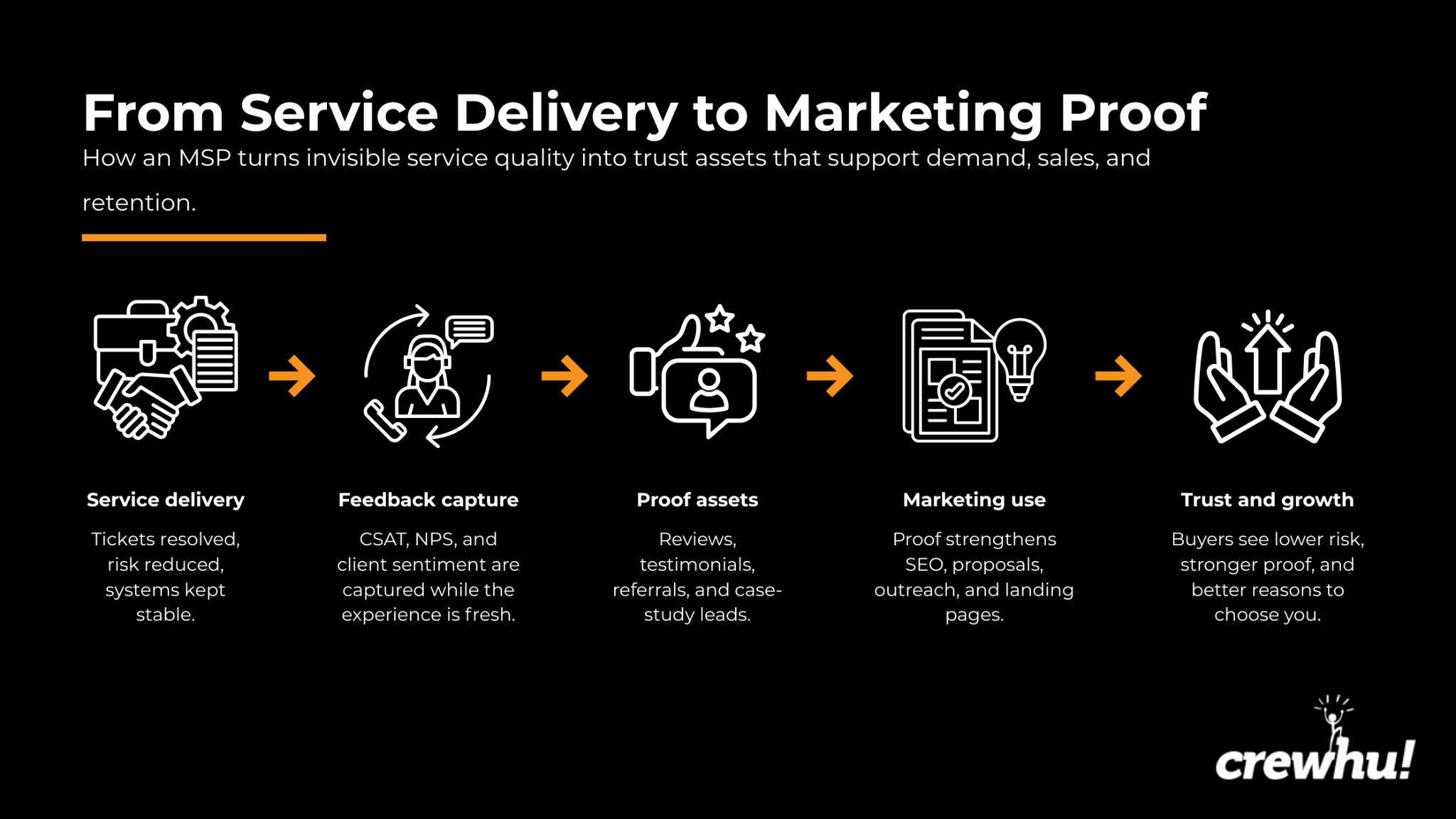
Captured service proof can keep working after the original ticket closes. The same service moment can support more than one growth motion when the MSP captures it cleanly:
Service moment → Feedback captured → Proof asset created → Proof reused across search, sales, referrals, and retention → More visible trust → Better future conversations
The same asset can strengthen several growth motions if the MSP knows where to reuse it.
How proof compounds across SEO, outbound, conversion, and retention
Different proof assets can support different parts of the MSP growth system:
- A review can support local and branded credibility.
- A testimonial can make an email nurture sequence or outbound follow-up feel less cold.
- A case study can help a sales team address buyer skepticism.
- A CSAT pattern can reveal which accounts may be ready for referral conversation, an expansion discussion, or a deeper success story.
Proof rarely stays in one place during an MSP buying process. The same evidence may need to reassure more than one person as the deal moves through the buying process. Research from Forrester shows purchase decisions often involve multiple departments, internal stakeholders, and outside sources of influence, so you need to convince more than one contact to complete a deal.
The proof should match the stakeholder concern in front of the MSP, for instance:
- A CFO may care about risk reduction.
- An operations lead may want better uptime and communication.
- An office manager may be concerned about responsiveness and user experience.
- An internal IT contact may focus on documentation and escalation quality.
The strongest proof strategy gives each stakeholder evidence that speaks to their specific concern.
WHAT TO MEASURE AND WHERE TO FOCUS FIRST
MSPs should avoid the trap of trying every tactic at once. That just spreads teams too thin and produces mediocre results. Marketing usually feels inconsistent for one of three reasons: The MSP isn’t visible enough, prospects don’t convert, or service proof isn’t being captured and reused. Start with the bottleneck that creates the most drag, then keep an eye on your efforts with concrete numbers to hone in on these and other problems before they get out of hand.
Measure the metrics that show whether MSP marketing is working
Traffic volume is useful only if it connects to buyer behavior. Better MSP marketing metrics connect activity to commercial movement:
- Pipeline quality: Whether marketing attracts buyers who match the MSP’s ICP
- Sales conversion: Whether interested prospects trust the offer enough to move forward
- Review velocity: Whether fresh customer proof is being created at a healthy pace
- Referral activity: Whether existing relationships are turning into advocacy
- Channel-assisted conversion: Whether key channels are helping create real sales movement
How small MSPs should prioritize marketing efforts
Small MSPs don’t need a full-scale marketing department to improve their system. They need to choose the highest-leverage fix for their current constraint:
- If the messaging sounds generic, start with positioning.
- If the MSP has clear positioning but few people find it, improve search, educational content, and authority-building.
- If prospects engage but stall, improve proof and landing-page clarity.
- If service quality is strong and proof is thin, build a feedback loop that captures reviews, testimonials, referrals, and case study leads.
What to fix first if marketing feels busy but growth still feels inconsistent
|
Problem |
Primary Symptom |
Likely Cause |
What to Fix First |
|
Visibility |
High-fit buyers aren’t finding or recognizing the MSP |
Weak positioning, poor search visibility, or low authority in the channels buyers actually trust |
Sharpen ICP and messaging, then build search/content and authority around real buyer triggers |
|
Conversion |
Prospects show interest but don’t book, reply, or move forward |
Vague offer, weak proof, low trust, or poor channel-to-page fit |
Tighten business-outcome messaging, improve proof, and align CTAs with buyer intent |
|
Proof Capture |
Service quality exists, but reviews, testimonials, referrals, and case-study material stay thin |
No feedback loop after strong service moments; client sentiment dies inside tickets or inboxes |
Route post-service feedback into reviews, testimonials, referrals, case-study leads, and sales support |
This diagnostic keeps every growth obstacle from being mislabeled as a lead-generation issue. Sometimes the problem needs sharper visibility, stronger proof, or a better way to turn service delivery into evidence.
HOW CREWHU HELPS MSPS TURN CUSTOMER EXPERIENCE INTO MARKETING INFRASTRUCTURE
The proof-capture problem is operational. Strong service often disappears inside tickets, inboxes, private comments, and unmanaged feedback. Crewhu helps close that gap by capturing customer experience close to the service moment. From there, MSPs can route proof-worthy signals toward reviews, testimonials, referrals, case-study leads, sales support, and retention insight.
Capture feedback at the right moment
Customer feedback is most useful when it stays attached to the service interaction that created it. A client who just had an issue resolved can give more specific feedback than one who’s asked months later.
In practice, that means collecting CSAT and NPS signals around ticket or project activity, then giving teams visibility into what customers experienced while the service moment is still fresh.
For MSP marketing, the point is service-moment visibility. Ticket-close feedback, project feedback, and post-service signals can show which experiences deserve proof follow-up and which patterns need operational attention.
Use service feedback to guide reviews, testimonials, and referrals
Service feedback is easy to lose without a consistent follow-up path. A client may be willing to provide a testimonial, make a referral, or become a case-study candidate. Google review invitations need a neutral process, so they shouldn’t depend on expected sentiment, incentives, or scripted language.
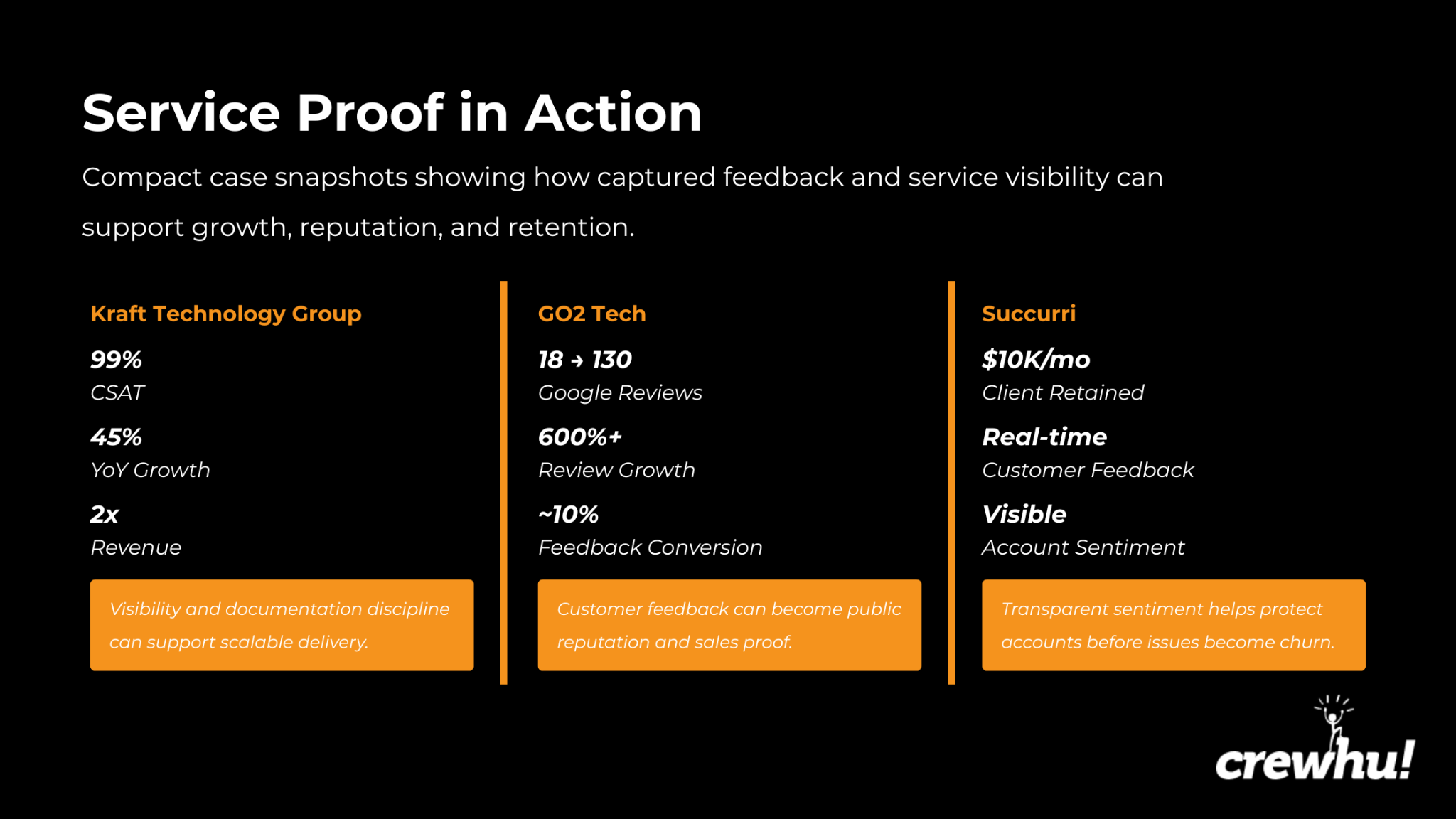
GO2 Tech is a prime example: After partnering with Crewhu, the company grew its Google reviews by more than 600% while averaging over four new reviews per month. Captured customer experience can point to review opportunities. With an honest, neutral request process, finished reviews give future buyers another piece of service proof.
Make service quality visible instead of leaving it hidden inside ticket resolution
MSPs are pros at resolving issues, but the evidence often stays inside the operational system. The ticket closes and the client moves on, so future buyers never see the service quality behind that resolution.
Crewhu helps address that gap by connecting feedback capture, service-quality visibility, and post-service activation. Captured customer experience has value outside internal reporting. The same signal supports marketing proof, sales conversations, referral timing, and retention discussions.
Kraft Technology Group experienced this firsthand with Crewhu, reporting 45% year-over-year growth and doubled revenue without adding staff. The case study shows how better visibility into customer experience and team performance can support growth without forcing every improvement through more headcount.
THE BEST MSP MARKETING MAKES GREAT DELIVERY VISIBLE
MSP marketing needs to create a credible and repeatable growth system built around visible service quality:
- Positioning tells buyers who the MSP serves and what risks it mitigates.
- Channel focus makes that positioning visible where buyers search, read, compare, and validate.
- Service-derived proof gives buyers a reason to trust the provider early in the decision process.
- Measurement then helps the MSP decide whether to fix visibility, conversion, or proof capture first.
Don’t depend on being louder to see results. Smart marketing makes good delivery clear to see. Consistently capturing reviews, testimonials, referrals, case-study leads, and customer feedback turns service quality into a growth asset that future buyers can see.
Make your MSP simpler to understand, safer to trust, and easier to choose.
If you already deliver strong service but struggle to turn it into reviews, referrals, and testimonials, Crewhu can help make those moments easier to capture and reuse. Book a demo to see how customer feedback, CSAT/NPS, recognition, and review activation can work together as part of the same service-to-growth loop.
FAQ
What is the best marketing strategy for an MSP?
The best MSP marketing strategy starts with clear positioning, then uses focused channels and visible service proof to reduce buyer risk. MSPs should define who they serve, explain the operational problems they reduce, show evidence from real service moments, and measure whether the current bottleneck is visibility, conversion, or proof capture.
How do MSPs get more leads?
MSPs earn better leads by combining demand capture, authority-building, and visible proof. Search and educational content help buyers who already feel a problem. LinkedIn, email, and informed outbound build familiarity. Reviews, testimonials, referrals, and case studies make the provider safer to trust, which usually matters more than raw lead volume.
Which marketing channels work best for MSPs?
The strongest MSP channel mix usually includes search and educational content, LinkedIn and email, informed outbound, referrals, partnerships, and ecosystem visibility. The right mix depends on the MSP’s ICP, buyer triggers, budget, current proof assets, and bottleneck. Channels work best when they reinforce the same positioning and buyer-facing evidence.
Does SEO still matter for MSP marketing?
Yes. SEO still matters when it’s tied to ICP-aware content, operational relevance, and trust signals that make the click worth taking. Generic IT content may bring traffic. Specific pages about audit pressure, cyber insurance, downtime, cloud migration, or provider switching are more likely to attract buyers with real intent.
How important are reviews in MSP marketing?
Reviews are important because they reduce perceived risk in a category where the wrong provider can affect uptime, security, compliance, and employee productivity. Recent, specific reviews help buyers see that the MSP delivers reliable service in real situations. They also support local credibility, sales conversations, referrals, and conversion.