-1.png)
Key Takeaways
- A steady flow of recent, authentic feedback stands as one of the strongest signals influencing both your visibility in local search rankings and your credibility with prospective clients.
- The secret to capturing more ratings is making the process fast and frictionless for satisfied customers at the perfect moment.
- Consistency matters far more than occasional volume spikes. A predictable, automated "drip" of customer reviews consistently outperforms random bursts in both search engine rankings and consumer trust.
- MSPs that operationalize review requests by embedding them directly into daily service workflows always outperform companies relying on manual, ad hoc outreach.
- Not all review-generation tactics are safe or compliant. Destructive practices like review gating or incentivizing feedback will damage your market credibility, violate Google guidelines, and expose your business to severe search penalties.
For MSPs, reputation is a direct growth driver. When businesses evaluate potential IT partners, they're thoroughly assessing reliability, responsiveness, and trust. That critical evaluation increasingly starts the exact second a prospect looks at your Google reviews.
Research from Demandsage shows that 93% of buyers check online reviews before choosing a business, treating them as a digital form of word-of-mouth. For MSPs navigating long-term contracts and high customer dependency, that public trust signal carries immense weight. If your local competitors maintain a stronger, more consistent review presence, they're simply more likely to be seen (and chosen) over your team.
Beyond shaping client perception, reviews directly dictate whether your business gets discovered online at all. Google reviews are widely considered one of the primary signals determining whether your company lands in the coveted Map Pack when prospects actively search for IT support. That means empowering your team to collect client praise is directly tied to higher revenue.
This guide will help you close the gap between the premium quality of your technical service and how it's perceived online. You'll learn how to get more Google reviews while transforming everyday customer interactions into a consistent, repeatable system. By implementing these strategies, your online reputation will finally reflect the elite level of support you already deliver.
WHY YOUR BUSINESS NEEDS GOOGLE REVIEWS TO DOMINATE THE LOCAL MARKET
Before jumping straight into ground-level tactics, you need to understand why these stars matter so much, both for your prospective customers and your ultimate visibility on Google. They fundamentally dictate your presence across the entire local web.
Buyers trust the wisdom of the crowd over marketing copy
In the hyper-competitive MSP space, clear differentiation isn't always obvious at first glance. Most providers pitch a nearly identical catalog of core services, including remote monitoring, network security, help desk support, and infrastructure management.
Because of this parity, modern B2B buyers rely heavily on external validation to figure out who they can actually trust. Reviews become that essential strategic shortcut.
Instead of carefully evaluating every local provider from scratch, potential clients instantly look for hard proof that other businesses have already had an exceptional experience with your crew. Data from Influitive confirms that 84% of B2B buyers kick off their purchasing journey with a trusted referral, leaning on authentic peer feedback to validate solutions before they ever engage directly with a salesperson.
A robust volume of ratings signals instant market reliability, while detailed customer feedback lets prospects understand exactly what it's like to work with your service desk daily.
But you can't only lean on stellar ratings from years ago. Recency plays an astronomical role in modern buyer behavior, with 74% of buyers specifically hunting for reviews written within the past three months.
Prospects aren't looking for static proof that your engineers were great two years ago. They want concrete assurance that your current service standard still meets that elite baseline today. Because of this, public reviews from the past 30 to 90 days carry significantly more weight than older, stale feedback.
Fresh ratings power your local Google rankings
Google doesn't just count your total number of stars and call it a day. The search algorithm actively analyzes the text of your reviews to better interpret what specialized services your business offers and how clients experience them.
When multiple clients naturally use specific phrases like "fast IT support," "responsive help desk," or "reliable cybersecurity audits," Google directly links those operational strengths to your profile. This helps your company rank for high-intent, long-tail keywords that perfectly mirror real customer language.
These keyword signals play a massive, direct role in whether your brand lands in the prized Local 3-Pack. Without a healthy, consistent volume of high-quality ratings, your business will be relegated to the "More businesses" click-through list.
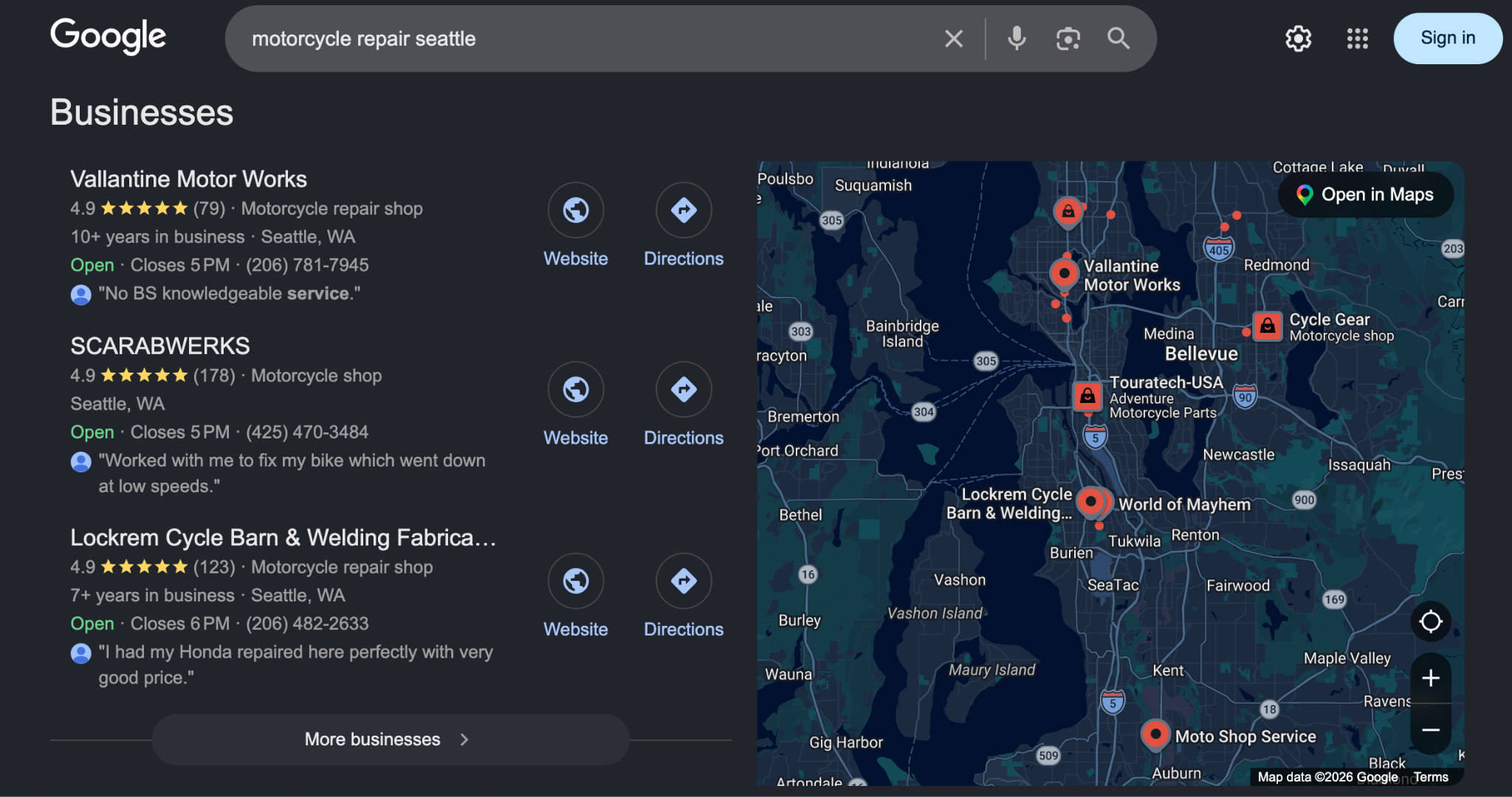
Being pushed out of the top tier is a business killer, as user actions like phone calls, website clicks, and direct driving directions drop by a staggering 93% once you fall past the top three spots, according to Semrush.
While several structural factors influence your overall search visibility, companies with a steady drip of high-quality, recent reviews consistently perform better in both visibility and raw engagement. A strong review profile proves to Google that your team is active, heavily trusted, and consistently delivering value to the market.
Review sentiment dictates AI-driven search recommendations
Search behavior is shifting rapidly, and traditional lists of blue links are no longer the only way prospects find your business.
More decision-makers are now relying on AI-driven search experiences, conversational summaries, and natural language overviews to source enterprise IT partners. Instead of endlessly scrolling through pages of local results, they're directly asking AI platforms conversational questions like, "Who's the most reliable MSP for a law firm in Chicago?"
Your overall review sentiment and specific text content heavily dictate how these conversational engines perceive and prioritize your business. AI systems instantly synthesize unstructured data from multiple sources across the web, relying on your customer reviews to generate their final recommendations.
If your public review profile is critically sparse or your client feedback doesn't explicitly highlight the right keywords, these tools can't confidently recommend your company. That means you won't show up first, or even at all, causing you to lose out on premium new business opportunities.
For modern operations leaders, this profound technological shift introduces a new layer of digital marketing: answer engine optimization (AEO). To win the AEO game, your reviews must consistently spotlight foundational operational strengths like responsiveness, reliability, and deep technical expertise. Actively guiding your clients to mention specific services ensures your business is properly interpreted and featured at the top of AI-generated answers.
BUILD THE FOUNDATION: WHY AN OPTIMIZED GOOGLE BUSINESS PROFILE MATTERS FIRST
Before you throw all your energy into generating fresh client ratings, your Google Business Profile (GBP) needs to be set up completely and primed to convert that incoming interest into real business growth.
Think of your profile as your team's digital storefront. If a prospect clicks onto a profile that’s missing critical contact data, lacks recent imagery, or leaves them guessing about your specific service areas, they’ll walk away regardless of how many five-star ratings you have.
A perfectly polished profile ensures that when you do execute review outreach campaigns, your customers can seamlessly navigate your listing and follow through with their praise. At an absolute minimum, your operations team needs to audit your profile and verify the following elements are locked down:
- Claim and verify your profile: You have to establish absolute corporate ownership of your listing before you can manage or reply to customer reviews. Google provides distinct verification options tailored directly to your specific business type and physical location.
Follow their setup prompts carefully and avoid making major logistical changes to your information during the active review window to prevent any unnecessary delays.
- Maintain consistent business information (NAP): Your official company name, physical address, and phone number must match exactly across your corporate website and all external online directories. Even tiny formatting discrepancies create conflicting signals for search algorithms that quickly degrade your local search authority.
- Complete your entire profile: Write a clear, engaging business description, map out your precise geographic service areas, and upload authentic, high-resolution photos of your actual team and workspace. Showcasing the real engineers behind your help desk builds immediate baseline trust and significantly improves user engagement.
- Enable direct messaging and inquiries: Turning on native features like active profile messaging or direct quote requests gives you an instant line of communication to your clients. This creates an invaluable structural opportunity for your service managers to catch and resolve critical client friction points privately before they turn into public negative feedback.
- Generate a direct review link: Use the built-in "Get more reviews" dashboard feature to create a short, customized URL. This single link drastically slashes user friction by taking the customer straight to the review form, bypassing multiple manual steps and making it entirely effortless for a busy client to leave feedback.
DISPLAY SOCIAL PROOF TO REASSURE POTENTIAL BUYERS
Make it a habit to regularly showcase real, glowing customer reviews across your corporate website and active social channels. Seeing consistently positive feedback from peers reduces perceived risk for prospective clients and naturally encourages current customers to contribute their own unique experiences. It successfully positions your business as a low-risk partner with a verified track record in their specific vertical, such as legal or healthcare.
Feature your selected customer reviews prominently on landing pages, core service pages, and high-impact LinkedIn posts. Don't just default to displaying your newest ratings; specifically choose reviews that explicitly mention targeted service lines, like a "Cybersecurity audit."
This subtle formatting choice primes the next reviewer to mention those exact same services in their own feedback. Whenever possible, tag the reviewer on social channels as well (after securing their professional permission) to maximize your post's organic reach and show the market that real people stand firmly behind the praise.
9 CREATIVE IDEAS TO LAND MORE GOOGLE REVIEWS
Generating reviews consistently requires a strategic mix of quick digital wins, offline touch points, and scalable automation. Below are nine practical ideas your leadership team can implement immediately to capture authentic customer feedback while building a repeatable reputation system for the long term.
Low-hanging fruit: Quick digital wins
These digital tactics are exceptionally easy to implement and require minimal ongoing effort. They focus heavily on capturing premium reviews from everyday interactions that already happen naturally across your business.
1) Use Crewhu Echo to determine who to ask
The best way to get feedback? Go straight to the source. With Crewhu Echo, you can see a list of all customers who’ve left a Google review for your business, which means you also know who hasn’t. The Echo dashboard shows the names of every reviewer, so you can work backwards to pinpoint the clients you’ve served but who haven’t published any testimonials.
Make a list of their names, contact information, the date or time period you helped them, and what problems you solved. Then, reach out with individually tailored messages that include details of each specific experience and ask them to leave a Google review describing the event in their own words. Emphasize they be honest so you don’t come off as fishing for positive feedback.
2) Use dynamic email signature links
Every single email your employee crew sends represents a prime opportunity to turn routine client communication into a review-driving touch point. Embed a low-pressure review call to action (CTA) like, "Was I helpful today?" or, "How did I do?" directly into every staff member's active email signature.
This setup captures honest feedback at the exact moment of interaction. It seamlessly taps into your silent-advocate customers who are completely satisfied but wouldn't otherwise go out of their way to leave a review.
Be sure to include your direct Google review link right in the signature format, and refresh the visual design and messaging every few months to prevent it from becoming background noise that clients easily ignore.
3) Include a "Review of the Week" section in your email newsletter
Insert a dedicated "Review of the Week" spotlight section to your regular weekly or monthly email newsletter to highlight recent customer feedback. That addition creates a powerful sense of public recognition and actively encourages other clients to share their own experiences, knowing their feedback could easily be featured in the next blast.
Feature a standout five-star review, include the reviewer's name with their permission, and add a direct, clickable link to the full review so readers can see the real-world context alongside your professional team reply. To make the section even more engaging for your reader base, present it as a fun community spotlight, such as "Customer of the Week," and append a soft CTA like, "Want to be featured next? Share your experience here."
3) Add a dedicated "Review Us" button to your website's landing pages
Placing a dedicated, high-contrast "Review Us" button across key pages on your website helps capture client intent at the exact moment a user is actively engaged with your brand.
Position the button clearly in high-visibility real estate areas such as site headers, global footers, or post-conversion success pages. Your marketing team can leverage real-time heatmap data to identify where digital users naturally pause or interact the most on your current layout.
Use distinct, contrasting brand colors and clear copy for the button to ensure it stands out sharply from surrounding page elements. Continuously test different color variations, sizes, and button copy to pinpoint the precise combination that drives the highest click-through rates.
On mobile devices, consider deploying a sticky button that stays locked at the bottom of the screen as users scroll, keeping the "Review Us" option fully visible regardless of how far down the page they travel.
Physical touch points: Offline strategies
Not every high-value review opportunity happens strictly online. These offline strategies help your team capture feedback during real-world interactions, where customer satisfaction is frequently at its peak.
4) Teach employees to ask for reviews
Train your front-line service team to confidently ask for reviews during real-time customer interactions. Research proves that 68% of customers are willing to leave a review if it's framed persuasively and asked at the right moment.
The secret is impeccable operational timing. For service-driven organizations like MSPs, the most reliable trigger window occurs shortly after a complex support ticket is officially marked as "Resolved." This gives the client enough time to confirm the issue is truly fixed while keeping the positive, helpful experience top of mind.
Framing the request as a personal favor makes it significantly more effective. For example, a technician might say, "It would really help me out if you could mention my name in a quick Google review." This type of indirect ask increases the likelihood of specific employee name mentions, which massively strengthens your public social proof.
To support your team on the ground, build a small internal library of reusable templates for email, SMS, and verbal requests. That setup removes the guesswork for your engineers and ensures brand consistency while leaving plenty of room for quick personalization.
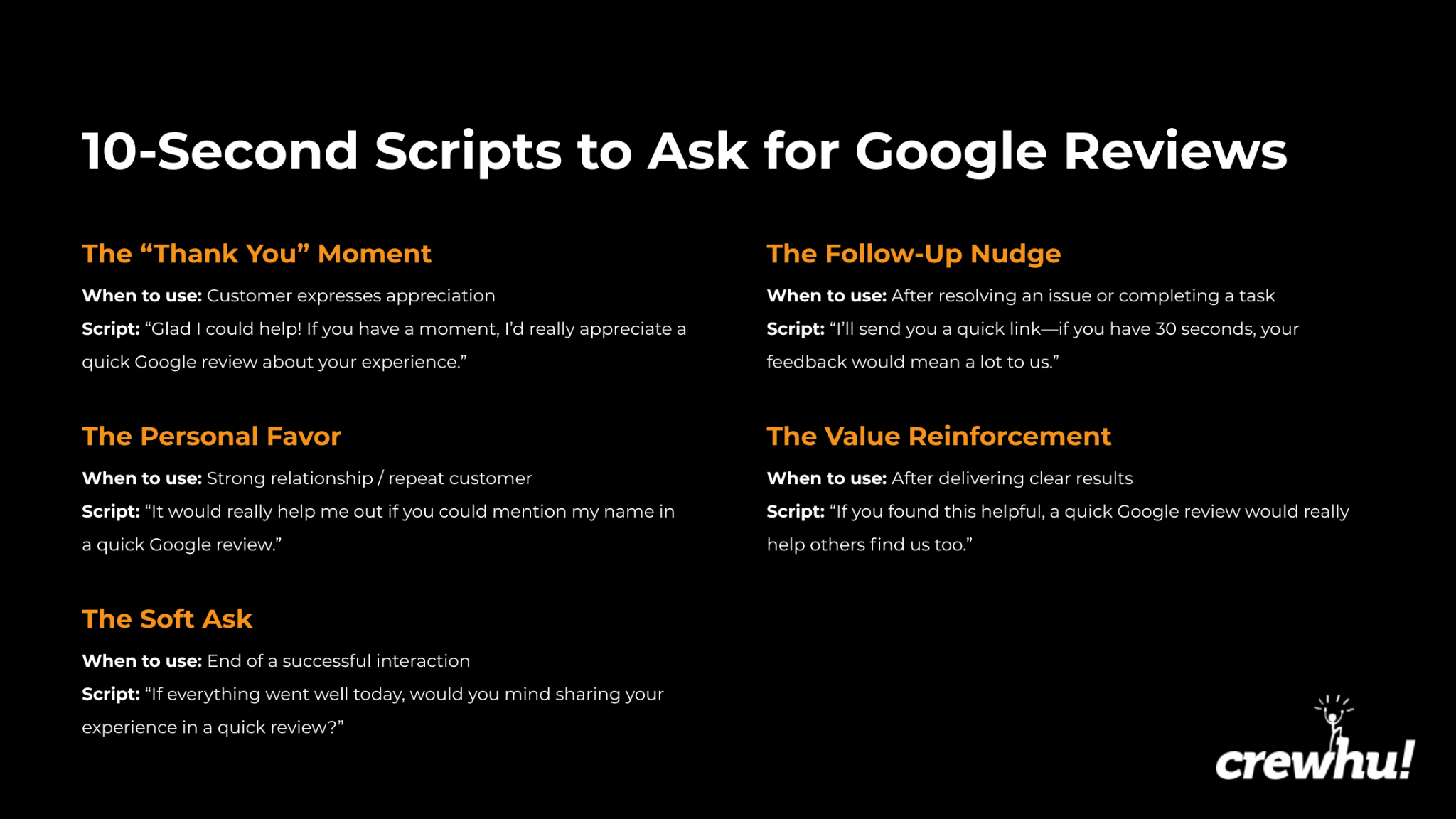
Your service desk managers must also pay close attention to unsolicited feedback. When a customer goes out of their way to express deep appreciation in a random email, a meeting sync, or a quick chat message, it's a massive signal of peak satisfaction. These verbal wins are the ideal moments to dispatch a personalized review request while that positive sentiment is fresh.
To build lasting operational consistency, reinforce this habit by adding hard accountability checks directly into your core workflow systems. For instance, requiring a review request step to be executed before a major project can be formally marked as complete or archived in your CRM ensures this critical growth action is never skipped.
5) Place branded QR codes on physical touch points
Placing custom QR codes that link directly to your Google review page onto physical company materials eliminates user friction and enables customers to act instantly.
For physical, service-based businesses like MSPs, these high-visibility QR codes can be printed directly onto "Support & Feedback" stickers and affixed to the physical server racks your team manages. When a client stakeholder visits their internal server room and notices your clean, organized cabling work, they're instantly primed to scan the code and praise your brand.
Utilize dynamic QR codes so your marketing team can seamlessly update back-end destination links without ever reprinting physical stickers, and pair the code with a clear instruction like, "Scan to share your experience."
Advanced strategies: Automation and relationship building
These advanced tactics focus on establishing a repeatable, highly scalable technical system for generating a continuous stream of reviews over time.
6) Set up automated "Leave Us a Review" SMS or emails
Automate your review outreach to transform review generation from a sporadic, one-time marketing effort into a self-sustaining system. By automatically triggering review requests after key customer milestones, such as resolved help desk tickets or completed engineering projects, you give every satisfied client a seamless opportunity to share feedback while the positive experience is fresh in their mind.
A healthy operational benchmark is to track and audit your total incoming reviews for resolved tickets or projects every 60 to 90 days. While localized performance varies, the average conversion rate for review requests from local service businesses sits around 5% to 10% per 100 asks. If your internal conversion metrics consistently fall below that target range, it's a clear sign your request timing, core messaging, or channel selection needs calibration.
For the absolute best results, combine your communication channels. For example, try dispatching an initial automated email request, followed by a short, personalized SMS if there's no response within a couple of business days. Send that initial message immediately after service completion, then limit your follow-up cadence to a single nudge if they don't respond.
These automated requests should be sent from a real person's name, rather than an uninviting, generic address, to make the message feel authentic. You can also A/B test different email subject lines or text message formats to see what drives higher engagement scores over time.
7) Send personalized review requests to "brand champions" identified through NPS surveys
Make it a priority to identify and reach out to customers who’ve already expressed strong satisfaction with your business, such as clients who submit high Net Promoter Score (NPS) responses. These specific brand champions are historically the most likely to leave detailed, multi-sentence public reviews that highlight your true business strengths.
Tailor and personalize your direct outreach by referencing your unique history with them. For example, you could write, "Since you've partnered with our team for [X] months, your feedback would mean the world to our engineering crew." This wording makes the request feel intentional instead of broadly soliciting.
Software tools like Crewhu easily automate this workflow by instantly identifying your top promoters and triggering targeted review requests at the exact micro-moment customer sentiment peaks. Once a brand champion successfully leaves a public review, have an executive or account manager follow up with a personalized thank-you note to deepen that client relationship. To avoid survey fatigue, limit how often you send review requests to the same individual.
8) Ask your happiest customers to leave a second review
Customers can leave more than one review for a business (although Google only allows one). If it’s been a year or two since a very happy client has left feedback, reach out to them and ask for another one.
Send them a personalized message that acknowledges the amount of time that’s passed and mentions their problem and the solution you provided. Briefly state the importance of honest feedback for your business, then ask them either to update their current Google review or leave a new one on a different platform like Yelp or Facebook. When written well, review requests can see a 30% completion rate, so don’t skimp on the writing here.
Crewhu Echo can simplify this task for you. The feature consolidates all your Google reviews onto an organized dashboard so you can see every reviewer’s name, their feedback and the date they posted it, and their star rating. Echo also lets you reply to them directly in the dashboard so you can easily check in with customers and ask for a review refresh or a new one on another platform.
9) Run internal "Review Month" contests for staff
Launching gamification and internal recognition programs turns the process of public review generation into a highly motivating, team-driven initiative. These internal sprint campaigns and friendly competitions bridge the gap between day-to-day technician performance and macro marketing outcomes.
When your engineers feel publicly recognized and motivated, they’re more engaged during daily customer interactions. Highly focused employees are naturally more attentive and likely to go the extra mile to resolve a tough issue. That special care then leads to better service experiences, which makes clients much more likely to leave positive, detailed reviews without your marketing team needing to prompt them heavily.
To implement an internal contest effectively, track incoming reviews linked directly to individual employees and reward their active participation through points, public callouts, or tangible incentives. Prioritize quality over raw volume by counting only the reviews where the client explicitly mentions the technician by name.
Use specialized platforms like Crewhu to host a shared team dashboard or live leaderboard that displays rankings and celebrates wins in real time, which helps sustain momentum and engagement across the entire organization.
THE ART OF THE FOLLOW-UP AND CLOSING THE LOOP
Not every customer will respond to your first review request, and that's completely normal. Sending even just one well-timed follow-up after that initial ask can significantly boost your overall response rate without overwhelming the client.
Keep this second message simple, brief, and entirely customer-focused. For instance, you can try a punchy script like, "Just checking in to make sure everything’s running smoothly. If you have a moment, we'd really appreciate your feedback."
While capturing the review is a massive win, how your team handles the feedback you receive is equally important for your reputation. Your team should make it a strict operational rule to reply to every review, including the negative ones. Don't look at a poor rating as an absolute disaster; instead, treat it as a valuable public opportunity to demonstrate your crew's deep accountability.
When handling negative reviews on your profile, always:
- Acknowledge the client's issue quickly.
- Avoid getting defensive under any circumstances.
- Show a genuine willingness to resolve the problem offline.
A great professional response could be: "Thank you for your feedback. We're sorry your experience didn't meet expectations. We'd like to make this right. Please reach out to us directly so we can resolve this."
Publish a thoughtful response within 24 to 72 hours to signal to future prospects that you take customer sentiment seriously and are completely committed to continuous improvement.
When it comes to positive reviews, personalize your reply by actively referencing specific operational details and reinforcing the great outcome your crew delivered. Avoid generic, boilerplate responses, as they can easily feel automated and instantly reduce your public credibility.
Consistent engagement with both your positive and negative feedback ultimately builds long-term market trust and proves to everyone that your business is active, responsive, and fanatically customer-focused.
CRITICAL RULES: WHAT NOT TO DO (GOOGLE'S TOS)
The following guidelines will help you stay compliant while building a steady flow of authentic, trustworthy customer feedback.
- Review gating is strictly forbidden: Review gating is the standard practice of filtering your customers before showing them a direct review link. For instance, say you ask a client to rate your service from 1 to 10. If they pick an 8 to 10, they're pushed to Google, but if they score you lower, they're guided to talk to internal staff instead.
Google's official guidelines are strictly against this strategy because it creates a heavily biased data set that misleads the end user. While review gating might be illegal, gathering internal feedback isn't a problem. The right path is to ask everyone for a standard CSAT score.
If their score is positive, you can encourage them to leave a public Google review. If their feedback is negative, it should instantly trigger an internal management alert to step in and resolve the issue right away.
- Don't offer incentives for reviews: Even if your only intention is to encourage higher participation, offering rewards in exchange for a review is a direct violation of Google's Terms of Service. That includes hand-outs like discounts, gift cards, or corporate freebies.
Paying for feedback heavily weakens the credibility of your profile over time. Even worse, it can lead to your reviews being mass-deleted if Google discovers what you’re doing.
- No reviews from employees: Your employees can’t review their own workplace under any circumstances. You also can’t post reviews for your own business from your personal accounts.
Google's algorithms are incredibly advanced and will routinely detect patterns of inauthentic profile activity. That can result in your reviews being flagged or permanently removed. More importantly, these shortcut practices can severely damage trust with potential customers if they're discovered.
- Focus on authentic, relevant customer reviews: The Google search algorithm looks closely at who’s leaving reviews on your profile. Feedback from customers who have directly experienced your services carries significantly more weight than a random review from a brand-new account with zero history.
That weight increases when those clients are located within your typical service area or target market. Don't stress over elite reviewer status. What matters most to Google is pure authenticity and relevance.
HOW CREWHU TURNS CUSTOMER FEEDBACK INTO A SCALABLE REVIEW ENGINE
While the manual strategies outlined in this guide are effective, executing them without software support almost always leads to highly inconsistent results. When your service desk gets busy, manual review requests are easily missed, timing varies wildly from technician to technician, and critical follow-ups fall through the cracks.
Crewhu is specifically designed to eliminate this operational bottleneck by turning your review generation into a structured, automated system. By integrating seamlessly with platforms like ConnectWise, Autotask, and other leading PSA or CRM tools, Crewhu automatically triggers CSAT and NPS surveys at the perfect micro-moment, such as right after a ticket is resolved or an engineering project is completed.
From there, the platform uses guided prompts to help convert that private feedback into public Google reviews, allowing your MSP to consistently turn day-to-day customer appreciation into visible social proof.
Consider Go2Tech’s situation: Before Crewhu, the company struggled with a slow, manual, and highly inconsistent process for gathering customer feedback. By implementing Crewhu's automated workflows though, they successfully integrated review requests directly into their daily ticket cycle.
The results were game-changing for their local search presence, yielding a 600% increase in Google reviews. Go2Tech also consistently maintained a near 10% conversion rate from positive feedback straight to public Google reviews.
By rewarding their technicians for each win through gamified point systems like Crewhu Bucks, they linked client feedback and reviews directly to individual employees. This not only skyrocketed their review count but also built a powerful culture of accountability and recognition that sustained their long-term growth.
BUILD A REPEATABLE SYSTEM TO BOOST GOOGLE REVIEWS AND GROW YOUR LOCAL PRESENCE
Google reviews are a core part of how your business is discovered, evaluated, and chosen by local prospects. Maintaining a steady stream of authentic, positive feedback improves your visibility across search results and Google’s Map Pack. It also actively reinforces baseline trust with potential clients before they ever interact with your team.
When it comes to building your digital reputation, there are no shortcuts. Dangerous tricks like review gating, buying feedback, or posting fake reviews might provide a temporary boost but carry severe, long-term risks. Beyond triggering devastating Google penalties, your brand could easily face regulatory scrutiny from agencies like the FTC for misleading advertising.
The only sustainable, high-ROI approach is to build a repeatable, automated system that consistently generates authentic reviews without relying on constant manual effort. By combining smart operational timing, simple workflows, and intelligent automation, you can turn client praise into a reliable long-term growth channel.
Dedicated platforms like Crewhu make this transformation entirely seamless by automating feedback collection, pinpointing the perfect customers to ask, and pushing verified reviews directly to your Google Business Profile. This turns review generation into a frictionless, self-sustaining loop, allowing your business to maintain a steady drip of new reviews while completely freeing your crew from tedious manual follow-ups.
Ready to turn your reviews into a self-sustaining lead-generation engine? Book a demo today to see how Crewhu can transform your crew and take your local presence to new heights.
FAQS
How can I increase my Google reviews fast?
Kick-start the process by manually reaching out to your most loyal brand champions with a personalized note and direct link. Next, broadcast a targeted message to clients who recently left positive CSAT scores. Finally, train your front-line service crew to confidently ask for reviews in real time during successful everyday client interactions.
How do I create a Google review link?
You can easily generate a direct, customized review link straight from your main Google Business Profile management dashboard. Look for the "Get more reviews" option to instantly produce the short URL. This specific link takes your busy clients straight to the active feedback form, removing unnecessary clicks.
Is review boosting illegal?
Review boosting via fake accounts or shadow profiles directly violates Google's core platform guidelines and can quickly trigger severe algorithmic search penalties. However, proactively asking your real, active customers for their completely honest feedback is completely acceptable and encouraged.
Can a business owner remove bad Google reviews?
No, you can't manually delete them. Only reviews that explicitly violate Google's official terms of service, like outright spam or inappropriate language, can be successfully flagged and removed. Because platform removal is rare, your best strategy is responding professionally and consistently generating positive reviews to naturally push the bad ratings down onto the second page.