-1.png)
Key Takeaways
- The best MSP marketing ideas make invisible service quality visible early in the buyer journey, while prospects are still deciding who seems credible enough to contact.
- Reviews, testimonials, case studies, and referrals work best when they grow out of real service moments. Local proof, educational content, and service-page proof
- Google Business Profile and SEO help prospects find local proof. Email, LinkedIn, paid ads, service pages, and referrals are useful marketing channels when they have credible proof to carry.
- Small MSPs should prioritize marketing ideas by what proof they already have, which buyer doubts they need to reduce, and what they can realistically execute. Growth stage and measurable response should guide what comes next.
- Crewhu excels at helping MSPs make great service visible by capturing CSAT/NPS-style feedback and pinpointing service moments that deserve review follow-up. That gives teams a more consistent path to reviews, testimonials, referrals, and proof assets built from real customer experience.
Why MSP marketing ideas should make trust visible
It’s a familiar MSP frustration. They do good work, but prospects can’t see it.
A technician resolves a difficult ticket. A project lead completes an onboarding without drama. A senior engineer prevents downtime before the client notices the risk. All of these get a team thanks from the customer in a ticket reply, but they don’t post it online. That praise stays inside the PSA and never reaches the places prospects check for trust.
That’s the real marketing gap for many MSPs. The tactics already exist; SEO, LinkedIn, paid ads, email, referrals, webinars, and Google Business Profile have been MSP marketing standards for years. The problem is, their best evidence often gets buried inside tickets, project notes, and routine service delivery.
Customer acquisition is also getting harder. Kaseya frames acquiring new customers as a major MSP challenge, while Datto describes similar pressure around growth and profitability.
To relieve some of that burden, this article gives a practical idea bank for turning everyday service quality into visible buyer proof. It then shows how to use that proof across local search, referrals, content, social, email, website pages, and paid amplification.
Why MSP marketing ideas need to start with buyer trust
MSP marketing is different from ordinary small-business advertising because buyers can’t inspect the product prior to purchasing. What they’re really committing to is reliable service under pressure.
A business can try a piece of software or compare a physical product before purchase. It can’t fully test whether an MSP will respond calmly during an outage, document an environment properly, protect sensitive data, communicate clearly with nontechnical staff, or prevent a messy escalation six months into the relationship.
That’s why MSP marketing is a trust and risk reduction effort. Well before a prospect even speaks with sales, they’ve already done their homework. They scour reviews that mention responsiveness, examples from similar businesses, relevant service proof, and evidence of calm communication under pressure to narrow their vendor list.
Awareness matters, but that alone doesn’t answer the buyer’s harder question: “Can I trust this team with systems my business depends on?”
Good service becomes marketing proof when buyers can see it
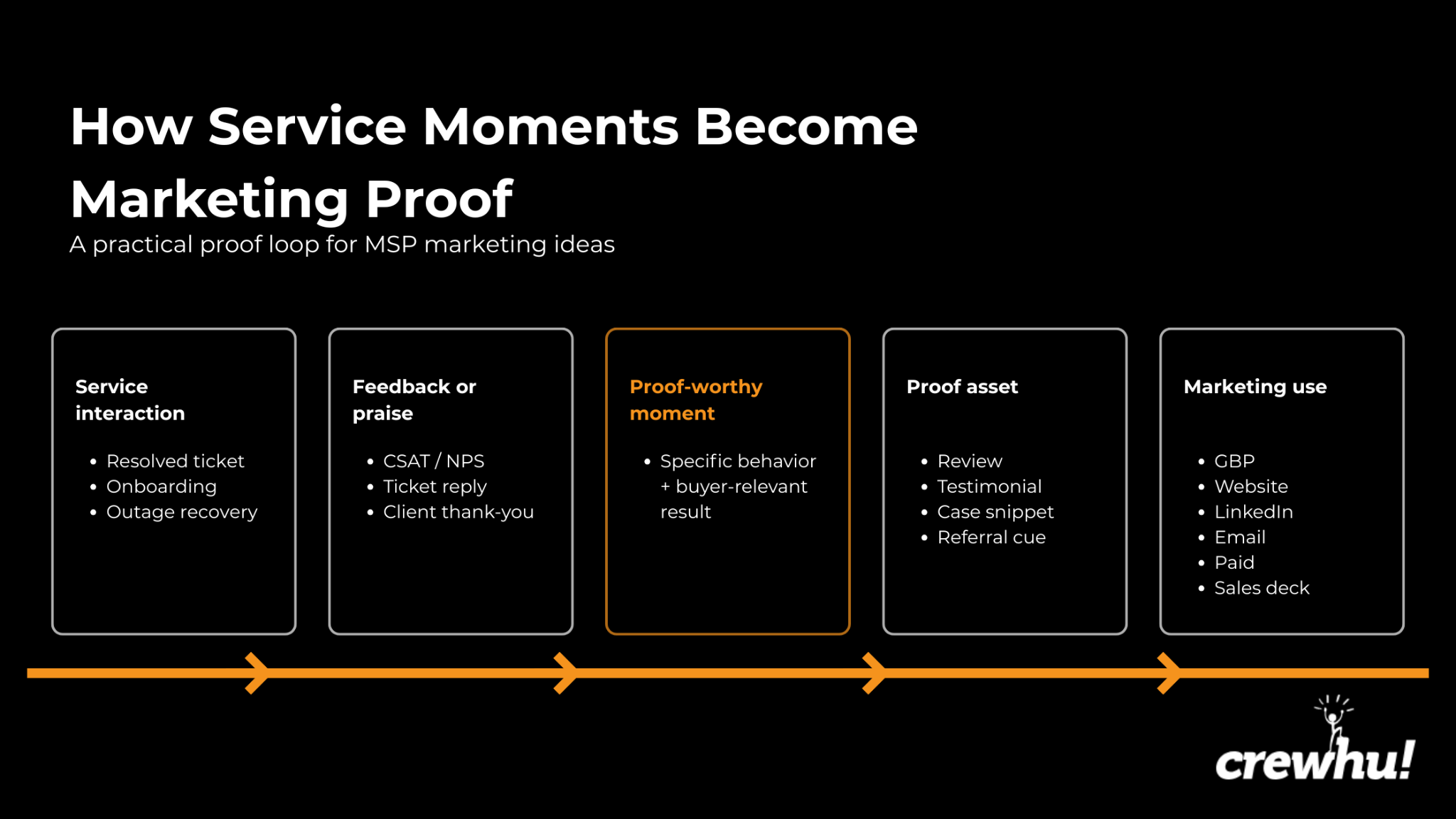
Service quality turns into marketing proof only when you capture, structure, and reuse it. The practical chain is straightforward:
- A service interaction creates a real customer experience.
- That experience leads to customer feedback or client praise.
- The feedback identifies a proof-worthy moment.
- That moment becomes a review, testimonial, case snippet, referral cue, or social proof asset.
- The MSP then uses that proof in marketing where buyers already look for trust.
It’s not difficult to follow this sequence since there are plenty of opportunities to gather social proof:
- Use a resolved ticket as a review-request trigger.
- Turn a successful onboarding into a short case study.
- Convert a client thank-you into a testimonial (with their permission).
- Treat a high-satisfaction project as a referral moment.
- Use a strong outage recovery as a proof block on a service page.
Local trust-building ideas that make your MSP credible where buyers search
Local trust-building ideas help MSPs make credibility searchable. Accurate local visibility helps the right buyers find the MSP. Proof from nearby clients, relevant verticals, partner relationships, and real service moments gives those buyers a reason to trust what they find.
Turn your Google Business Profile into a proof-led credibility hub
MSPs can turn a Google Business Profile into a proof-led credibility hub by making the profile useful to local buyers. Keep business information accurate and make service details easy to understand. Then, use reviews tied to real service interactions, thoughtful review replies, and local service proof to help prospects evaluate whether they can trust the MSP.
Google bases local results primarily on relevance, distance, and prominence, and they encourage complete and accurate business information.
For an MSP, the profile should help a local buyer understand what the company does and why it’s trustworthy. Use accurate service categories, updated information, real photos where appropriate, and reviews that reflect genuine customer experiences.
Keep the review process clean. Ask for reviews after genuine service interactions and make the process easy with a link or QR code. MSPs can train, remind, or recognize employees for following a consistent review-request process.
The customer side is different. Payment, discounts, rewards, or other perks should stay out of Google review requests. Keep the request neutral, too, without filtering by expected sentiment or steering customers toward a rating, keyword, staff name, or scripted language.
Build local landing pages around proof, not copied city templates
MSPs can construct proof-led local landing pages by showing why a business in that area should trust them. Accurate service-area details help the page match the local search. Local testimonials, approved case snippets, vertical examples, and nearby service context give the page proof beyond copied city copy.
Too many location pages lean on thin copy like “Managed IT services in [city]. We serve businesses in [city]. Contact us for IT support in [city].” A stronger page uses proof modules such as a local testimonial, a service-area case snippet, a relevant vertical example, a photo from an area event or team presence, and one or two problems local businesses actually face.
The page doesn’t need to pretend every city has a completely different IT universe. But it does need to show your MSP understands local buyer risk and has proof beyond boilerplate language.
Use local partnerships and community visibility as credibility signals
Local partnerships build credibility when they show other trusted organizations are willing to stand by your brand.
Useful partners may include:
- Cyber insurance brokers and compliance consultants
- Office relocation and commercial real estate firms
- Accountants and SaaS vendors that see technology pain early
- Local business associations and vertical associations
These businesses often approach MSPs (or are at least open to cooperation) at moments when IT risk becomes visible. A new office, a compliance requirement, a cyber insurance renewal, a cloud migration, or a leadership change can all expose the need for better IT support.
Proof-asset ideas that turn everyday service moments into reviews, testimonials, and case studies
Marketing turns service quality into social evidence by capturing and structuring client satisfaction.
Ask for reviews after real service moments
Review requests work best when tied to a real service interaction the client just experienced.
A generic quarterly review blast is less effective than a request tied to a specific interaction, such as:
- A successful onboarding
- Fast outage recovery
- A clear explanation during a difficult ticket
- A completed project that relieved a client’s operational risk
The feedback request can stay simple, like, “If this was helpful, would you be willing to share an honest review about your experience?” Keep the wording neutral by avoiding scripted sentiment, selective public-only review requests, and incentives for Google reviews.
Google's feedback guidance allows businesses to ask customers for reviews, including through a link or QR code, but their user-contribution policies prohibit fake engagement, incentives, and manipulation.
FTC review and endorsement guidance should also shape broader testimonial language, especially where incentives, disclosures, or material connections may be involved.
CSAT, NPS, and ticket comments help MSPs spot service moments worth a closer look. They can point to praise, friction, or a client win that deserves follow-up.
When the next step is a Google review request, the MSP still needs a clean boundary. Feedback helps the team decide which service moments deserve attention. It can’t function as a private screen that sends likely-positive customers into a separate Google review path.
Crewhu helps MSPs catch that feedback around ticket and project interactions automatically. That makes praise easier to see before it disappears into the PSA, inbox, or chat thread. From there, the team can choose the right follow-up, whether that means a review request, testimonial conversation, referral ask, or case-study permission request.
Turn client praise into specific testimonials
MSPs can transform client praise into specific, public-facing testimonials by including relevant information and getting permission. A useful quote names the client problem, the service behavior, and the outcome without warping the story into something the customer didn’t say.
A well-written summary might read, “Their team helped us clean up onboarding after we added two new offices. They documented the environment, communicated clearly with our staff, and made the transition smoother than our last provider.”
Before publishing a testimonial, remember to ask for permission to use the client name, quote, company details, results, or any recognizable situations. If the review involves incentives, compensation, or material connection, follow FTC guidance and legal review.
Craft small case studies and outcome snapshots from ordinary wins
MSPs can build useful case studies from ordinary wins by documenting the client problem, the service action, what changed, and where the proof can be reused. Even a small service win can work as a proof asset when the story is concrete, accurate, and approved for public use where client details appear.
Use this simple format to craft your own:
- What problem was the client dealing with?
- What did our company do?
- What changed for the client?
- Where can that proof be used: on a service page, in a proposal, in an email, or in a referral conversation?
Say an MSP client had recurring access issues after a staff expansion. Their MSP audited permissions, cleaned up onboarding documentation, trained the office manager on request flow, and reduced repeated access tickets. That can become a short website proof block, LinkedIn post, nurture-email example, or sales-deck slide.
If a story is about one client, project, or location, be transparent about it. Don’t turn a named outcome into a general promise.
Reuse one proof moment across multiple marketing channels
Reusing one social proof moment across multiple channels helps MSPs get more value from each proof asset while reducing the pressure to create new material from scratch. A client’s praise after a fast outage recovery can become several useful assets once permission and review boundaries are clear:
- A review request
- A testimonial
- A mini-case paragraph
- A LinkedIn post
- An email snippet
- A website proof block
- A proposal slide
- A referral cue
Your content is more versatile than you think, so stretch it as far as you can. Turn one service interaction into proof across the channels that need credible evidence, without inventing anything new.
|
Service moment |
Proof asset |
Website/Local use |
Email/Social use |
Sales/Referral use |
|
Fast outage recovery |
Review request or short testimonial |
Recovery proof block; honest GBP review request |
Recovery lesson or anonymized LinkedIn post |
Proposal proof for downtime-sensitive prospects |
|
Smooth onboarding |
Mini case snapshot |
Onboarding proof block on service/local page |
Checklist or before/after lesson |
Proof for growing or multi-location prospects |
|
Backup restore test |
Outcome snapshot |
BCDR proof block |
Continuity planning email or checklist post |
Reassurance for buyers worried about downtime |
|
Clear explanation during difficult ticket |
Specific testimonial quote |
Support/help desk proof block |
Service-quality snippet or technician spotlight |
Soft referral cue after explicit praise |
|
Microsoft 365 migration win |
Project mini-case |
Cloud services proof block |
Migration lesson or nurture email |
Proof for similar migration prospects |
Remember to use public proof only when client permission, confidentiality, and review/testimonial rules are clear. Keep Google review requests honest and non-incentivized.
Referral and relationship ideas built around trust signals
Referrals work best when MSPs make the trust transfer easy instead of leaving it to word-of-mouth reassurance.
Trigger referral asks from high-satisfaction moments
The optimal time to ask for a referral is usually right after a clear win for a client, such as a smooth onboarding, a security issue handled calmly, a successful backup restoration, a Microsoft 365 migration, or a ticket interaction where the customer thanked the technician.
Crewhu helps MSPs make those moments easier to catch and follow up on consistently. A strong CSAT or NPS response, repeated ticket praise, or project-close comment indicates a service moment deserves attention.
From there, the team can choose the right next step, whether that’s a referral ask, testimonial conversation, or review request. That kind of follow-up is hard to manage manually at scale. With Crewhu, the burden becomes a little lighter
Build partner referral plays with complementary vendors
Complementary vendors see IT needs before an MSP does, often spotting specific trigger moments:
- A cyber insurance broker may see companies struggling with security controls.
- A compliance consultant may see documentation gaps.
- A commercial real estate firm may know when a business is moving offices.
- A SaaS vendor may see clients struggling with implementation or integration problems.
Build small referral plays around those moments, such as a “new office IT readiness” checklist with a real estate partner, a “cyber insurance readiness” checklist with a broker, or a “compliance technology prep” workshop with a consultant.
Leverage client champions for strategic introductions
MSPs can use client champions for strategic introductions by making the ask easy to act on. The client should have a simple way to explain what changed after the service experience. A strong introduction connects the original problem to the improvement. It gives another business a clear reason to believe the same kind of help could be useful for them.
The best candidates have experienced a meaningful service outcome. They saw you eliminate an issue, prevent a problem, guide a project, improve communication, or make their work easier.
Make the introduction simple for these customers. Give them a short, forwardable note they can adapt, such as, “[MSP name] helped us clean up our onboarding and support process after we were getting too many repeated tickets. They may be worth talking to if you’re dealing with similar IT support issues.”
Authority and education ideas that help buyers understand risk before they talk to sales
Authority-building content should translate technical risk into business risk before buyers speak with sales.
A repeated ticket pattern, project-close comment, client question, or technician note can point to a useful educational subject. That topic can then become a blog post, LinkedIn lesson, short video, email, website proof block, or sales conversation.
Crewhu helps MSPs log feedback and praise signals before they disappear. Those signals give the team more raw material to turn everyday service work into useful content and buyer proof.
Publish vertical-specific content based on real service patterns
Generic IT tips are easy to ignore. Vertical-specific content is more useful because it reflects the buyer’s operating world, like:
- A law firm may care about document security, access control, and downtime during filing deadlines.
- A healthcare practice may care about compliance, device reliability, and patient-scheduling disruption.
- A construction company may care about jobsite connectivity and mobile access.
- A nonprofit may care about budget-constrained security planning.
Use recurring service patterns as content ideas. If technicians keep seeing the same Microsoft 365 permission issue in law firms, that can become an article or checklist. If several finance clients ask about phishing risk, turn those questions into a short guide.
Run micro-webinars or workshops around urgent business risks
Short webinars can pack a powerful punch. A 15- to 30-minute session is enough when the topic is tightly scoped, for instance, cyber insurance readiness, phishing risk for office managers, Microsoft 365 security basics, backup recovery planning, or compliance preparation for a certain vertical.
After the session, you can turn the recording into a short clip, checklist, LinkedIn post, email follow-up, or service-page resource that keeps the lesson visible and your company top of mind beyond the event’s end.
Use LinkedIn, video, and social proof to make expertise visible
Social content works when it highlights expertise instead of just proving you have a posting calendar. That can take the form of:
- A short video explaining a common security mistake
- A LinkedIn post unpacking an anonymized service-incident lesson
- A client-proof snippet from a completed project
- An employee expertise spotlight that shows how the team thinks through risk
Social content shouldn’t turn your MSP into a rote content machine. It should instead give prospects repeated, concrete reasons to believe the company understands the problems they’re trying to avoid.
Channel amplification ideas for distributing proof without making channels the sole strategy
Email, paid ads, retargeting, LinkedIn, and service pages are distribution platforms. Their job is to carry proof-based moments into places where buyers already pay attention. They work best when they spotlight a specific review, testimonial, case snippet, service lesson, or buyer-risk example from a real MSP interaction. Without that proof, the channel has to do work it can’t really do on its own.
Use email nurture to recycle proof and education
Email is a great option to help buyers keep learning when they aren’t ready for a sales call.
An MSP could then translate that into a monthly IT risk briefing built around proof and educational content, with one client lesson, one practical checklist, one service-page link, and one soft CTA. For example, a nurture email might explain how a backup recovery test exposed a documentation gap, then link to a backup readiness checklist.
Gauge your email campaign performance by whether it helps the right buyer understand risk, trust your expertise, and take a sensible next step.
Use paid search and retargeting to amplify existing proof
Paid ads excel when employed as a proof multiplier. They aren’t a guaranteed acquisition engine.
The safer approach is to use paid search or retargeting to push buyers toward proof-heavy pages. If someone visits a cybersecurity service page, a retargeting ad can point them to a case snippet, checklist, or webinar replay. If someone searches for managed IT services in a local market, the paid campaign should send them to a page with local proof and a clear reason to inquire.
Use Google Ads’ conversion tracking guidance to understand which campaigns and actions are producing results. Paid distribution can coax the right buyers to credible proof, but it can’t create trust on its own.
Improve service pages with proof blocks that go beyond feature lists
Every important service page should give buyers a reason to trust your MSP with their problem.
Many MSP service pages list features such as monitoring, patching, help desk, backup, security, cloud support, and vCIO. Those elements may be accurate but fail to answer the buyer’s most pressing question: Can this team handle the work when it matters?
Add proof blocks instead. A cybersecurity page can include a short incident-response example, a client quote about clear communication, a checklist download, and a simplistic explanation of how your MSP reduces operational risk. A backup page can include a recovery example and a short explanation of what happens when restore testing is neglected.
Avoid filling service pages with only vendor logos, generic “trusted IT partner” language, and stock images. Those elements may support the page, but they don’t replace hard evidence.
How to choose the right MSP marketing ideas
A strong MSP marketing plan starts with clear buyer hesitation and the easiest proof to broadcast. Tactic-stacking is the weaker path because it just creates more activity before it fosters trust.
Prioritize by buyer doubt, available proof, effort, and stage
Distribution without proof is just wasted reach. Use the strongest buyer doubt or your greatest weakness as your starting point:
- Invisible locally? Start with Google Business Profile, local landing pages, and local proof.
- Happy clients, but few reviews? Start with review requests tied to real service moments.
- Serving a vertical? Start with vertical-specific proof and content, as well as one micro-webinar.
- Website traffic, but low conversions? Start with proof blocks on service pages and an email nurture program that reuses existing evidence.
- Early stage with thin proof? Capture more service moments before scaling distribution.
|
Idea to |
Best when |
Proof to use |
Best |
Measure |
|
Review |
Responsiveness or service quality |
Specific |
Google/review |
New review volume and recency |
|
Local proof |
Local credibility |
Testimonial, local example, service-area |
Organic local |
Local page visits and inquiries |
|
Client |
Trust in service reliability |
Approved client |
Website/sales |
Testimonial use and assisted conversions |
|
Vertical |
Industry |
Recurring ticket or project pattern |
Blog/email/LinkedIn |
Downloads, replies, qualified |
|
Micro-webinar |
Risk understanding |
Specific risk lesson or checklist |
Email/LinkedIn/partners |
Registrations and follow-up |
|
Retargeting proof ad |
Whether the MSP can handle the issue |
Case snippet, checklist, or service proof |
Paid retargeting |
Return visits and conversion actions |
Measure proof creation, channel response, and conversion signals
Track performance across three layers:
- Proof creation: New reviews, testimonials, case snippets, referral-ready clients, and proof blocks
- Channel response: Email clicks, LinkedIn engagement, local page visits, paid conversion signals, and service-page form fills
- Business response: Qualified conversations, booked consultations, referral introductions, close-rate changes where trackable, and renewal or expansion signals
Avoid doing every idea at once
Trying too many marketing ideas at once makes it hard for MSPs to tell what’s working. One finished proof loop is easier to measure, repeat, and improve compared to a crowded campaign calendar. Start with the idea most likely to reduce buyer doubt, create visible proof, or move the right prospect toward a real conversation.
Choose two or three ideas that match your company’s current circumstances and resources:
- Start with already existing proof, such as recent praise, reviews, project wins, or service lessons.
- Choose the ideas that answer the strongest buyer doubt first, whether that’s local credibility, responsiveness, vertical expertise, or trust in service quality.
- Publish the evidence through simple, yet useful channels before adding more campaign activity.
- Measure the response as you go, then repeat the loop instead of expanding the calendar too quickly.
The best sequence is usually proof first, distribution second, and measurement throughout.
Crewhu captures valuable service moments before they disappear
An MSP can’t turn service quality into proof if the service moment disappears as soon as the ticket closes. An ask for a review, testimonial, referral, or case-study permission is missed if client praise stays buried in a ticket thread.
Crewhu’s customer feedback capabilities help MSPs collect CSAT/NPS-style feedback around service interactions. They also make those responses easier to see, track, and act on through dashboards, reporting, analytics, and notifications.
That matters since feedback can identify proof-worthy moments. A positive response after a difficult ticket may become a review request. A pattern of praise around one technician’s communication could turn into internal recognition and a client-facing testimonial opportunity. A project-close response might produce an outcome snapshot.
If those behaviors are invisible internally, managers have a harder time reinforcing them. This is where recognition and customer feedback connect.
Recognition improves employee morale and performance when it’s tied to logged service moments instead of being trapped in generic praise. A technician who calmly resolves a stressful outage, documents the fix clearly, and earns high marks from the client shouldn’t fade into the ticket queue as if nothing happened. With Crewhu, nothing falls through the cracks.
The best MSP marketing makes good service easier to see
Don’t dive headfirst into marketing and try to launch every idea at once. Start with a positive service moment, then move into channel selection.
A resolved ticket, a grateful client, a clean onboarding, a fast recovery, a useful checklist, a strong project outcome, or a high-satisfaction response can all become marketing proof if you capture and make the most of it.
Small MSPs get more leverage by identifying where buyer doubt is highest, finding the proof they already create through service delivery, and deploying it through the channels prospects currently use.
Good service is already happening. Marketing’s job is to make it visible so buyers trust you. The proof is in the pudding, so now you need to serve it up hot.
FAQ about MSP marketing ideas
What are the best MSP marketing ideas to start with?
Determine which ones best utilize the proof you already have. For many MSPs, that means review requests after positive service moments, testimonials from recent projects, proof blocks on service pages, local landing pages with real customer evidence, and referral asks tied to clear satisfaction. These ideas convert existing service quality into visible trust before adding channel complexity.
How do MSPs get more customers through marketing?
MSP marketing gets more customers when it reduces buyer uncertainty before the sales call. That can happen through local proof, reviews, testimonials, useful educational content, referral relationships, and service pages that show relevant outcomes. Channels matter, but the strongest campaigns showcase evidence the MSP has already earned through their service delivery.
What makes MSP marketing different from general B2B marketing?
MSP marketing has to address operational risk. Buyers are comparing vendors but also choosing who will protect systems, support staff, handle outages, communicate under pressure, and manage security concerns. That means MSP marketing needs visibility as well as credible proof of reliability, responsiveness, technical competence, and service consistency.
Should MSPs use paid ads?
MSPs can use paid ads, but these should amplify proof rather than replace it. Paid search and retargeting work better when they point buyers toward relevant landing pages, case snippets, reviews, checklists, or service pages with credible evidence. Treat paid ads as a measurable distribution channel and don’t assume they’ll guarantee acquisition.