.png)
Key Takeaways
- A strong MSP referral program starts with trust that clients have gained from support, project, and account-management experiences.
- Referral asks work best when they follow positive moments such as project success, QBR value, service recovery, positive feedback, or praise for a technician.
- A referral program needs clear rules for who can refer, what counts as “qualified,” and where the referral goes. It also needs ownership for follow-up, credit assignment, and reward fulfillment.
- Referral incentives should reward qualified introductions. Google review requests, testimonials, endorsements, partner referral rewards, and internal employee recognition need separate rules and processes.
- Crewhu helps MSPs uncover the feedback and service-performance signals behind referral-worthy moments, giving account teams better context for when and how to ask.
Most MSPs have clients who would gladly refer them, but they time the ask wrong. The referral moment often disappears before anyone turns it into an ask. A client praises a technician, onboarding stabilizes an account, or a QBR confirms value, then the post-satisfaction comment sits in an inbox, ticket note, or meeting recap.
An MSP referral program closes that operating gap. It helps you notice earned trust, choose the right ask moment, make the introduction easy, track follow-up, and reinforce the service behaviors that made the referral possible. It’s no small undertaking, but it’s worth it, and this article will tell you why (and how to set up your own).
What Is an MSP Referral Program?
An MSP referral program is a structured approach to encouraging existing clients, trusted partners, vendors, or other contacts to introduce relevant prospects. The system defines who can refer, what counts as “qualified,” how referrals are submitted, who follows up, when credit is assigned, and what reward applies.
This word-of-mouth exposure is important because a buyer can’t fully inspect your service before signing a contract. They have to trust another business's experience with your IT support, cybersecurity, service desk coverage, project work, or long-term account management.
What types of referrals can you ask for?
Client referrals, partner referrals, and affiliate programs are not the same thing. Client referrals come from people who are familiar with your MSP's service. They’re different from a vendor lead, partner handoff, or formal affiliate arrangement.
Partners and vendors can still send useful opportunities your way, but they often need different eligibility, reward, and attribution rules. Affiliate and channel programs are adjacent, so they shouldn't become the frame for a client referral program.
Why MSP Referral Rewards Need Service Trust First
A reward can encourage action, but it can't manufacture confidence. A client refers an MSP because they trust the company enough to attach their own credibility to the recommendation.
That confidence has to exist before the referral ask. It comes from clear ticket communication, calm escalation handling, reliable documentation, smooth onboarding, useful account reviews, and follow-through after something goes wrong.
The referral-ready moments MSPs usually miss
Referral-ready moments are usually specific instances. For example, a recurring issue gets fixed, a migration finishes without disruption, a service recovery rebuilds trust, or a client says, "I wish our previous provider had handled it this way." These moments often happen at ticket close, project handoff, QBR, or escalation follow-up.
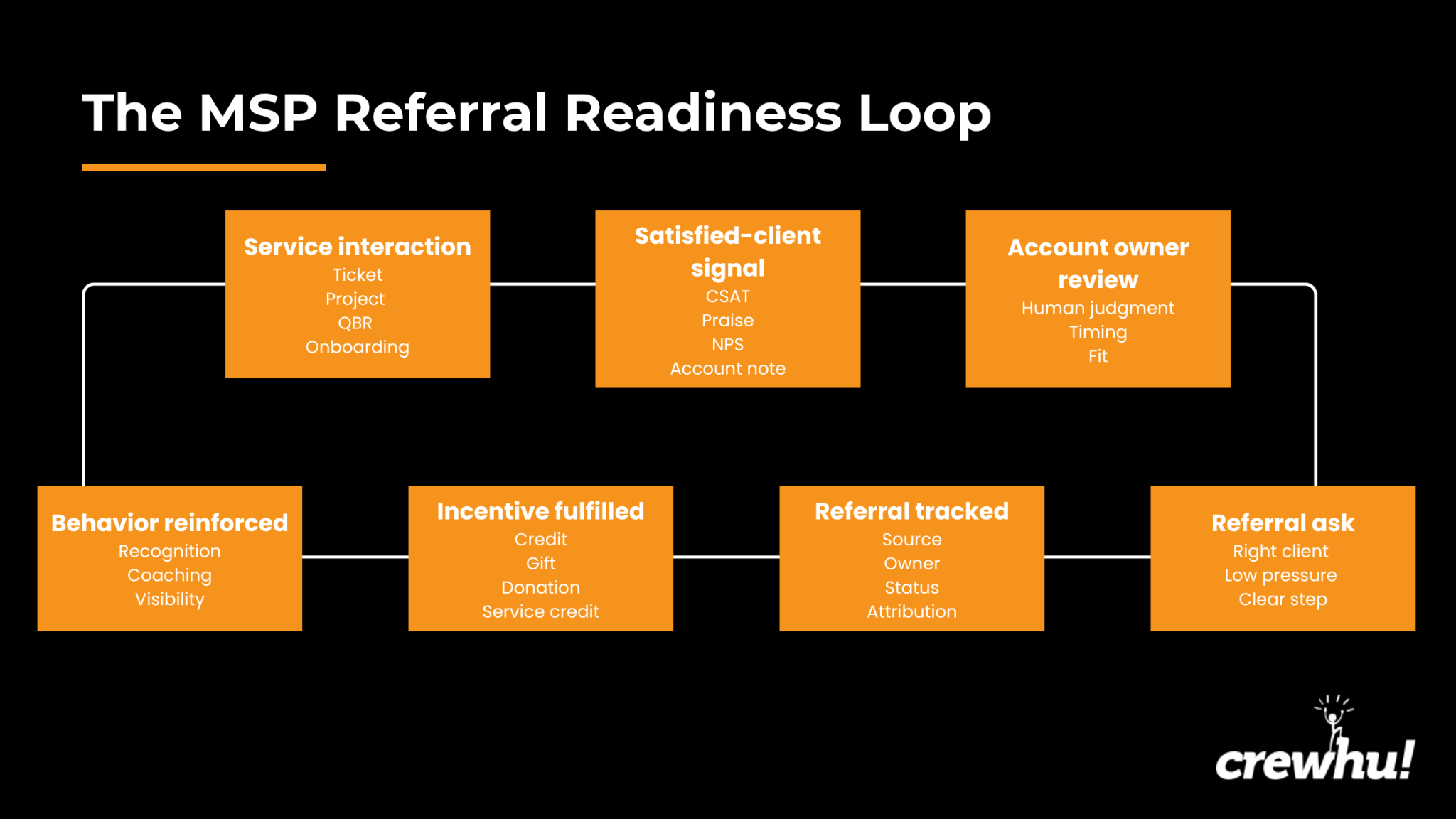
You need a way to see satisfied-client signals without turning every positive comment into an automated ask. CSAT, NPS-style feedback, praise, and account notes give the account owner a better indication of when the relationship is warm enough for a referral conversation.
What is the best time to ask for a client referral?
The right time to ask for a referral is right after a client signals satisfaction or appreciation for the service delivered. Making the ask specific, low-pressure, and easy to act on increases the chance of successfully receiving a referral.
Lean on satisfied-client signals to choose the right ask moment
The cue might come from ticket-close feedback, project comments, QBR notes, renewal conversations, executive sponsor praise, or service recovery follow-up. These tell the account owner when the client will be most receptive to a human ask.
If every positive score triggers a referral request, the program becomes mechanical. If feedback informs judgment though, the ask stays grounded in the relationship and is more likely to succeed.
Make the ask specific, low-pressure, and easy to act on
A vague request just creates work for the client. "Send us anyone who needs IT," forces them to define the prospect, explain the MSP's value, and decide how to introduce them.
A better approach names the problem and prospect type, such as, "Do you know another business owner dealing with unreliable IT support?" Then, it explains the next step, like a warm introduction and short discovery call.
How to Structure an MSP Referral Program Before You Promote It
You need to establish the operating rules before promoting your program. Otherwise, you’ll end up with scattered introductions, unclear ownership, and delayed rewards.
Before launch, define who can refer, what the criteria is for a qualified referral, where the referral goes, who follows up, when a reward is earned, how duplicate credit is handled, and how the referrer is updated.
Define who can refer and what counts as a qualified referral
Existing clients, partners, vendors, and employees can send opportunities your way. They operate in different spheres though, so they shouldn’t all follow the same rules.
Client referrals usually carry the most trust because they come from lived service experience. Vendor and partner introductions carry some weight, but they need separate fit, reward, and attribution rules. Employee referrals create a different incentive dynamic as well since they’re internal.
You also need to define what “referral” entails. It could be a name, a warm introduction, a booked discovery call, an ICP-fit company, a qualified opportunity, or a closed-won client.
Make the submission process simple
A strong relationship can still fail to produce referrals if the process is difficult or unclear. Referrers shouldn’t have to guess where to send a name, what details to include, or whether anyone followed up.
To make the process easy, give referrers one clear route, such as:
- A short referral form
- A direct account-manager email
- A warm-introduction path
At a minimum, capture the referred company, contact, referrer, fit notes, and next step.
Document the follow-up, attribution, and reward rules
Referral follow-up can build trust or destroy it. If an MSP delays follow-up, loses credit, or pays the reward late, the referrer learns not to bother next time.
Define the lead owner, first-response expectation, qualified-referral criteria, duplicate handling, reward trigger, and referrer updates so the follow-up, attribution, and reward rules are clear before the first referral arrives.
MSP Referral Incentives: Reward the Right Behavior Without Damaging Trust
Invest in referral incentives that promote relevant introductions and protect the client relationship. The right reward fits the relationship, referral type, and behavior you want to encourage.
Service credits, small gifts, or charitable donations may feel more natural to clients than cash, while larger or tiered rewards may fit formal partners. Determine which behavior each reward encourages.
Cash, credits, gifts, donations, and tiered rewards change the tone of the ask
Cash is easy both to understand and administer. In a client relationship though, it can make the referral feel transactional. Service credits keep the thank-you inside the managed-service relationship. Gifts also show appreciation, while donations can make the ask feel less commercial.
Tiered rewards may be a good option for repeat referral partners or longer sales cycles. The structure should reflect deal size, referrer type, and context rather than copy a generic payout menu.
Offer milestone-based rewards when lead quality matters more than lead volume
Rewarding every submitted name leads to low-quality activity. Milestone-based prizes align the program with your MSP's sales process by tying fulfillment to a warm introduction, booked meeting, qualified opportunity, or closed deal.
Each milestone has trade-offs though. Showing gratitude for an introduction is simple and client-friendly. Rewarding only closed deals, however, protects budget but may make you seem distant. Again, the trigger should match the desired behavior.
Don’t Confuse Referral Incentives With Review or Testimonial Incentives
Referral incentives need clear category boundaries. A private reward for a qualified introduction is different from offering something in exchange for posting, changing, or removing a public Google review. It also has different parameters compared to compensating a public testimonial.
Check applicable platform and disclosure guidance before attaching rewards, benefits, or material connections to reviews, testimonials, or endorsements.
| BOUNDARY TYPE | TRIGGER | REWARD CAUTION | MAIN RISK | KEEP SEPARATE FROM |
|
CLIENT Client referral reward |
Qualified intro or agreed referral milestone | Define when the reward is earned (before the ask, not after) | Low-fit leads or unclear attribution | Public review rewards |
|
PARTNER |
Partner or vendor introduction | Use a separate partner program with its own rules | Mixed fit or channel confusion | Client advocacy |
|
PLATFORM POLICY Google review request |
Request an honest public review | Don’t tie any reward to posting, changing, or removing a review | Platform policy risk if incentive is linked to the review | Referral rewards |
|
DISCLOSURE Testimonial/Endorsement |
Public quote, case snippet, or endorsement | Handle permission and material-connection disclosure carefully | Disclosure and accuracy risk if a benefit is exchanged | Private referral thank-you |
|
INTERNAL Internal recognition
|
Technician or account-team behavior clients notice | Reward employee behavior, not a client’s public proof | Blurring internal and client incentives | Client incentives |
A referral can later become public proof if a client provides a testimonial, case snippet, or quote. But that should also be handled separately from the referral reward.
When compensation, benefits, or material connections are involved, testimonials and endorsements may require disclosure. Get permission, keep facts accurate, and don’t treat private referral rewards as public-proof permission.
Track Referrals So the Program Doesn’t Depend on Memory
A referral program that relies on human memory will inevitably lose trust at some point. Someone forgets who made the introduction, a lead sits too long, two people claim the same credit, or a reward is delayed. That’s when the doubt begins to creep in.
You don't need a complicated system at launch to avoid this though. A simple CRM field, PSA note, spreadsheet, or account-management workflow can be enough if it keeps source, status, owner, attribution, and reward fulfillment visible.
Set up referral source, status, and reward tracking before launch
Outline your referral tracking process before the first announcement goes out. You have to capture at the very least who referred the opportunity, what company was referred, whether the introduction fits the ICP, and who owns the next step.
The record should also show current status, milestone, reward eligibility, reward fulfillment, and program notes. These fields make the referral clear enough for follow-up, credit, and reward fulfillment.
How to Measure Whether Your MSP Referral Program Is Working
Once you start tracking referrals, volume is just the starting point. You then need to determine whether they’re visible, qualified, have received a follow-up, and are moving toward the kind of client relationships you want.
Avoid universal benchmark ranges at this stage, since a new or informal referral program may not have enough internal data yet. Generic yardsticks also miss too much of the MSP context, from sales cycle length and account size to service fit, local market, and delivery model. Start with five diagnostic metrics instead.
Referral program metrics MSPs should review:
| METRIC | WHAT IT TELLS YOU | HEALTHY SIGNAL | WARNING SIGN |
| Referral source and status visibility | Is each referral visible, owned, and moving? | Source, owner, status, next step, and reward status are recorded. | Referrals sit in inboxes, QBR notes, tickets, or memory. |
| Qualified referral rate | Do referrals match your target client profile? | Referred companies fit by size, need, geography, budget, or complexity. | Volume rises, but sales rejects many leads as poor fit. |
| Referral-to-qualified-conversation conversion | Do introductions become real sales conversations? | Good-fit referrals become discovery calls or account-owner introductions. | Referred companies sit untouched or receive generic outreach. |
| Closed-won value and customer fit | Do closed referrals become accounts you want more of? | New clients fit the delivery model, margin, capacity, and long-term goals. | Closed referrals create low-margin work, scope mismatch, or delivery strain. |
| Referrer update and reward reliability | Does your MSP preserve trust after the referral? | Referrers get confirmation, status updates, and prompt reward fulfillment. | Referrers chase updates, rewards are delayed, or reward status is unclear. |
Consider these metrics and their meanings before changing your incentive:
- Low referral volume may point to poor program visibility.
- Weak referral quality may mean the ideal-customer language is too vague.
- If qualified referrals don’t become conversations, follow-up ownership may be broken.
- Delayed rewards point to an operations problem rather than a marketing problem.
Promote and Review the Program Without Turning It Into a Campaign Blast
Promotion is critical. The program shouldn’t be a generic nudging campaign. The best reminders appear when the client is already discussing outcomes, trust, or value. That might be during an account review, renewal conversation, service recovery follow-up, client newsletter, partner update, or account manager check-in.
The program should stay visible without turning every interaction into a sales pitch.
Put referral reminders in account moments before marketing emails
A newsletter reminder can help with awareness. When it’s tied to a real service moment, it jogs the client’s memory and resurfaces the positive feelings they had. After a successful project close or QBR, you can explain which companies you’re best suited to help and invite a low-pressure introduction.
Diagnose why the program stalls before changing the reward
When referrals slow down, the easiest reaction is to increase the incentive. But that risks missing the real problem entirely.
The issue might be unclear ask timing, weak client confidence, vague ICP language, slow follow-up, poor attribution, delayed rewards, or account managers just forgetting to ask. Review the trigger first. Then, check the ask, route, owner, attribution rule, and reward timing before switching incentives.
Keep Referral-Worthy Service Visible and Repeatable
A good referral program gives MSPs a practical way to act on their clients’ trust.
That confidence starts with clear communication, follow-through, recovery, and account-team visibility. Feedback and client conversations help pinpoint where trust is building. From there, the account owner can make a careful, timely ask, track the referral, and review what created the opportunity.
Referral readiness depends on visible service proof, and that’s where Crewhu steps in. Rather than becoming the referral program itself, they help MSPs collect customer feedback, make satisfaction cues easier to review, and reinforce the technician and account team behaviors clients notice. The MSP still owns the referral ask, tracking, attribution, reward rules, and policy review.
Use feedback to spot key service moments
MSPs need a reliable way to see where clients show confidence in their services. Feedback can come from help desk replies, ticket closures, project work, pulse surveys, NPS-style responses, or client comments. Those signals help leaders notice moments that might otherwise stay buried.
Crewhu simplifies how MSPs gather client feedback around service interactions. That then makes it easier to spot the signs of a satisfied client and gives account owners better context for referral conversations. It also avoids automatically turning a positive score into a referral trigger so your reps don’t waste their time on unfit leads.
Leverage recognition and visibility to reinforce the behaviors behind referrals
Referral-worthy trust is the result of repeated positive actions. Technicians communicate clearly, service teams resolve difficult tickets calmly, account managers catch praise, project teams follow through, and service leaders coach from feedback themes. Recognition and visibility help reinforce these behaviors, which produce a cycle of satisfaction between your customers and personnel.
Does your MSP already earn strong client trust, but referral-worthy moments keep disappearing into tickets, QBR notes, and one-off praise? Crewhu can pinpoint those service signals and make the actions behind them a habit. Book a demo to see how customer feedback, recognition, rewards, gamification, dashboards, and service-performance visibility can support the service-to-referral loop.
FAQ
How much budget should an MSP allocate to a referral program?
There is no universal percentage that fits every MSP referral program. Budget should depend on account value, reward timing, margin profile, and the type of referral you want to encourage. Many MSPs can start with modest service credits, small gifts, charitable donations, or milestone-based rewards. The reward structure can then change as the MSP learns which referrals become qualified conversations and closed clients.
How long does it take to see results from a referral program?
It depends on the MSP’s client base, sales cycle, ask timing, and follow-up discipline. Early results may show up as process signals before closed revenue. Look for more referral-ready moments logged, more account-team asks after strong service moments, more qualified conversations, and clearer referrer updates. Revenue impact usually takes longer because managed services often involve larger decisions and longer buying cycles.
Where do most MSP referrals come from?
MSPs should usually look first to the relationships where trust already exists. That often means client champions, executive sponsors, satisfied project stakeholders, and partners who understand the MSP’s service quality. The best referral sources aren’t always the loudest advocates. The goal is to choose people who understand the MSP’s fit and can make a relevant introduction.