.png)
Key Takeaways
- Employee recognition ideas must be specific. They should show the employee what they did, why it counted, and what behavior is worth repeating.
- Recognition doesn't have to be expensive. A timely thank-you, customer praise, peer shoutout, extra flexibility, or development opportunity can be meaningful when it fits the contribution.
- Service businesses should recognize the behaviors customers actually experience, such as clear communication, calm service recovery, clean handoffs, follow-through, and peer support.
- The right recognition format depends on the moment. Public praise, private appreciation, points, time off, team recognition, and rewards all work better when they are matched to the employee and the behavior.
- If recognition needs to scale across customer feedback, rewards, metrics, and team visibility, software can help. But the recognition logic has to come first.
Employee recognition ideas are easy to list but hard to make a reality. Most businesses can name the obvious options like gift cards, lunches, employee of the month awards, bonuses, and anniversary gifts. But recognition weakens when the reward is disconnected from the behavior it’s supposed to reinforce.
A gift card for “great work” is nice but vague. A note that says, “Thank you for staying calm with a frustrated customer, documenting the issue clearly, and helping the next person resolve it faster,” drives home the point. It tells the employee what specific actions mattered and what kind of work the company wants to see again.
That distinction carries extra weight in service businesses, where customers don't see their value statements. They instead experience the technician, support rep, dispatcher, account manager, field employee, service desk agent, or frontline worker who handles the moment in front of them. Recognition should help those service behaviors become visible, repeatable, and worth copying.
What makes an employee recognition idea impactful?
Recognition ideas are impactful when the employee can connect the praise to a concrete contribution.
The Incentive Research Foundation states that recognition should be fair, accessible, timely, sincere, specific, and part of everyday culture. It also points out that recognition doesn't have to come from senior leaders exclusively. Managers, peers, cross-functional teammates, and customers can all help make good work visible.
A simple “good job” is too thin; it doesn't tell the worker what to repeat. An effective recognition message names the action, standard, and impact, for instance, “You gave the customer a clear update before they had to ask. That protected trust and made the handoff easier for the next person.”
The Journal of Management Control agrees, saying that verbal rewards are most useful when they give clear information about what was accomplished and avoid vague praise. That means praise should act like feedback and help employees understand which behavior created value.
For practical purposes, strong recognition ideas usually pass four tests:
- They’re specific: The employee knows what behavior earned praise.
- They’re timely: The recognition happens close enough to the work that the connection is still clear.
- They’re proportionate: A small daily win doesn't need a huge reward, and an exceptional contribution shouldn't receive the same generic thank-you as everything else.
- They fit the person: Some employees enjoy public praise, while others prefer a private note, a one-on-one thank-you, or some other quieter form of appreciation.
What should employees be recognized for?
Many recognition programs start with familiar moments such as work anniversaries, service milestones or sales goals, employee of the month, or company values awards. Those moments are useful because tenure and loyalty deserve to be noticed, but service companies also need to go beyond milestones.
They should also recognize the behaviors that shape the customer experience. Some are day-to-day service habits like proactive communication, clean handoffs, calm service recovery, accurate documentation, or helpful peer support. Others show up through completed jobs, positive customer feedback, or follow-through after a difficult interaction.
Catalyst argues that companies often invest heavily in customer interactions while overlooking the frontline employees who create those experiences. If customers experience the business through people, the organization has to notice and reinforce the actions those people take to protect the experience.
Certain moments have nothing to do with metrics at all. A new employee who learns quickly, a dispatcher who keeps the day moving, or a senior technician who mentors others deserves praise even when no customer survey mentions them.
The point is to make the invisible work visible.
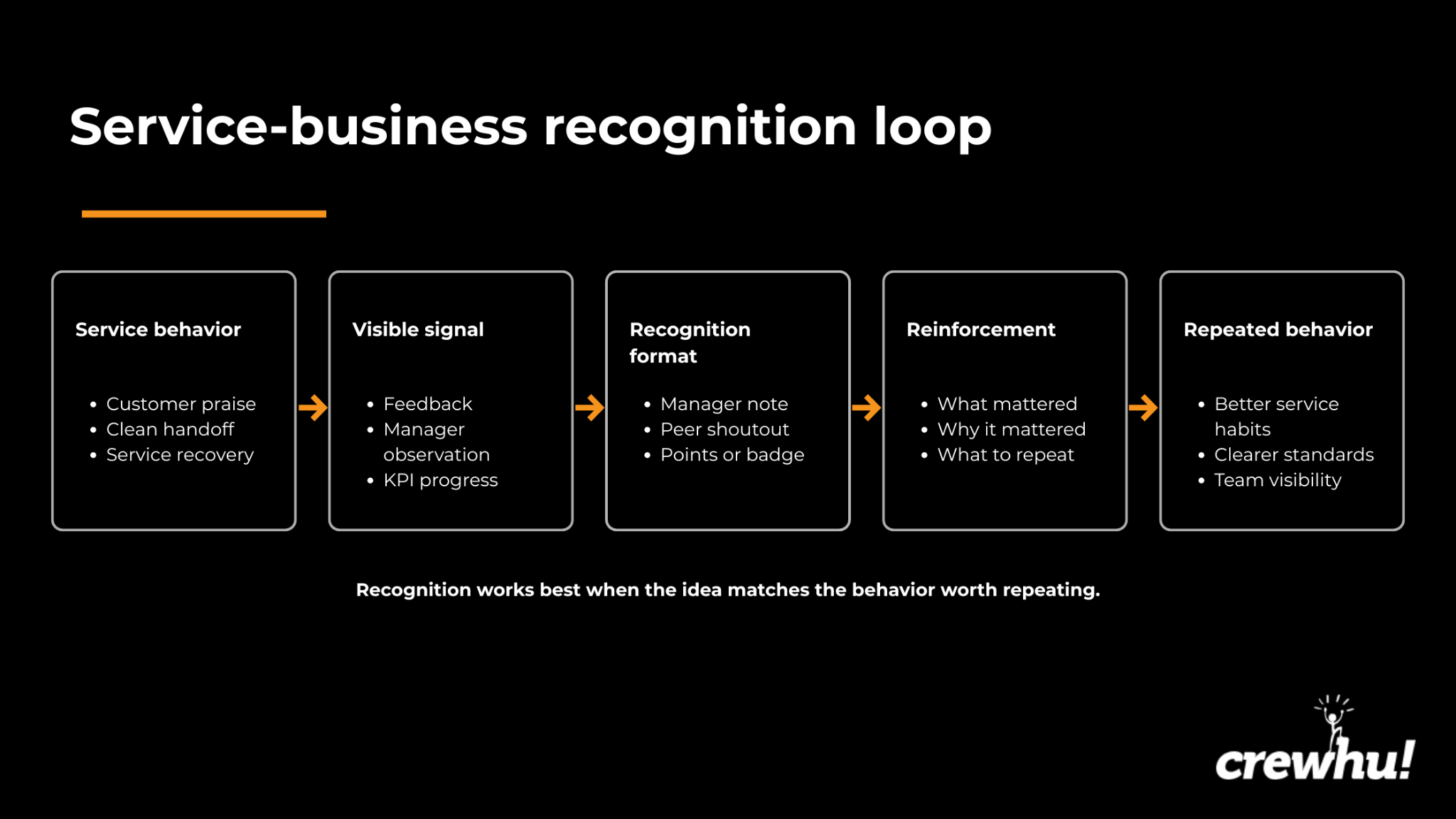
Employee recognition ideas for different budgets and situations
Recognition can take various formats such as individual, team, peer, milestone, customer comments, project help, and core-value behavior. Approaching recognition with this mindset helps pinpoint the best types for your business and prevents every employee contribution from receiving the same default reward.
No-cost and low-cost recognition ideas
Start with recognition that costs little but requires attention:
- A specific handwritten note is still one of the simplest but effective ideas. It works best when it names the action, for example, “I noticed you stayed late to make sure the customer had a clean update before Monday. That helped the whole team avoid confusion. Thanks for that!” A note like this is small but makes an impact and avoids coming across as generic.
- A private thank-you from a manager can work well for employees who don't like public attention. It’s also useful when the work involved a difficult customer or sensitive situation that shouldn't be discussed in front of the team.
- Public team-channel recognition works when the behavior is safe to share. A Slack or Teams shoutout can reinforce a standard quickly. For instance, “Maria caught a missing handoff detail before escalation. That’s the documentation discipline we need.”
- A “win of the week” mention gives managers a regular rhythm for recognition. It can highlight customer praise, peer support, service recovery, or behind-the-scenes work that kept the week moving.
- Customer praise should be shared with the employee and, where appropriate, with the team. Client feedback is powerful because it connects recognition to a specific service moment and keeps it from depending on the manager’s memory alone.
- Peer-nominated recognition spotlights the work that managers miss. A colleague may be the first person to notice who helped with a stuck ticket, covered a shift, explained a process, or took pressure off the team.
These ideas are low cost and effort. Recognition doesn't need to be grand or expensive to carry weight. It just needs to feel real.
Customer-facing recognition ideas
Service businesses should build recognition around the moments customers feel:
- Positive customer feedback: When a customer says a technician was clear, a dispatcher was helpful, or a support rep stayed patient, that feedback shouldn't sit unused in a survey dashboard. Turn it into a recognition moment.
- Calm service recovery: If an employee turns around a frustrated customer, de-escalates a tense conversation, or fixes a mistake without blaming someone else, that should be made visible. Service recovery takes strong judgment and emotional control.
- Proactive updates: Customers often get frustrated when they have to chase information. A team member who gives a clear update before the customer asks is protecting trust.
- Clear handoffs: Customers may never see the handoff itself, but they notice when they have to repeat information or explain the problem again. A clean handoff gives the next employee enough context to continue without making the customer start over.
- Documentation and job notes: For MSPs, field services, repair shops, healthcare support, and other service environments, good notes reduce rework. They also help other employees serve the customer faster and with less guesswork.
- Problem prevention: An employee who prevents a repeat issue won’t get the dramatic thank-you that comes after a critical rescue, but their efforts are still valuable. Prevention is often the behavior that protects the customer experience most.
Helpful Tip: If the customer would notice when a behavior disappears, the business should consider recognizing it when it happens.
Peer and team recognition ideas
Manager recognition has value, but managers can't see everything. Peer recognition helps catch work that happens between formal reviews, customer surveys, or leadership meetings:
- Run a simple weekly peer nomination. Ask each employee to nominate someone who helped them do better work that week and have them include the behavior along with the name.
- A team kudos channel can work for distributed or hybrid teams when it has a simple structure. Ask people to connect praise to a standard such as customer care, ownership, documentation, follow-through, collaboration, core values, or service recovery.
- Rotating team awards are useful when they tell a story. Rather than focusing on how expensive it is, what matters most is emphasizing the behavior attached to it.
- A “behind-the-scenes helper” award can recognize invisible work, including the person who fixed a process, helped a new hire, created a template, improved a handoff, or reduced friction for everyone else.
- A cross-functional thank-you helps prevent silos. A support team might recognize finance for helping resolve a billing issue quickly, or operations might recognize sales for setting better customer expectations.
Watch out for favoritism though. Peer recognition can become a popularity contest if no one defines what counts. Give employees examples of recognition-worthy behavior so the program rewards contribution and doesn't drift toward social visibility.
Time, flexibility, and growth-based recognition ideas
Rewards don't always need to be cash or gifts. Extra time off, a flexible start time, a preferred shift, or an early finish after a demanding week are also meaningful options. These ideas work especially well when the employee has carried extra load or handled a difficult period with professionalism.
Consider growth-based recognition as well. You could offer a certification budget, a training session, a conference seat, a mentorship opportunity, or ownership of a small improvement project. This tells the employee, “We noticed your contribution, and we want to invest in what you can do next.”
JLL emphasizes these types of perks, saying frontline workers need more than surface-level engagement gestures. They highlight career pathways, wellbeing, recognition, manager support, and flexible scheduling as part of a more durable workforce strategy.
Similarly, in the Give an Ovation podcast episode Empower Your Team, Elevate Your Guests, host Zack Oates spoke with Geoffrey Toffetti of Frontline Performance Group about connecting reward, recognition, accountability, leaderboards, and frontline service standards. Not every business needs a leaderboard. The company has to define the behaviors behind that phrase, then recognize people when those behaviors show up.
Be careful not to make flexibility a polite wrapper for burnout though. Recognition can support a broader employee retention strategy, but it can't compensate for chronic understaffing, poor scheduling, unsafe workloads, or managers who ignore employee strain.
Points, rewards, and KPI-based recognition ideas
Points and rewards are designed to reinforce the right behavior. A points program can recognize customer-service wins, core-value behaviors, team support, project completion, or KPI progress. Gift cards, reward stores, small bonuses, and prize redemptions are also attractive perks when the reward is proportionate and the reason for it is clear.
KPI-based recognition needs careful design since it can easily cement bad habits. Rewarding speed alone, for instance, could encourage rushed work, praising call volume might make employees avoid complex problems, and spotlighting ticket closure can lead to weak notes or poor handoffs.
A better approach is to recognize balanced service behaviors like:
- First-contact resolution without rushed communication
- High-quality documentation
- Positive customer feedback
- Clean handoffs
- Proactive updates
- Repeat issue prevention
- Teamwork during escalation
- Service recovery after a difficult interaction
Rewards should make the behavior easier to remember, rather than the only reason the behavior happens.
Recognition idea matcher: Choose the right format for the behavior
Before choosing a recognition method, start with the signal ahead of the reward. Review the matcher below to keep perks in the background and put the decision first.
|
If the signal is... |
Recognition should clarify... |
Best-fit recognition format |
Why it works |
What to watch for |
|
A customer gives specific positive feedback |
The behavior that created the customer’s trust |
Customer-triggered shoutout, manager note, or points |
Keeps recognition close to the service moment |
Remove customer details when needed |
|
A difficult issue is recovered well |
The judgment or ownership that protected the relationship |
Private note, then optional team learning moment |
Recognizes emotional labor and service recovery |
Don’t expose a sensitive customer situation |
|
A handoff prevents rework |
The operational discipline that saved time or confusion |
Team channel example or manager recognition |
Makes invisible quality work visible |
Avoid turning documentation into bureaucracy |
|
A teammate helps without being asked |
How they made dependency easier for someone else |
Peer nomination or team kudos |
Catches work managers often miss |
Define criteria to avoid popularity bias |
|
A KPI improves for the right reason |
Which behavior moved the number without hurting quality |
Badge, points, or milestone reward |
Reinforces progress without reducing performance to volume |
Don’t reward speed over customer outcome |
|
A person reaches a tenure milestone |
What their consistency has made possible over time |
Personal note plus milestone recognition |
Makes loyalty feel human and intentional |
Don’t rely on tenure as the only recognition moment |
|
An employee builds a new skill |
The future capability the business wants to encourage |
Training budget, certification support, or stretch opportunity |
Turns recognition into growth investment |
Don’t make extra work the only “reward” |
|
A quiet contributor prevents problems |
The risk, friction, or rework that didn't happen because of them |
Private-public hybrid |
Values prevention as well as rescue |
Explain the avoided risk clearly |
How to keep recognition fair, frequent, and measurable
Recognition breaks down when employees can't tell why some contributions are noticed and others are ignored. Fair treatment starts with clear criteria. Managers must define recognition parameters, such as customer praise, service recovery, documentation, peer support, account-saving service moments, positive feedback, process improvement, core values, or goal progress. That gives employee recognition the right lens. It should sit inside a management rhythm and shouldn't appear only when someone remembers to send praise.
You need to strike a balance between regular recognition and constant praise too. Important work shouldn’t wait three months to be noticed. Recognition feels more genuine when it’s tailored and sincere, and timely praise increases perceived authenticity because the employee can still connect the appreciation to the contribution.
Measurable recognition doesn't reduce appreciation down to a dashboard. Leaders should still look for recognition patterns by asking:
- Who gets recognized frequently?
- Who commonly gives recognition?
- Which behaviors are being reinforced?
- Are customer-facing wins visible?
- Are quiet contributors ignored?
- Are remote or field employees less likely to be seen?
Gallup and Workhuman reported that employees receiving high-quality recognition were less likely to have changed organizations two years later. While it can't replace pay, workload design, growth paths, or good management, recognition still has significant influence.
As this article previously mentioned, public recognition isn’t always the right format. In a recent Appreciation at Work podcast episode
William Attaway sat down with leadership coach Sheryl Driggers to discuss why leaders often confuse performance recognition with real appreciation, and why a public shoutout may not land well for every employee. Managers need to learn the person along with the program.
Recommended listen: Incentives should reinforce the service behavior you want repeated
In the Customer Service Revolution episode Incentives That Drive Service Behaviors, John DiJulius and Denise Thompson dissect a useful service-business question: Are your incentives creating the customer experience you actually want? The episode’s core idea ties directly to recognition; employees repeat what the business measures, rewards, praises, promotes, and tolerates.
So, don’t reward shortcuts and then expect careful service. A business that recognizes only speed, volume, or sales will see employees optimize for those things. Recognition should also make ownership, empathy, personalization, follow-through, teamwork, problem prevention, and service recovery visible.
Listen to this episode for a practical way to think about recognition as a service-behavior design choice, beyond a simple employee perk.
Make recognition easier to see and repeat
Recognition depends on attention. Managers have to notice the behavior, understand why it matters, choose the right format, and act on it while the moment is still fresh. That's manageable when a team is small. But as customer feedback, team communication, performance metrics, and rewards spread across tools and teams, it may be necessary to evaluate employee recognition software to accommodate that scaling.
Crewhu steps in here to give service businesses a way to make service signals easier to catch and turn into recognition. Our solution supports Slack and Microsoft Teams recognition automated badges, and badges for customer service wins, birthdays and anniversaries, and displays of core values. It also covers manager and executive recognition, budgetary controls, and recognition reporting. Recognition can connect to points and rewards tied to customer service, core values, and metrics. Prize redemption and reward dashboards round out the reward workflow.
For service businesses that want recognition to stay close to the customer moment, Crewhu can help teams collect transactional customer feedback from help desk replies, ticket closures, or project tickets, then report feedback by customer, employee, issue tag, and other service signals. When the behavior is tied to goals or performance metrics, Crewhu helps teams track KPIs through systems such as PSA, CRM, documentation, and VoIP tools, set SMART goals, and run contests around selected metrics.
Recognition shouldn't turn into automated praise though. When customer feedback, team recognition, rewards, and performance metrics are connected, leaders have a better chance to recognize the right behavior before it becomes old news.
Turn recognition into a repeatable service habit
Effective recognition ideas make employees feel noticed and also teach the team what good work looks like in practice. They turn customer praise, careful handoffs, service recovery, peer support, and steady improvement into signals the business can see and reinforce.
Recognition works better as a service habit than a random reward calendar. Notice the work, name the behavior, choose the right format, and reinforce it while the moment is still fresh.
Recognition should make the right work visible before it disappears. If your service team needs a more consistent way to connect customer feedback, recognition, rewards, and performance signals around the behaviors customers actually experience, book a Crewhu demo today.
FAQ
What are good employee recognition ideas?
Good employee recognition ideas include specific manager thank-you notes, peer shoutouts, customer-feedback recognition, points, gift cards, extra time off, milestone celebrations, development opportunities, core-value badges, team awards, and public recognition for service wins. The best way to recognize employees is to be specific, timely, sincere, and proportionate.
What should employees be recognized for?
Employees should be recognized for both milestones and meaningful work behaviors. That can include positive customer feedback, clean handoffs, strong documentation, calm service recovery, proactive communication, peer support, KPI progress, learning, tenure, and actions that reflect company values. Service businesses should pay special attention to behaviors that affect customer experience.
How can small businesses recognize employees on a budget?
Small businesses can recognize employees with handwritten notes, team shoutouts, flexible scheduling, peer nominations, small gift cards, customer praise, development opportunities, and simple milestone celebrations. Low-cost recognition works when it’s thoughtful and specific. A sincere thank-you tied to a real contribution is often more meaningful than a generic reward.
Should employee recognition be public or private?
It depends on the employee and the moment. Public recognition can reinforce team standards and make good work visible. But some employees prefer private appreciation. Sensitive customer issues, personal effort, or emotional service recovery are also better off recognized privately. Managers should learn how each person prefers to be appreciated.
How do you recognize remote or hybrid employees?
Remote and hybrid employees need recognition that’s visible without feeling like their superiors are going through the motions. Use team-channel shoutouts, peer nominations, manager video check-ins, digital badges, mailed notes, customer praise, and recognition during team meetings. Consistency is the key. Don’t overlook remote employees just because managers don't see their work in person.
How often should employees be recognized?
Employees should be recognized whenever there’s a meaningful contribution worth reinforcing. Forced daily praise is a useless goal. Managers and peers should notice good work while it's still fresh and follow up quickly. Frequent, sincere recognition helps employees understand what the business values and which behaviors are worth repeating.