
Stop letting your performance dashboards gather dust. Turn your MSP technician performance metrics into SMART goals that drive better service, faster response times, happier clients and business growth.
Are your technicians meeting their assigned targets while your wider KPIs barely move? Many MSPs collect service desk data throughout the day, yet response times remain inconsistent, documentation keeps slipping, and customer satisfaction seems stuck at the same level.
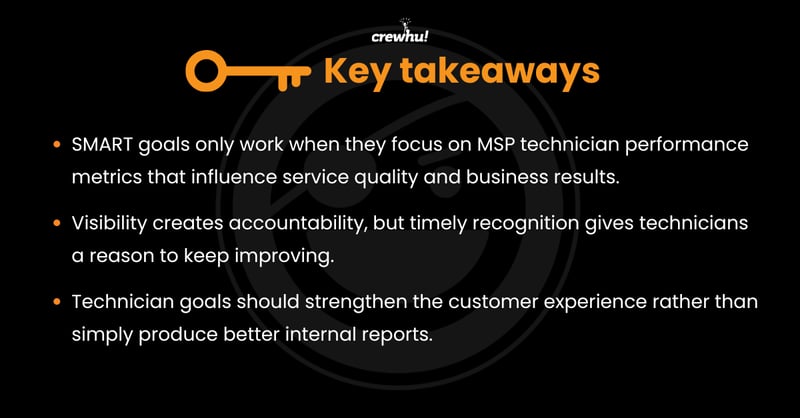
The issue usually isn’t measurement. Most MSP leaders already have dashboards filled with ticket activity, SLA results, resolution times, and customer feedback. However, numbers sitting inside a report don’t automatically help technicians understand which behaviors need to change or why those changes matter to clients.
Technicians need goals that turn broad expectations into something specific enough to act on. They also need regular feedback, visible progress, and recognition that reinforces the right behavior and celebrates small wins along the way.
According to Gallup and Workhuman, 61% of employees who receive weekly feedback and recognition are engaged, compared with 38% of employees who receive frequent feedback but less frequent recognition.
SMART goals give technicians a clear target, while recognition and gamification create an instant feedback loop that keeps those goals front and center. Instead of reviewing the same disappointing numbers at month-end, MSP leaders can help technicians understand the goal, track progress in real time, celebrate improvements, and build habits that drive exceptional service.
Continue reading to find out which MSP technician performance metrics deserve your attention, how to turn them into practical SMART goals, and why recognition and gamification help those improvements stick.
Why MSP Technician Performance Metrics Matter
Help desk performance metrics show whether technicians are delivering the service clients expect. Response times, resolution quality, CSAT, and SLA compliance reveal where performance is strong and where service may be slipping.
However, metrics only create value when they guide action. A slow first response can frustrate clients, while weak documentation forces the next technician to rebuild context that should already exist.
Reliable data also makes coaching more useful. Instead of giving vague advice, managers can point to specific patterns, identify obstacles, and set clear improvement goals.
The Service Desk Institute includes KPI analysis, SLA management, coaching, and customer satisfaction among key service desk responsibilities. For MSPs, though, tracking is only the starting point. The real value comes from using metrics to build better habits before poor performance becomes routine.
The MSP Technician Performance Metrics Worth Tracking
Not every available metric deserves equal attention. Focusing on too many numbers can leave technicians unsure about what actually matters, so MSP leaders should prioritize the MSP KPIs that have a clear connection to service quality, efficiency, and customer trust.
-
First response time: First response time measures how quickly a technician acknowledges a new support request. Clients may understand that a full resolution takes time, but silence often creates frustration long before the technical work begins.
-
First contact resolution: First-contact resolution tracks the percentage of issues solved during the first interaction. Strong performance can reduce repeat work, prevent unnecessary handoffs, and give clients a smoother support experience.
-
Average resolution time: Average resolution time shows how long technicians take to close tickets fully. It can reveal workflow bottlenecks, training gaps, or recurring technical problems, although speed should always be considered alongside resolution quality.
-
Customer Satisfaction (CSAT): CSAT reflects how clients rate the support they receive. A strong score usually suggests that the technician combined technical knowledge with clear communication, ownership, and appropriate follow-through.
-
SLA compliance: SLA compliance shows whether tickets are meeting agreed response and resolution targets. Consistent performance protects client trust, reduces contractual risk, and helps the MSP deliver what it promised.
-
Ticket backlog: Ticket backlog measures how much unresolved work is waiting for attention. A growing queue may point to limited resources, poor prioritization, inefficient processes, or recurring issues that need a permanent fix.
Together, these help desk performance metrics provide a practical view of technician performance. However, they become useful only when technicians understand how their own decisions influence them.
How SMART Goals Help Improve Technician Performance Metrics
Metrics tell you where performance stands, but SMART goals give technicians a defined route forward. Instead of handing someone a vague instruction and hoping for improvement, the SMART criteria turn expectations into a target that can be understood, measured, and reviewed.
A SMART goal should be:
-
Specific: Clearly state the behavior or result that needs to improve.
-
Measurable: Include a number or outcome that makes progress visible.
-
Achievable: Set a meaningful challenge that still reflects current workload and resources.
-
Relevant: Connect the goal to service quality, customer expectations, or another business priority.
-
Time-bound: Include a deadline and regular checkpoints that keep progress moving.
For MSP technicians, the strongest goals connect operational performance to the customer experience.
3 SMART Goals Examples for MSP Technicians
Here are three practical SMART goals MSP leaders can use to improve technician performance and the customer experience.
1. Improve First Response Time
Goal: Reduce average first response time from 45 minutes to under 30 minutes within the next 60 days while maintaining SLA compliance above 95%.
Why it matters: Fast responses reassure clients that their issue is being handled, even if the resolution takes longer. Improving first response time is one of the fastest ways to strengthen the customer experience.
2. Increase First Contact Resolution
Goal: Raise first-contact resolution from 72% to 80% over the next quarter by improving documentation, knowledge sharing, and troubleshooting processes.
Why it matters: Solving issues during the first interaction reduces ticket volume, minimizes repeat work, and creates a smoother experience for clients.
3. Boost Customer Satisfaction (CSAT)
Goal: Increase your team's average CSAT score from 94% to 97% over the next 90 days by improving communication, setting clear expectations, and following up with clients before closing tickets.
Why it matters: Higher CSAT reflects more than technical expertise. It shows technicians are delivering the kind of exceptional service that builds trust and long-term client relationships.
Whatever metric you choose, make progress visible. Regular feedback, recognition, and gamification help technicians stay engaged and reinforce the behaviors that lead to lasting improvement.
Why Metrics Alone Don't Change Behavior
Dashboards can make performance visible, but visibility alone rarely creates lasting motivation. A technician may understand that resolution time needs attention, yet the number does not explain how to improve it, what support is available, or whether progress will receive any acknowledgment.
Performance starts improving when metrics become part of regular coaching rather than a scorecard brought out only when something goes wrong. Managers can use one-on-one discussions to identify obstacles, agree on realistic next steps, and connect the technician’s work to customer and business outcomes.
Recognition matters just as much. Technicians who only hear about missed targets can start viewing metrics as punishment, while crews that receive timely acknowledgment can see the same data as proof of progress.
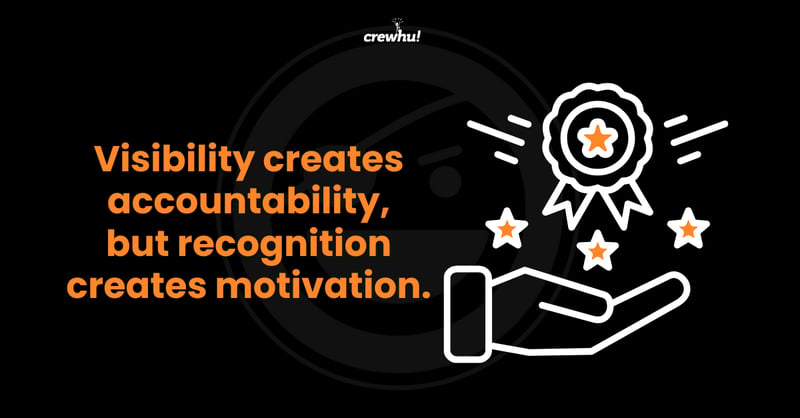
This distinction is key: visibility creates accountability, but recognition creates motivation. MSP leaders need both if they want performance improvements to continue after the initial goal-setting conversation.
Reinforce the Right Behaviors with Recognition and Gamification
Recognition encourages technicians to repeat positive behaviors. Celebrating achievements shows employees that consistent performance receives appreciation, not just measurement.
Gamification adds another layer of motivation by making progress visible and engaging. Friendly competition encourages technicians to stay focused while working toward individual and team goals.
An effective program may include:
-
Leaderboards: Show progress in real time and create healthy competition around agreed performance goals.
-
Achievement badges: Recognize milestones such as strong CSAT, consistent SLA compliance, or improved documentation.
-
Points and rewards: Give technicians meaningful incentives for reaching SMART goals and maintaining stronger habits.
-
Peer recognition: Allow crew members to acknowledge collaboration, knowledge sharing, and support that may not appear in standard reports.
-
Crew contests: Encourage technicians to work toward a shared result rather than competing only for individual rankings.
Recognition should be timely enough that technicians can connect it to the behavior that earned it. The 2025 State of Recognition Report from Achievers Workforce Institute found that employees recognized weekly were nine times as likely to feel a sense of belonging and six times as likely to see a long-term future with their company.
Crewhu helps MSPs gamify the metrics that matter by connecting goals, recognition, contests, and rewards to performance data. Instead of asking managers to monitor every number manually, the platform makes progress visible and reinforces wins as they happen.
Frequently Asked Questions
Q: What Are the Most Important MSP Technician Performance Metrics?
The most useful metrics usually include first response time, first-contact resolution, average resolution time, CSAT, SLA compliance, ticket backlog, documentation quality, and billable utilization. The right mix depends on the MSP’s service model and customer commitments.
Q: How Do You Improve Technician KPIs Without Micromanaging?
Set clear SMART goals, make progress visible, review results regularly, and recognize improvement as it happens. Technicians can manage their own progress when expectations are clear and feedback does not depend on a manager constantly checking every ticket.
Q: How Often Should Technician Performance Metrics Be Reviewed?
Technicians should be able to see relevant performance data in real time, while managers should hold structured reviews weekly or biweekly. Monthly and quarterly reviews are useful for spotting broader patterns, but they are often too late for correcting daily habits.
Achieve Better MSP KPIs with Crewhu
Tracking more MSP KPIs will not automatically improve technician performance on its own. Real improvement happens when your team understands the metrics that matter, receives instant feedback, and gets recognized for delivering exceptional service.
SMART goals give technicians a clear path forward. Recognition and gamification keep those goals visible by celebrating the small wins, reinforcing the right behaviors, and creating an instant feedback loop that builds engagement, accountability, and consistent performance.
That's where Crewhu stands apart. We don't just collect data or display dashboards—we help you turn technician performance into action. By combining real-time recognition, gamification, customer feedback, and KPI tracking, Crewhu empowers your team to stay focused, motivated, and committed to delivering exceptional service every day.
Ready to get more from your team? Book a demo today and see how Crewhu helps MSPs build engaged crews, delight clients, and turn the metrics that matter into lasting results.