.png)
Key Takeaways
- Employee retention is an operating issue for service businesses. When reliable employees leave, customer continuity, service quality, scheduling capacity, internal standards, and manager attention all take a hit.
- The strongest employee retention strategies combine fair employment fundamentals with daily management habits like credible pay, growth paths, schedule stability and workload visibility, manager check-ins, and recognition and feedback loops.
- Service businesses should treat retention as a signal system. Managers need earlier visibility into workload strain, role friction, employee voice, customer feedback, and the service behaviors worth repeating.
- Recognition works best when it’s specific and tied to the behaviors that protect customer experience, including calm service recovery, proactive updates, clean handoffs, peer support, accurate documentation, and follow-through.
- Crewhu takes positive customer feedback beyond CSAT by connecting it to the employee and service behavior that earned it, so teams can reinforce that work through recognition and rewards.
Why employee retention is an operating problem for service businesses
Employee retention strategies matter because service businesses lose more than headcount when good employees leave. They also lose customer context, service habits, scheduling capacity, peer knowledge, informal standards, and the steady behaviors customers rely on.
That loss shows up quickly. A dispatcher leaves, and routes become harder to balance, or a senior technician, project lead, advisor, or support specialist jumps ship, and newer employees lose a practical source of judgment. Customers feel the disruption in slower responses, rougher handoffs, repeated questions, and less consistent service.
Bank of America connects retention to avoided disruption, preserved productivity, protected morale, consistent customer experiences, and reduced pressure on remaining employees. The company points to compensation and advancement, management quality, flexibility, workload, and recognition and feedback as practical retention areas for small-business owners.
Retention is how companies keep the people, behaviors, and customer knowledge that make them reliable, so it deserves time and attention.
What employee retention strategies need to accomplish
Employee retention strategies should remove obvious reasons to leave, give employees a reason to grow inside the business, and help managers see risk before resignation becomes the first clear signal.
Remove obvious reasons to leave
Pay and benefits, along with basic fairness, safe working conditions, and manageable expectations, are the foundation. Once those fundamentals are competitive, visible, and consistently applied, the rest of the retention system has something real to build on. Recognition, growth paths, feedback, and culture work better when employees can see that the basics are handled fairly.
Recent job-quality research from Gallup defines job quality through five dimensions:
- Financial wellbeing
- Workplace culture and safety
- Growth and development opportunities
- Agency and voice
- Work structure and autonomy
They also report that only 40% of the U.S. workforce holds “quality” jobs, emphasizing gaps around pay, advancement, scheduling, and fairness.
For a service business, retention starts with the conditions employees experience every week. Are shifts predictable? Is workload visible? Are managers removing friction? Do employees have a voice in the parts of the job that affect them? Can they see a path beyond the same pressure and the same title?
Give employees a reason to grow inside the business
Good employees are more likely to stay when they can see a future with their company. That could take the form of a managerial or other lead role, deeper technical skill, better customer ownership, scheduling autonomy, specialization (possibly accompanied by certifications), or mentorship.
Companies shouldn’t underestimate the power of clear paths to advancement. Work Institute revealed that career development was the leading reason why personnel left in 2024. That included lack of growth opportunities, inadequate career progression, and insufficient professional development. Gallup research also found that 25% of U.S. employees don’t have opportunities for promotion or advancement, defined as available options to build skills, gain experience, and progress one’s career.
For a service business, that makes growth paths a practical retention strategy. Employees need to know which skills matter, what “better” work looks like, how to advance in their roles, and what their next step could be inside the business.
Create earlier warning signals before resignation
Retention improves when managers get useful signals well ahead of exit interviews.
Those signals come from one-on-ones, stay interviews, customer or peer feedback (good and bad), schedule strain, repeated overtime or absenteeism, or stalled development. Managers need a practical way to see friction while employees are still reachable.
Manager visibility is highly influential, according to Gallup. They found U.S. engagement fell to 31%, its lowest level in a decade, and some of the largest declines were due to poor communication of expectations, not feeling cared for at work, and lack of encouragement to develop. They also emphasize managerial upskilling on clear priorities, ongoing feedback, and accountability as a way to reverse this decline.
For service businesses, those are operating signals. If employees lack clarity, feel unseen, and see no path to grow, retention risk is already forming.
Employee retention strategies for service businesses
Start with the roles and handoffs that keep service running
A retention strategy should begin with a review of operational risk before it moves into employee surveys, engagement tools, or retention program design.
Identify the roles, behaviors, and customer moments that are most disruptive when someone leaves, such as:
- A field employee who carries years of customer-specific knowledge.
- A dispatcher who protects the schedule through pure judgment rather than software field captures.
- A customer support lead who knows which clients need extra communication before they escalate.
Then map the disruption points:
- Which roles have the longest ramp-up time?
- Which employees hold critical customer context?
- What service behaviors protect trust?
- What handoffs break when an experienced person leaves?
- Do certain customer complaints become more common after turnover?
This exercise reframes retention to focus on the people and behaviors that protect the customer experience, as well as the conditions that make those employees more likely to stay. A service business should know where turnover damages continuity, where employee knowledge protects quality, and where managers need earlier signals.
Make pay and benefits credible
Weak pay undermines every other strategy, while credible pay gives recognition, development, and positive work culture room to prosper.
Competitive compensation, useful benefits, and basic fairness remove obvious reasons to leave. They also create the trust needed for other retention strategies to work.
Research continues to highlight the connection between job quality and financial wellbeing in the form of fair pay, stable employment, and benefits that meet basic needs and reduce financial stress. It also encourages growth, voice, safety, work structure, autonomy, predictable schedules, and manageable workload.
Service businesses need to review their pay rates for critical roles, compare compensation against local and industry realities, and watch for repeated offer losses. Then they should connect paid work to the daily management system through clear expectations, better scheduling, managerial follow-up, growth paths, feedback, and recognition.
A raise may keep someone from leaving this month but not necessarily the next. A healthy work environment gives them a reason to stay through next year and beyond.
Train managers to catch flight risk early
Managers are the part of a retention system that employees deal with the most. They shape clarity, workload escalation, recognition, coaching, development, and whether feedback leads to action.
Train managers to run better check-ins. A useful employee check-in asks specific questions like:
- What’s making the work harder than it needs to be?
- Where are customers or internal handoffs creating repeated pressure?
- What do you want to learn next?
- Which part of the schedule or workload is becoming unsustainable?
- What would make this role easier to stay in six months from now?
Stay interviews help managers act on what they hear. Employees learn quickly whether feedback changes anything. If the same issue appears in three one-on-ones and nothing improves, the feedback loop is useless, and employees have another reason to disengage.
Good manager training should focus on observable behaviors that include asking specific questions, documenting recurring friction, escalating patterns, closing the loop, and following up. Employees need managers who take signals seriously and translate them into action.
Give employees a visible path to grow
Growth keeps reliable employees from feeling trapped in a role they’ve outgrown.
In a service business, growth looks different by role. A frontline employee could become a trainer, a support specialist may own complex customer cases, or a technician might specialize in a higher-value service area.
Visibility is crucial in promotion. Employees should know what skills they need to advance, which behaviors earn trust, how promotions are decided, and what a next step could look like. A growth path that lives only in the owner’s head is invisible to the employee. A simple and transparent career ladder is a great way to retain great employees and motivate them to stay.
Introduce skills ladders, mentorship and shadowing, cross-training, lead roles, and clear promotion criteria.
Growth also protects service quality. As the number of employees who can handle complex work, coach peers, and own customer relationships increases, the business becomes less fragile. Retention and resilience reinforce each other.
Design workload and flexibility around service coverage
Flexibility in a service business means designing more predictability, fairness, control, and recovery into the work while maintaining coverage. Many employees need to be on site, in the field, on phones, in customer meetings, or available during service windows, so flexibility has to match the service model.
Start with schedule predictability. Employees trust a business more when schedules are stable, changes are explained, and shift assignment feels fair. Improve coverage planning, define PTO norms, and break the habit of giving the same reliable people difficult shifts, urgent escalations, or emotional customer interactions.
Then inspect workload. Burnout builds where pressure stays hidden, so watch for overtime patterns, schedule instability, missed breaks, unresolved escalations, and repeated coverage gaps. Calendar control, manageable workload, and meaningful autonomy over when and how work gets done drive quality work structuring.
A randomized controlled trial by Nature found that hybrid work improved satisfaction and reduced quit rates by one-third without damaging later performance reviews. For service businesses, it’s a clear sign that flexibility works best when designed around work, the customer promise, and real employee constraints.
That could lead to shift-swap autonomy, more notice, recovery time after heavy periods, fair rotation of difficult duties, or clearer boundaries on after-hours work.
Credit the service behaviors customers remember
Recognition drives retention by making valuable service behavior visible enough for managers and peers to repeat, reward, and coach.
Generic praise is easy to ignore, but specific recognition tells employees what a job well done looks like. Service businesses should recognize concrete behaviors like:
- Calming a frustrated customer
- Sending a proactive update or noticing a customer issue before it becomes a complaint
- Documenting a fix clearly
- Helping a teammate through a rush
- Saving a handoff
- Following through after a service failure
Recognition should be specific, visible, and tied to the behaviors that protect customer experience and team reliability. Managers must be able to name the action, connect it to the customer or team outcome, and make the standard easier for everyone to see.
This is where customer feedback is especially useful. Customers often notice patience, responsiveness, clarity, and follow-through well before managers do. Once that feedback reaches the right people, it’s solidified into both a recognition moment and a service-quality signal.
Get ahead of exit interviews with stay interviews and feedback loops
A service business should hear what makes a role easier or harder to stay in while the employee is still part of the team.
Stay interviews and regular check-ins help managers ask better questions while there’s still time to save the relationship. They need to pinpoint what keeps an employee at the company and what would pull them away?, as well as what’s getting harder, if anything, where they feel stuck, and what customers or teammates keep asking of them that leadership has missed.
These conversations should be paired with other signals like:
- Customer feedback reveals who consistently builds trust.
- Peer feedback tells who supports the team during busy periods.
- Schedule and workload patterns uncover where managers are asking too much of too few people.
- Recognition data shows if good work is visible or not.
Engagement research points to clarity, care, development, and feedback as management issues that leaders need to address. Job-quality studies also emphasize the influence agency and voice have over decisions that shape the job, including working conditions and the implementation of technology.
The process is simple: Collect signals, look for patterns, act on what’s actionable, and close the loop.
Measure retention by behavior, risk, and service impact
Turnover rate matters, but it’s a lagging indicator. By the time turnover rises, managers have likely missed months of warning signs.
Retention benchmarks can reveal risk earlier:
- Track voluntary turnover by role, team, manager, tenure, and location.
- Watch absenteeism, schedule instability, overtime, internal mobility, training participation, and promotion movement.
- Review recurring stay-interview themes.
- Compare customer feedback patterns with teams, shifts, locations, or managers.
- Look at recognition frequency, quality, and behavior specificity alongside reward counts.
Service businesses should also assess how turnover affects customer work by monitoring delayed responses, repeat issues, escalation patterns, missed handoffs, service recovery time, and customer comments that mention specific employees.
This turns retention from a backward-looking HR metric into a managerial discipline. If one team has rising schedule strain, review coverage. If newer employees leave quickly, inspect onboarding and manager support. If strong employees see no growth path, clarify skills and next steps. If customer praise never reaches employees, fix the recognition loop.
The service-business retention signal loop
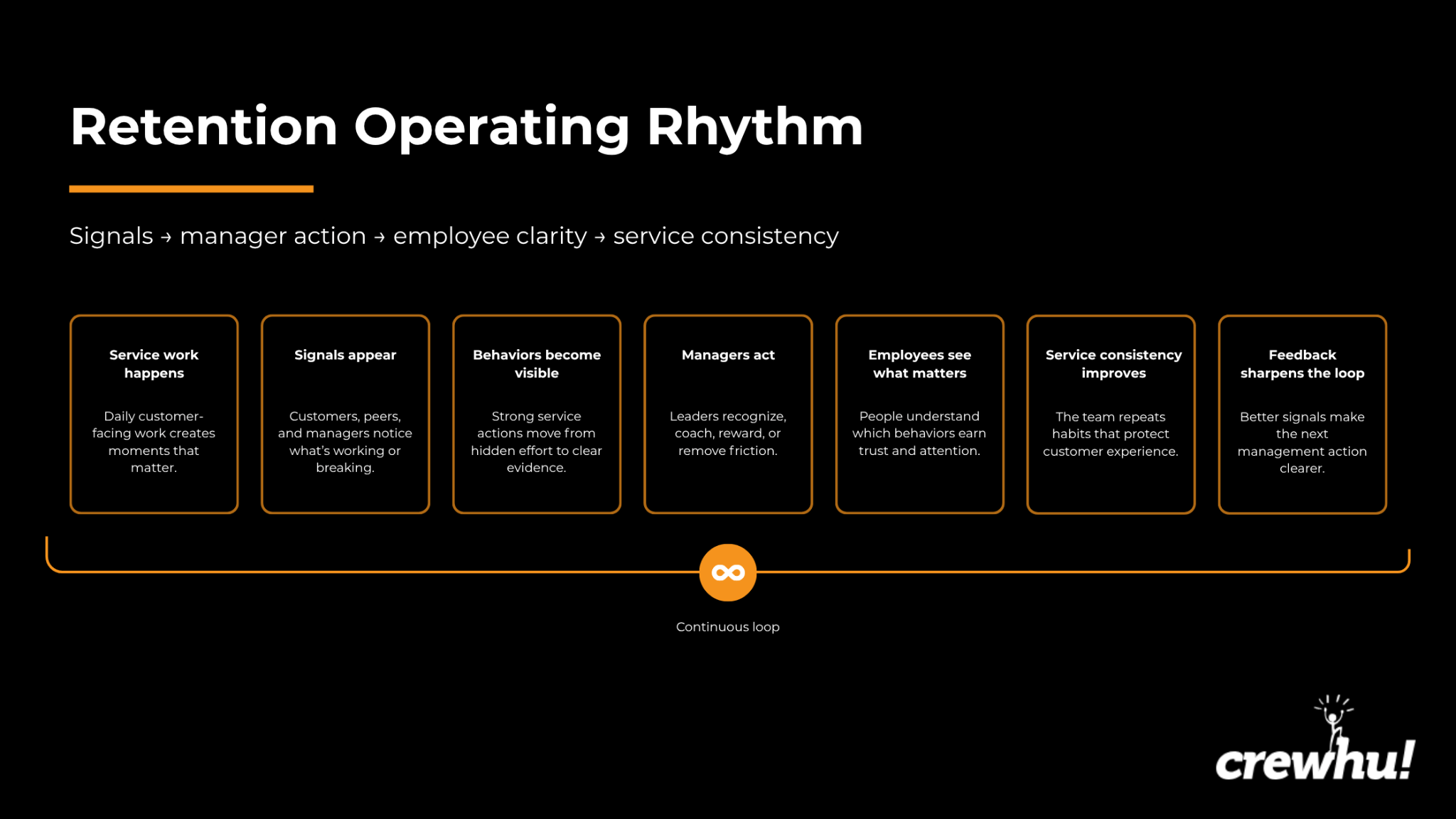
The strongest employee retention strategies create a loop:
- Service work produces signals.
- Managers act on those signals.
- Employees see what matters.
- The business reinforces the behaviors that protect customer experience.
Service teams already produce strong work every day, but positive feedback can stop at a score or remain buried in a dashboard. Connecting that feedback to the employee and service behavior behind it makes good service visible and easier to repeat.
Recommended Watch:
In this IT Business Podcast episode, host Uncle Marv talks with Crewhu CEO Stephen Spiegel about connecting customer feedback, employee recognition, and gamified metrics. They discuss how customer praise can become a visible signal for the team instead of ending as a survey result.
Turn positive customer feedback into recognition
If your service team is doing strong work, but those moments are scattered across tickets, customer comments, manager memory, and informal praise, Crewhu gives you a practical way to bring these signals into the spotlight. Book a demo to see how we unify customer feedback, team recognition, rewards, gamified metrics, and service quality into a strong operating rhythm.
Crewhu goes beyond CSAT by connecting positive customer feedback to the employee and the service behavior that earned it. Praise for clear communication, a smooth handoff, or thoughtful follow-through becomes visible to managers and the wider team.
That feedback can lead to timely recognition, points, or rewards. Specific customer comments show employees which actions earned attention, while the business reinforces those behaviors across the team. Customer praise becomes part of a feedback-to-recognition loop instead of ending as a score in a report.
Book a demo to see how Crewhu turns customer feedback into employee recognition.
FAQ
What are the most effective employee retention strategies?
The most effective employee retention strategies combine credible pay, useful benefits, growth opportunities, manager check-ins, workload control, flexibility, recognition, and feedback. For service businesses, the strongest strategies also protect customer continuity by keeping the people who understand customers, handoffs, service standards, and the daily behaviors that make work reliable.
How can small service businesses improve employee retention?
Small service businesses can improve their retention by analyzing the roles and service moments that are hardest to replace. Review pay, scheduling, workload, and advancement, then train managers to run better check-ins, recognize specific service behaviors, and act on feedback before resignation becomes the first clear warning.
How do managers affect employee retention?
Managers affect retention by shaping the employee’s daily work experience. They clarify expectations, notice workload strain, support development, recognize good work, and close the loop after feedback. A manager who asks specific questions and acts on recurring friction gives employees more reason to stay.
What role does recognition play in employee retention?
Recognition supports retention when it makes valuable work visible. In a service business, that means highlighting customer recovery, proactive communication, accurate documentation, clean handoffs, peer support, and follow-through. The best recognition is specific, timely, and connected to behaviors that the business wants to continue.
How should a business measure employee retention?
A business should measure retention with both lagging and early signals. Turnover rate matters, but leaders should also watch schedule strain, absenteeism, internal mobility, manager follow-up, training participation, customer feedback patterns, recognition quality, workload bottlenecks, and service recovery issues. Those indicators give early warnings about where retention risk is forming.