Key Takeaways
- Low employee productivity typically traces back to one of four root causes: unclear goals and priorities, poor management and communication, low recognition and engagement, or an inefficient work setting.
- More hours don't automatically mean more or better output. Past a certain point, fatigue and stress cause productivity to decline, making longer on-call rotations and after-hours shifts counterproductive.
- Productivity, performance, and busyness aren’t the same. Conflating the three leads to measuring (and rewarding) the wrong behaviors.
- Accurately assessing productivity requires role-specific metrics, not just hours worked or tickets closed, as well as OKRs that connect daily tasks to business outcomes and regular check-ins that explain the "why" behind dips that a dashboard or PSA report alone can't show.
- The right tools can remove friction, but they won't replace good management. PSA/RMM platforms, project management, async communication, automation, and AI tools each solve a specific bottleneck. But they only work on top of clear goals and consistent recognition.
People don't search "how to improve technician productivity" because they suspect their team is slacking off. They search it because something doesn’t add up. SLAs keep slipping, solid technicians seem worn down, and tickets stall in one status meeting after another.
The natural response would be to tighten the reins, add oversight, or ask for longer hours from employees. But those so-called “solutions” just end up making things worse. Improving employee productivity demands clearing away the ambiguity, friction, and exhaustion that erode output.
You need to pinpoint what actually drags productivity down, measure it reliably, and then introduce concrete, sustainable ways to boost productivity in the workplace.
Understanding Employee Productivity
Employee productivity is a ratio. It measures input (the time, resources, and effort that went into work) relative to the output (the results). Your goal should be to get more from your technicians, not just have them put in more hours or close more tickets at any cost.
Productivity is vastly different from performance and busyness. Someone can sit in meetings all day and answer every message the second it arrives but still have little to show for it. Or they can turn in excellent, high-quality work in a given week and still be labeled less "productive" based on the numbers if a task was unusually complex. Meanwhile, someone else could look highly productive by closing a stack of easy tickets that meets a quality bar.
“Busy” is just a relative state while performance folds in quality, judgment, and how well the work meets a standard (i.e., did the fix actually hold, or did the ticket get reopened?). Productivity looks more narrowly at output volume relative to input.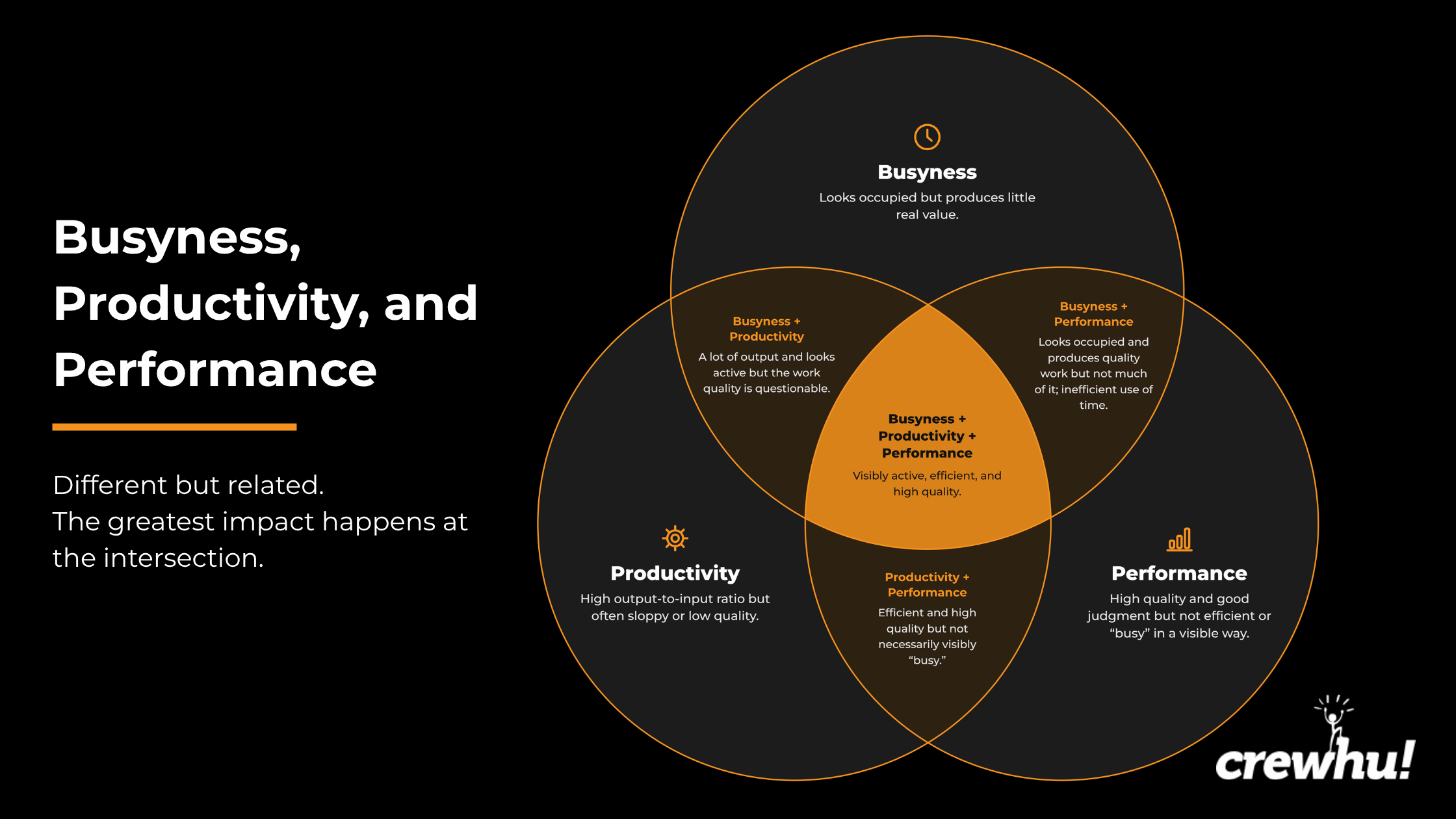
How to Measure Employee Productivity
You measure employee productivity by tracking relevant metrics such as tickets resolved per hour, average time per ticket, and other useful indicators of employee output. Vague impressions about who “seems” productive aren't a reliable basis for meaningful action. Take a more grounded approach to see what’s working and what needs tweaking.
Tie metrics to role-specific deliverables instead of only hours worked. This can be tickets closed at a quality standard, features shipped, or qualified pipeline generated. Productivity looks different between a help desk technician, a network engineer, and a technical account manager after all.
Metrics breakdown
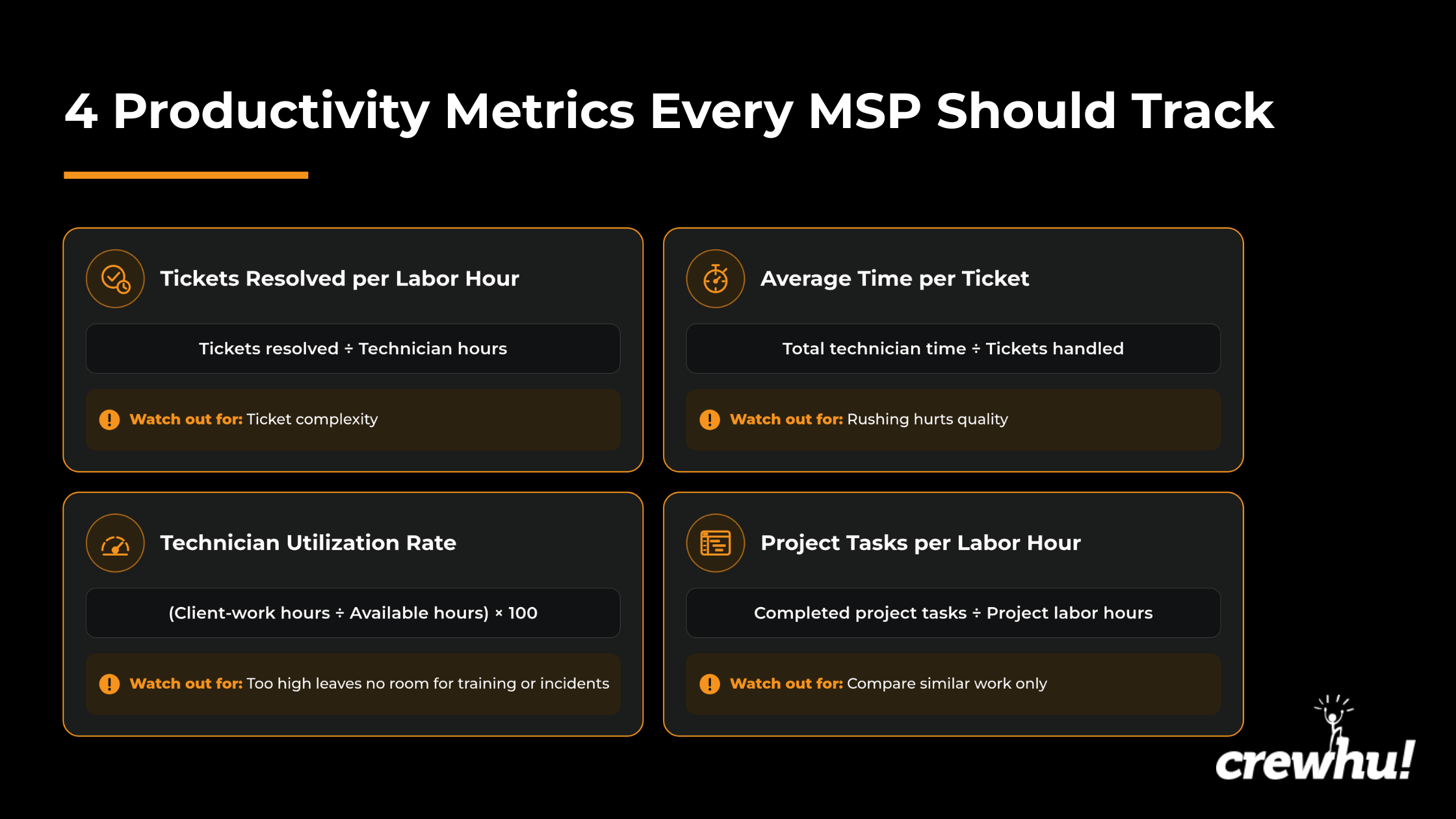
Below are some of the most commonly used metrics for gauging employee productivity:
- Tickets resolved per labor hour: This quantifies a tech’s service desk output relative to the time invested. MSPs can use it to track whether productivity is improving over time, although differences in ticket complexity need to be considered when comparing technicians.
- Average time per ticket: This measures the amount of time required to complete a work task. It approaches productivity through the lens of how much labor was required to produce each unit of output. Businesses can track it over time to identify whether better processes, documentation, training, or automation are reducing the effort required to handle similar work. A lower number isn't automatically better, though, since rushing tickets often sacrifices quality.
- Technician utilization rate: This monitors how much of a technician's available working time is spent on productive work. It reveals how effectively available labor capacity is being converted into client work, as well as identifies problems such as excessive administrative work, poor scheduling, or insufficient workload. Be aware though, that pushing utilization too high can leave little capacity for documentation, training, unexpected incidents, and breaks.
- Project tasks completed per labor hour: Here, you apply the same output-to-input principle to project and onboarding work instead of support tickets. Companies can use it to determine whether repeatable work (such as deployments, migrations, or onboarding tasks) is becoming more efficient over time. It’s best for comparing similar types of work since one project task can require considerably more effort than another.
Metrics shouldn’t be your only method of productivity tracking. Short pulse surveys and daily standups uncover problems that a dashboard alone will miss. For example, a report might show output dipping without explaining why. A quick check-in often reveals the real cause, whether that's a performance issue, an unclear priority, or mismanagement that broke down the pipeline somewhere.
Practical Ways to Improve Employee Productivity at Work
Before you implement changes to increase employee productivity, capture a baseline first. Pull your current SLA compliance, first-call resolution rate, and CSAT scores. That way, you can reliably measure and compare improvement using your chosen productivity metrics. A clear "before" picture is necessary to tell if a new tool, process, or policy moved anything, or whether the numbers would have shifted regardless.
Highlight the bigger picture
You can help motivate employees by showing them their work has a purpose. Connect individual goals to the greater organizational outcomes so they see what part they play and why their work matters. When someone can trace a ticket back to a company outcome, they’re less likely to treat it as an isolated number in the queue. Gallup also found that 50% of employees with a strong sense of work purpose are more engaged at work, compared to just 9% of those with a low sense of purpose.
Avoid unnecessary meetings
Everyone has sat through a meeting where they all thought the same thing: “This could’ve been an email.” Consider if a meeting genuinely needs to happen live or can be conveyed through some other format. For instance, you could shift routine status updates to emails or Slack messages. Other options include ticket notes, a shared group chat, or a daily recording.
Research by MIT Sloan Review found that cutting meetings by 40% drove a 71% increase in employee productivity. So, not every update requires calendar space. A concise summary protects focused time and leaves a searchable record behind.
Incorporate flexible work schedules
Giving people control over when they work boosts sustained focus and increases employee productivity by as much as 50%, according to research published in BJIR. When employees can schedule work during their sharpest hours instead of being forced into a rigid 9-to-5 or on-call rotation, companies often see higher output from the same amount of time spent. It’s okay to ask people to be available during certain hours and to respond to messages in a timely fashion. But don’t push traditional work schedules when it’s unnecessary.
While there’s no definitive answer on the number of hours your techs should work, Organization Science says most fall between 40 and 45 hours weekly. Their research suggests this range is optimal for long-term productivity, avoiding overwork, and maintaining client satisfaction. Data publishing in Occup Environ Med also found that working over 45 hours greatly increases irritability, anxiety, and depression, so keep schedules below that ceiling.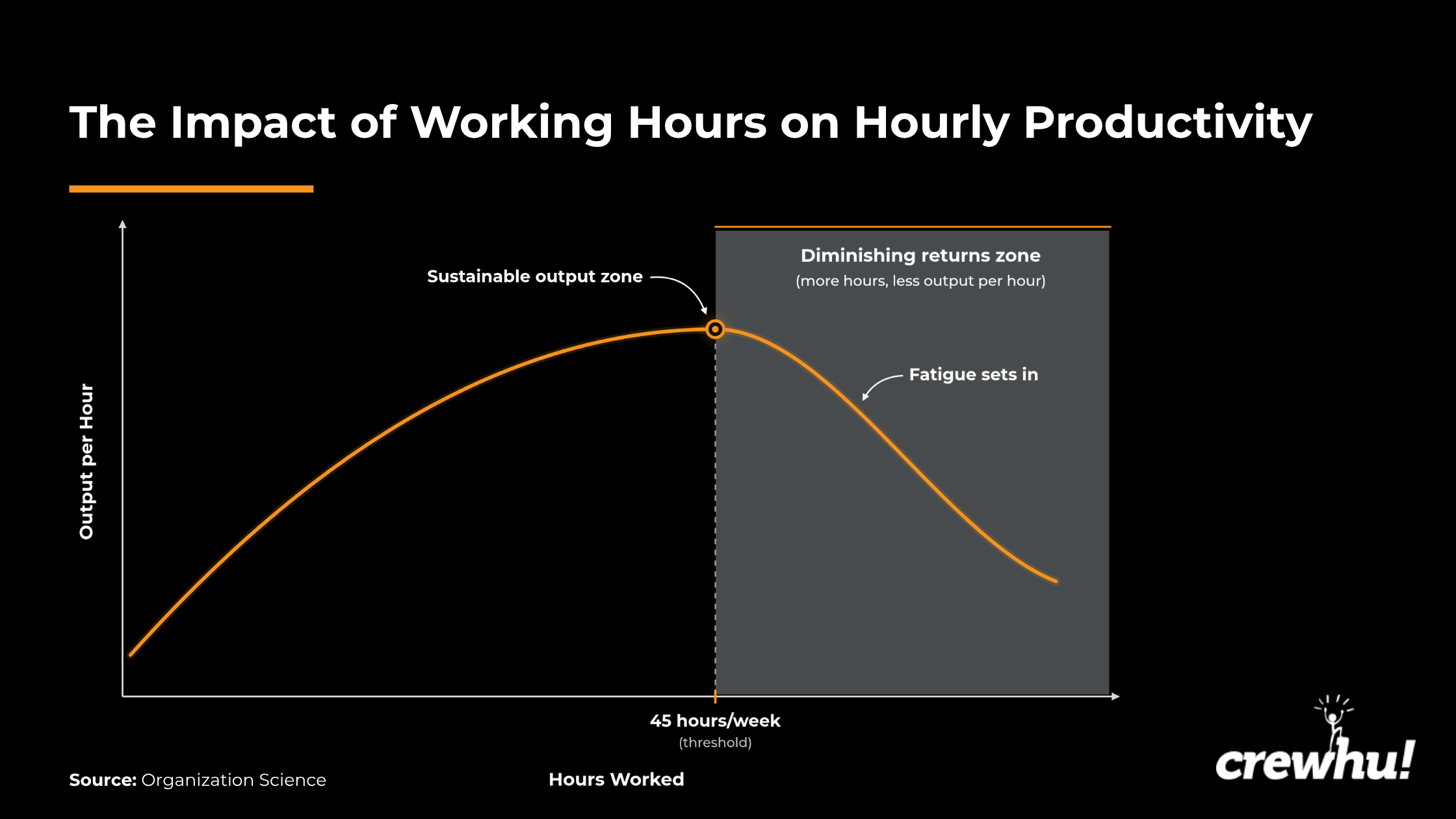
Invest in onboarding
Build a structured onboarding process so new hires can get up to speed faster and with less trial and error. It should include ramp-up time on your specific PSA/RMM stack and documentation standards. If left to figure things out alone or with minimal assistance, a new employee can take months longer to become fully operational than one given a clear path.
Assign responsibilities and centralize information
Clear role boundaries help a business run smoothly. The service desk owns first-line support, the NOC takes the lead on infrastructure monitoring, project engineers handle larger implementations like client onboarding and migrations, and field technicians cover work that requires an on-site presence.
When each team knows what it owns, escalations have a destination, accountability is traceable, and nobody wonders whether someone else is already handling the issue. In fact, data from Psychological Research (in the Balkans) showed that role clarity was a positive predictor of job performance among both employees and managers.
That doesn’t mean departments should become knowledge silos though. According to Stack Overflow, 30% of professional developers said knowledge silos disrupted their productivity at least 10 times per week. That translates to wasted time looking for data that should be easily available, and paying twice as much to solve one problem.
The fix isn't more meetings or constant cross-team chatter. You need to connect the work itself: Build a shared, searchable knowledge base, standardize ticket notes and documentation, make PSA and project information visible across functions, and define clear escalation paths and visible ownership.
Tools and Technology That Support Employee Productivity
No tool can substitute for experience and knowledge, but it can clear out a lot of the friction that stops a good process from working.
PSA/RMM and Project Management
PSA and RMM platforms, along with dedicated project management platforms, put task ownership, deadlines, and progress in one visible place. This eliminates information siloing. For example, an MSP rolling out a new client onboarding might use ConnectWise or Autotask to track the project alongside Trello or Asana for the onboarding checklist. With it, the engineer, account manager, and service desk lead each can see their own tasks on a shared timeline. Meanwhile, automated reminders nudge anyone whose task is approaching its due date.
Asynchronous Communication
Asynchronous-friendly communication tools cut down on interruptions and different schedules, letting people respond when they have time instead of breaking focus whenever a notification appears. For instance, an MSP running an overnight NOC or supporting clients 24/7 could use Slack or Microsoft Teams alongside a meeting recording tool like Fathom to capture key decisions and action items from important calls. This allows techs in other shifts to review AI-generated summaries and transcripts when their own focus blocks begin.
Repetitive Task Automation
Automating repetitive, low-value tasks frees up capacity for the work that actually requires attention. Frequent rules-based tasks, from client onboarding data entry to routine patch approvals, are excellent candidates for automation. An MSP’s finance or operations team might use Zapier or Workato to automatically pull invoice data from emails into a Google Sheet, then route it to the right manager for approval. That turns a 20-minute-per-invoice chore into a hands-off workflow that only flags exceptions.
AI Tools
AI-driven knowledge tools cut down on the time technicians spend hunting for internal information, which is often a bigger, quieter drain on the workday than it appears. Consider an engineer who needs a client's network diagram or past incident history mid-ticket. Instead of digging through SharePoint and old email threads, they ask a tool like Microsoft Copilot or Glean. The question gets an answer pulled in seconds, shaving several minutes off every ticket and keeping SLAs intact.
Productivity Isn’t All About the Numbers
Improving technician productivity doesn’t come from pushing people harder. The real gains come from clearing away ambiguous roles and responsibilities, procedural friction, and workload exhaustion. Visible priorities and clear ownership give work direction, while shared knowledge stops teams from solving the same problem twice. Protected focus time and a sustainable workweek also keep people sharp. Measure output against input, with reopen rates and CSAT as quality checks, to pinpoint whether the gains are real or just faster ticket-closing. Tools help ease the burden, but only when the process underneath them is sound.
People sustain good work when they see it get noticed. As a company grows, client praise, ticket data, and performance metrics tend to end up in separate systems, and recognition depends on a manager remembering. Crewhu can help close that gap by automatically turning client feedback and KPIs into recognition that keeps your workers happy and motivated. Book a demo with Crewhu today and see how automated recognition can drive greater employee productivity.
Frequently Asked Questions About Employee Productivity
How do you improve employee productivity?
Remove unclear goals, weak management habits, low engagement, and clunky processes. Other useful steps include tying individual work to company goals, trimming unnecessary meetings, and giving people the right tools. It’s also important to guard against chronic overworking and reinforce good behavior through steady feedback and recognition. Real, lasting gains come from improving the workplace overall.
How is productivity defined in the workplace?
Workplace productivity is the ratio between what gets produced and the time, resources, and effort spent producing it. It's not the same as performance, which also factors in quality, or busyness, which measures activity rather than results. A useful definition ties productivity to measurable outcomes for a given role, not general effort or hours logged.
What is the 3-3-3 rule for productivity?
The 3-3-3 rule is a personal time-management approach: Spend three hours on the single most important, focus-heavy task of the day, follow it with three hours on smaller but still necessary work, then wrap up with three tasks related to home, health, or life outside of work. It structures the day around one clear priority instead of letting it fill up reactively with whatever demands attention first.
What are the five Ds of productivity?
The five Ds are a way of sorting incoming tasks:
- Do it (if it's quick and important)
- Delegate it (if someone else is better suited)
- Defer it (if it isn't urgent yet)
- Delete it (if it isn't necessary at all)
- Diarize it (schedule it for a specific time later).
How does employee engagement impact productivity?
Highly engaged teams outperform disengaged ones. Disengaged employees tend to do just enough to get by, while engaged employees go further. They take initiative, follow through, and put in extra care without being asked, which improves both the quality and the amount of work they produce.