Key Takeaways
- A customer feedback loop collects customer input, learns what it means, then acts on it and follows up.
- If a customer leaves a low score or complaint, someone needs to see it, contact the customer, and sort out what went wrong.
- Praise needs somewhere to go too. Make sure it reaches the employee or team who earned it so good service gets recognized, rewarded, and repeated.
- If the same complaint keeps coming back, fix the process, training, handoff, or service standard behind it.
- A good experience can keep working after the job is done. Reviews, testimonials, and referrals give future customers something real to judge the business on.
What is a customer feedback loop?
A customer feedback loop is the process of collecting customer input, understanding what it means, acting on it, and following up with the customer or team so they can see what changed.
In a service business, feedback is easier to act on when it stays tied to the work that produced it. The team should be able to connect a score or comment to the actual ticket, visit, repair, or project handoff.
You should also be able to see what the feedback changed. Maybe the next handoff goes more smoothly, the same mistake stops reappearing, or an employee gets recognized for something customers consistently value. That’s how feedback shapes the next customer experience.
How a customer feedback loop works in a service business
The loop follows the work. A job or ticket closes, the customer tells you how it went, and the response points to what should happen next. A low score may need a call back, a return visit, or a manager stepping in. When a customer spotlights great work, that praise should reach the person who earned it. Or, if the same complaint keeps popping up, fix the process behind it.
A score alone won’t tell you whether the problem was a late arrival, a confusing handoff, a repair that didn’t hold, or poor communication. Whoever follows up needs enough context to understand what happened and the ability to do something about it.
Good feedback should travel too. When a customer praises a technician or team member, recognize the specific action or behavior they did well and reward them according to your program. That gives your workforce a concrete example to repeat going forward. 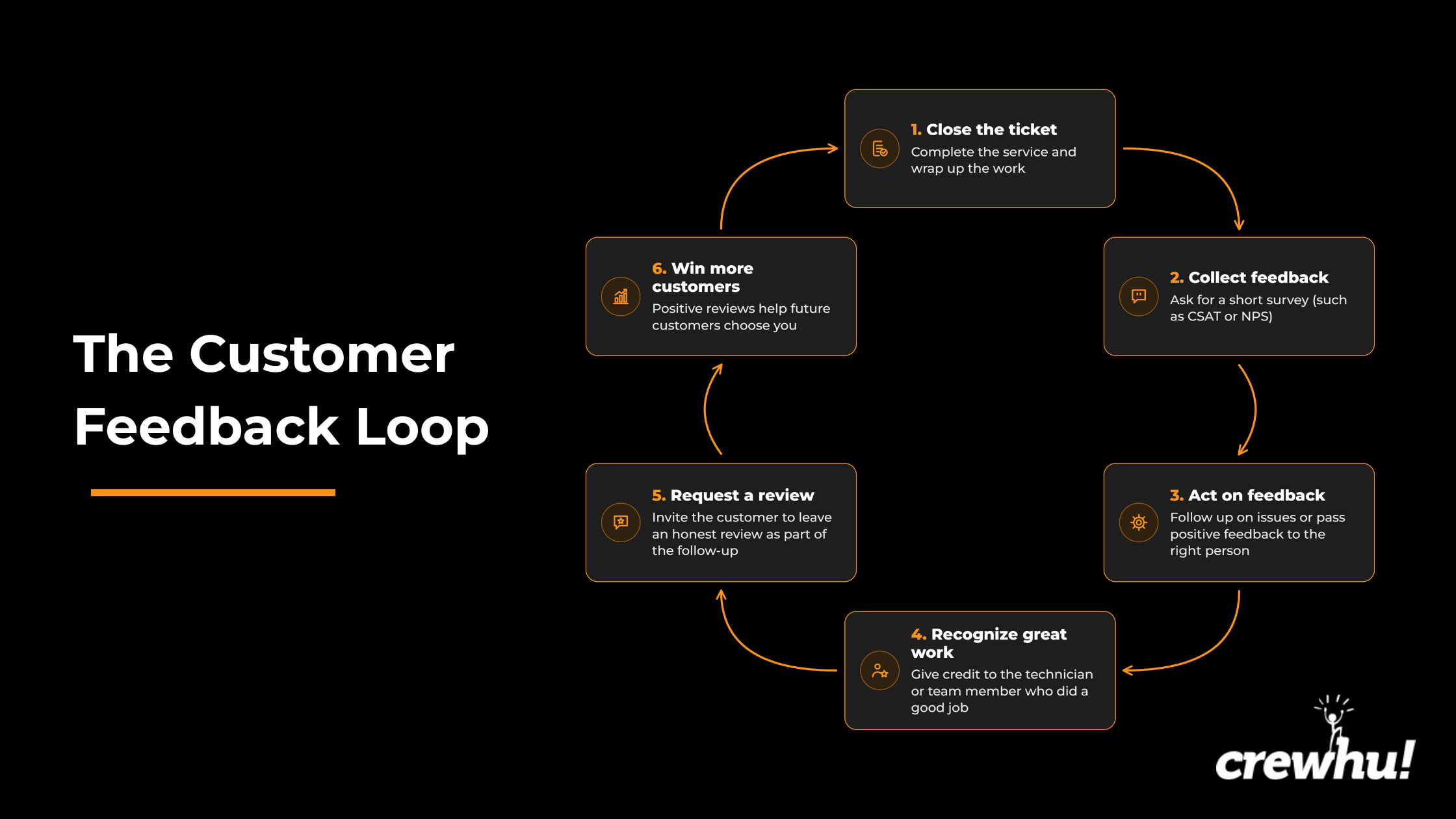
How to close the loop on negative feedback
When a customer leaves a low score or complaint, make sure it goes to someone who can address the problem. Then figure out the root cause of what went wrong before jumping to a fix:
- Get the full story: A low score can’t tell you everything. Get to the heart of what happened and when, who was involved, what the customer expected, and what went wrong from their point of view.
Say a customer describes an electrician as “unhelpful.” Maybe the technician showed up late, buried the customer in jargon, left a safety concern unexplained, didn’t clean up, or walked away without making it clear whether the repair was finished. You can’t fix the issue until you know what you’re dealing with.
- Tackle the actual problem: This might mean correcting the work, clearing up a misunderstanding, sending someone back out, or getting a manager involved. The response should fit what happened.
- Keep the customer in the loop: Tell them what you found, what you can do, and what happens next. An internal task marked “done” doesn’t mean much if the customer is still wondering what the solution was.
- Watch for repeats: One complaint can be a one-time fluke. The same complaint showing up again and again is a sign to look at the process, training, handoff, or service standard behind it.
Recommended Listen:
In Episode 258 of “The Customer Service Revolution” podcast, John DiJulius and Denise Thompson look at where automation and self-service help and where a service interaction still needs human judgment. Software can surface a complaint and move it to the right place quickly, but someone still has to understand the situation, talk to the customer, and decide what to do.
How to close the loop on positive feedback
Customer praise tells you what people notice when the service goes well. Maybe an electrician took the time to explain a safety issue, an auto shop kept the customer updated without being chased, or a support technician stayed calm and followed through. Pass that praise to the people who did the work while the details are still fresh.
Recognize the behavior customers noticed
Good recognition is specific. “Great job,” doesn’t tell an employee much. “The customer noticed how clearly you explained the issue before starting the repair,” pinpoints exactly what the customer valued.
Positive feedback can be applied in several ways:
- Share the comment with the employee or team.
- Recognize the behavior publicly when appropriate.
- Use the example in coaching or training.
- Identify behaviors worth adopting as service standards.
- Look for patterns in what customers praise most.
Make good work easy to spot and repeat. If customers consistently praise clear explanations, fast updates, or careful follow-through, the team has a pretty good idea of what to keep doing. And when feedback normally shows up only when something goes wrong, sharing the good stuff matters even more.
Let good service build trust
A good experience doesn’t have to end when the job does. Reviews, testimonials, and referrals let customers share that experience with people who are still deciding who to hire.
That matters for service businesses, because customers often have to commit to a service before they can judge the work for themselves. A homeowner can’t know how an electrician will handle a tricky repair until they’re in the house. Likewise, a new MSP client can’t see months of communication and follow-through before signing the contract. Real customer experiences help fill in some of that blank space.
If you ask for reviews, invite customers to share an honest experience without incentives, pressure, or filtering the request based on a private score. A review request can be part of the follow-up, but a high survey rating shouldn’t be the ticket that unlocks it.
When customers choose to share a good experience, that story helps guide the next customer through the door. That then creates another job, ticket, or service interaction where the loop starts again.
How to tell if the feedback loop is working
Use the score as a starting point. CSAT is useful after a specific job or interaction, while NPS gives you a broader read on the customer relationship. CES shows how hard the customer had to work to get something done.
Then look at what happened after the feedback came in. Did somebody contact the customer? Did the problem get fixed? Did the same complaint come back? Did praise reach the employee who earned it? Those are the signs that feedback is moving through the business.
|
Feedback signal |
What it may be telling you |
What to do next |
|
Low CSAT after a service visit |
Something in that interaction needs attention |
Contact the customer, understand what happened, and fix the issue or explain what happens next |
|
NPS detractor |
There may be a broader account or relationship problem |
Look at the account history and follow up with the customer |
|
High-effort interaction |
The customer had to work too hard to get something done |
Find the step causing the friction and simplify the process or communication |
|
Negative public review |
A customer is unhappy, and the experience is now visible to others |
Respond, investigate what happened, and address the issue where possible |
|
Repeated complaint |
The same problem may be coming from the process, training, handoff, or expectations |
Fix what’s causing the pattern and watch to see if it comes back |
|
Customer praise |
The customer noticed something worth repeating |
Share the feedback, recognize the employee or team, and use the example to reinforce good service |
You don’t need a dashboard full of new KPIs to pinpoint where the loop is getting stuck. A few practical checks will hone in on the culprit:
- How long does it take to respond when feedback needs attention?
- How often does the customer hear what happened after raising an issue?
- Which complaints keep coming back after you thought they were fixed?
- Are promised changes to training, process, or communication actually carried out?
- How often does customer praise reach the employee or team who earned it?
Start with your own baseline and set response expectations that make sense for the type of service you provide and the seriousness of the issue.
How software keeps the feedback loop moving
A spreadsheet can do the job when feedback volume is low. But once surveys, reviews, tickets, calls, field visits, and account check-ins start piling up, things get messy fast.
That’s when software steps in to connect feedback to the customer and the service that led to it. A manager should be able to gauge what happened, who was involved, whether the issue needs attention, and if anyone followed up without playing detective across five different systems.
Speed’s also crucial. A low score should trigger an alert instead of sitting in a weekly report. Praise should reach the team while everyone still remembers the job. Repeated complaints can be tagged so a pattern shows up before it becomes business as usual.
If you’re comparing customer feedback software, don’t stop at collection. Judge the system by what your team can do after the customer hits Submit.
How Crewhu connects feedback to what happens next
Crewhu’s customer feedback tools can collect transactional CSAT or relationship NPS through PSA, ticketing, and email workflows. Real-time notifications help the right people see feedback quickly, while dashboards and reporting make it easier to see which customer, employee, and service interaction the feedback came from.
Then the feedback can go somewhere useful. If a customer flags a problem, the team has the context to follow up. If someone praises an employee, that feedback can feed recognition, rewards, and gamified metrics that make strong performance visible and worth repeating.
Succurri used Crewhu to put positive customer feedback in front of both employees and leadership. Managing partner Andrew Eckstrom described it as a “closed loop of communication and validation.” Instead of good feedback disappearing into a survey report, the people doing the work could actually see it.
Crewhu also connects customer feedback with online reputation tools so review requests can be part of the same follow-up. The feedback can still inform recognition and service improvement inside the business while boosting your external image.
Make the next customer interaction your best yet
A feedback loop needs to leverage customer feedback to improve processes and behaviors. Maybe a manager catches a service issue before it repeats, or a technician gets recognized for the way they explained a repair. A messy handoff might get cleaned up because customers kept tripping over the same communication gap.
Hear it, act on it, and carry the lesson forward. Keep the path short enough that feedback doesn’t die in a dashboard.
Crewhu helps service businesses link customer feedback to follow-up, recognition, rewards, review requests, and the next service interaction. If you want to see how that can work with your team, book a Crewhu demo.