Key takeaways
- Employees leave for predictable reasons like inadequate pay and poor management. Stalled growth, feeling unrecognized, and burnout from poor work-life balance are other major culprits.
- Pay and visible growth paths are foundational to employee retention. No cultural initiative can offset pay that’s not competitive. It’s equally important to document career ladders, internal hiring priorities, and mentorships so employees can picture a real future at the company.
- Management quality is one of the biggest retention levers; people quit managers, not companies. Ongoing training, regular stay interviews before problems escalate, and holding managers accountable for retention all matter more than any company-wide policy.
- Retention works as a system, not a single fix. Compensation, growth, management, culture, and flexibility must reinforce each other. Genuine recognition and well-being programs build lasting loyalty, and tools like Crewhu support those initiatives by making good work visible in real time.
Employee turnover is more expensive than it seems on the surface. Replacing an employee costs more than just their annual salary once hidden costs like lost productivity and training time are totaled. While senior staff have to handle vacant roles, the remaining employees face being overworked and burned out. Whether it’s a small startup with big dreams or a conglomerate spanning time zones, keeping staff happy and loyal is a major factor that affects organizational outcomes.
When you replace personnel, everyone has to relearn how to function together every few months. There are also financial and performance tolls each departure takes. These cut deeper for service businesses since a technician who leaves doesn't just vacate a seat; they take undocumented knowledge of client environments, workarounds, and vendor quirks with them. Their experience is expensive and slow to rebuild. That’s why it’s smarter, cheaper, and more effective to improve employee retention and keep your people happy.
The Value of Effective Employee Retention
It's tempting to view employee departures as isolated events. Someone got a better offer, moved, or just wasn't a good fit. But zoom out, and you’ll notice a pattern. People rarely leave for random reasons; it’s more often the fault of organizational issues. The cumulative cost of losing people gets expensive fast, so you need to do some introspection to save your team and your budget.
What Employee Turnover Actually Costs a Business
The price of losing an employee is almost never just "hire someone new and move on." Headhunting firms typically charge 15%–35% of an employee's first-year salary just to source and place a replacement, according to LegalClarity. If that were the whole bill, most MSPs could absorb it without much pain, especially for entry-level roles. But the final number lands much higher, with Sales Sherpa placing it as high as 150%–200% for MSPs.
The gap between the recruiting fee and the real total is made up almost entirely of hidden costs. Those hidden costs cluster around three things: the senior technician's time, the productivity gap while the new hire ramps up, and the strain that both of those put on everyone else.
Senior technician time spent onboarding
A new tech isn’t ready to go with just a laptop and login credentials. They need a senior person walking them through client environments, tools, and edge cases that live nowhere in the documentation. RewiredMSP estimates new technicians should shadow an experienced technician for their first two weeks, followed by ongoing check-ins and reviews well beyond that.
That's two-plus weeks where a senior engineer (often your most billable, client-trusted person) is doing less of their own work to coach a newbie. Multiply that by the fact that full ramp-up takes about 90 days, and you have a senior employee operating at partial capacity for an entire quarter.
Lost productivity during ramp-up
Even with a great mentor, a new technician can't do the job at full speed on day one. You should expect them to be less productive in the first couple of months as they get a hang of things. That doesn't just mean a bit slower on ticket resolution though; tickets that would've taken 15 minutes for the departed tech now take an hour, routine escalations require a senior's intervention, and client-facing response times will slip.
This isn’t something your onboarding process or the relative knowledge of your new employee can make up for. The departing technician takes with them the "tribal knowledge" of individual client environments, including the quirks, workarounds, and history that never made it into a ticketing system. When that’s gone, new technicians don’t have any documentation to close that knowledge gap.
The burnout and turnover contagion
While the new hire ramps up and the senior technician is half-occupied mentoring them, someone has to cover the work both of them are neglecting. That falls on the rest of the team in the form of overtime, a heavier ticket load, and the stress of picking up slack that isn't technically theirs. This slowly but surely causes burnout. Watch for its early signs, namely, a noticeable drop in productivity, increased escalation of resolvable tickets, and slipping documentation quality.
Burnout can easily turn one departure into two or three, as the growing discontent among the remaining employees can trigger a “turnover contagion.” In fact, Visier discovered that, when a team member sees an employee leave, they’re about 9% more likely to resign in the next 135 days than someone who wasn’t a team member. That chance is higher if the team is smaller, with a 6-10 person team seeing a likelihood of almost 15%.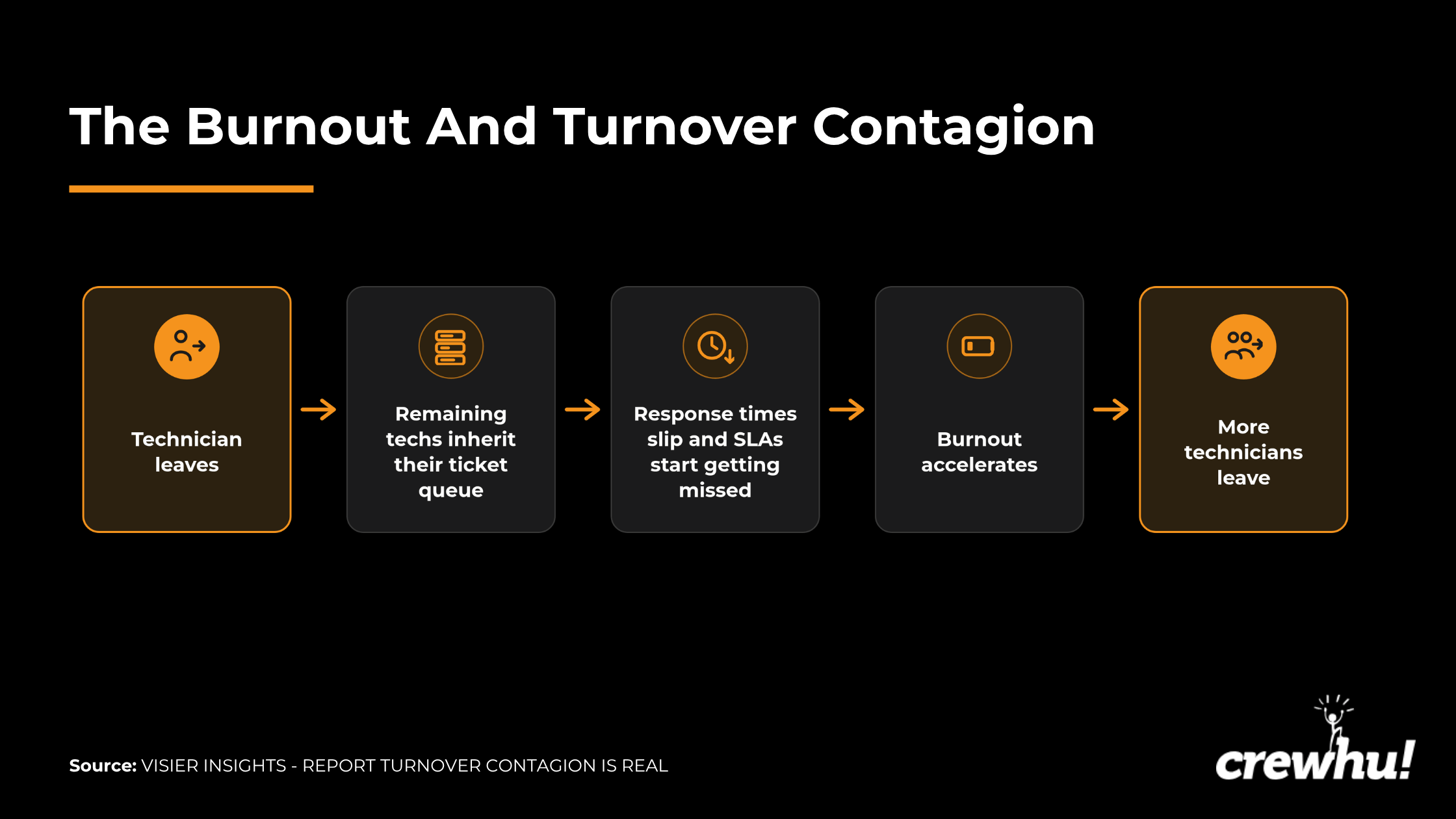
Why Employees Leave Companies
Motivating your employees to stay starts by understanding why they want to leave in the first place. The most common problems you’re likely to face, according to the Work Institute Retention Report, are:
- Stalled career - 18.9%
- Health and family - 12.4%
- Work-life balance - 11.9%
- Bad management - 9.7%
- Pay - 8.2%
Some are frustrated because they feel they’ve hit a dead end with their career, while others struggle to find a good work-life balance and feel burned out. Some simply have personal reasons that you can’t change or improve upon.
Outlining these reasons helps you determine what changes you need to make and how to address the issues at hand.
Stalled career
Service business technical tracks often plateau at senior technician. If there’s no visible path toward higher roles like architect, cybersecurity specialist, or account management, ambitious techs will leave to find that next move elsewhere. If they can't picture a better version of this job in two years, they have no reason to stick with you.
A similar issue is feeling invisible, which is a particular risk among MSP help desks. A technician's best work often goes unseen by leadership. A fast, calm resolution to a nightmare ticket might have the client’s silent appreciation, but it needs to be recognized internally to show the company cares.
Health and family
Personal circumstances often push people out the door for reasons that have nothing to do with the job itself. A chronic health condition, a new caregiving responsibility for a family member, or a major life shift like divorce or relocation can suddenly make an otherwise good job untenable. MSP technicians on rigid shift schedules or on-call rotations can be hit especially hard if there's little room to adjust hours around a doctor's appointment or a sick family member. Without flexibility to accommodate these moments, even loyal, high-performing employees will be left with no option but to leave.
Work-life balance
Burnout and work-life imbalance are major deciding factors for departure. Remote work has blurred the boundaries and altered expectations about staying available after hours, and not necessarily for the better. For instance, research from Kaseya shows that 59% of MSP workers had to work holidays or weekends and 39% worked consecutive 50+ hour weeks. Forget “balance”; workers are struggling just to make their hours sustainable.
Bad management
Bad management is a top reason why techs quit. Vague expectations frustrate people, No recognition wears them down, and Favoritism and micromanagement kill trust and autonomy. MSP work already entails ticket overload and after-hours calls; add in a manager who doesn't coach or listen, and burnout quickly turns into resignation. Skilled techs have options, so they won't stick around for bad management.
Insufficient pay
Job hopping has become a less effective strategy for finding a good salary, but it’s still an issue. Even employees who like their manager and coworkers will leave if they believe they can earn noticeably more at a different job. You can’t afford to overlook annual salary increases or the current market wage.
The Steps to Improve Employee Retention
Understanding the costs and causes is half the battle. The harder but more valuable work is designing a strategy that addresses those root issues. An occasional team-building exercise or last-minute counteroffer only puts a band-aid on a larger wound. Genuine change lies in how you treat your workers. From transparent advancements and pay to better work-life balance, the following strategies will help boost your employee retention.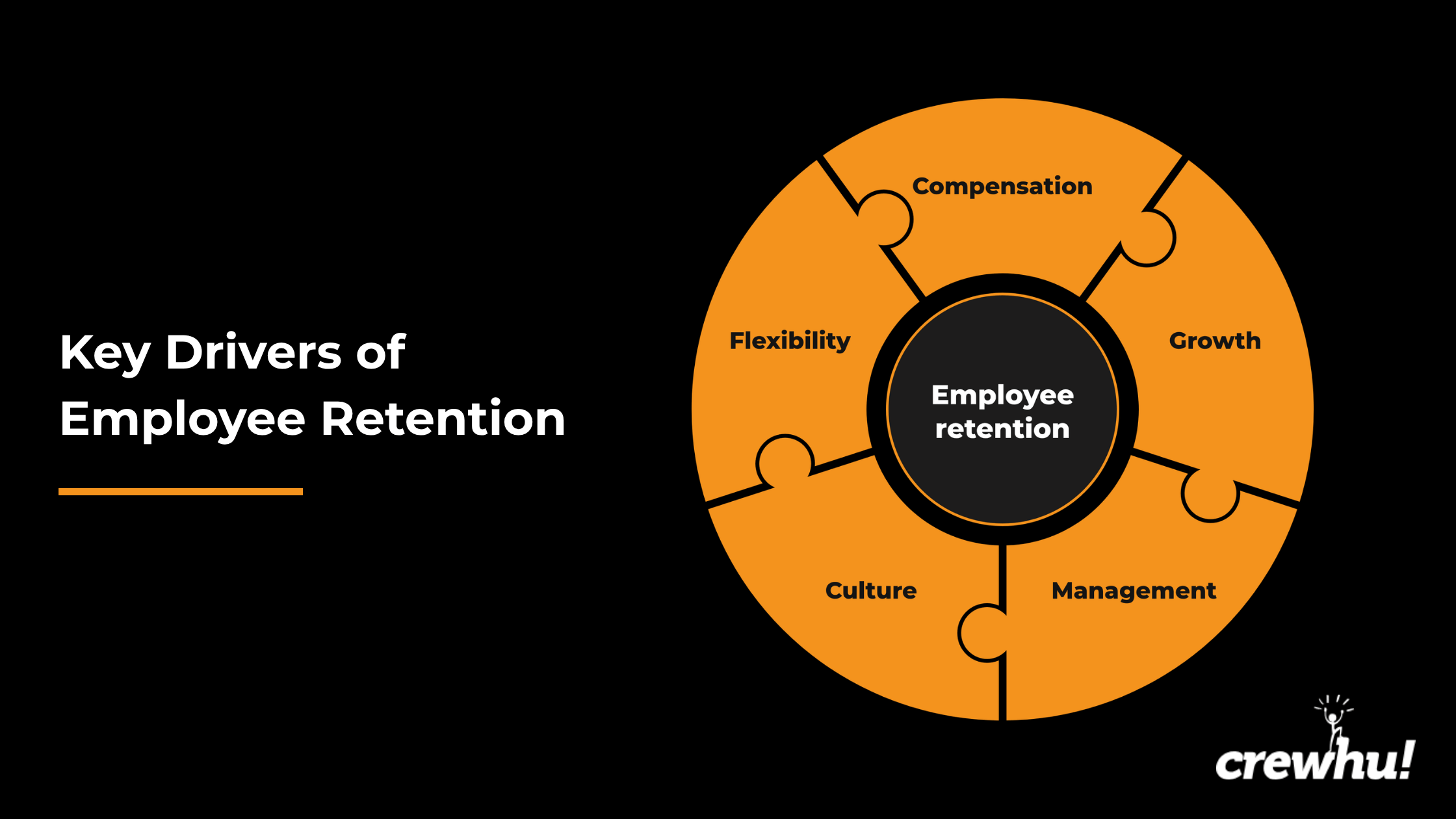
Make Growth Visible and Attainable
Build career ladders that are documented and visible, rather than something that only lives in a manager's head. If an employee can't see what skills or milestones lead to advancement, that path might as well not exist from their perspective.
A documented path might look like:
Tier 1 Support → Tier 2/System Admin → Tier 3/Senior System Engineer → NOC lead or Cybersecurity specialist → Solutions architect or Account manager.
At a well-run MSP, this path lives in several places. It should be:
- Situated in the employee handbook as a real, permanent map, not buried in a policy binder.
- Introduced during onboarding so people understand the trajectory from day one rather than years in.
- Come up in one-on-ones and performance reviews, where a manager can point to it directly instead of leaving progress vague.
- Accessible anytime through the HR or employee portal so people don't have to wait for a meeting to check where they stand.
- Reflected in job descriptions so the distinctions between levels are clear, and promotions feel like a natural next step rather than an arbitrary call.
The real test is whether an employee can answer three questions: Where am I now? Where can I go next? What exactly do I need to do to get there? These give employees a sense of control over their careers.
Hire internally
Few things undercut a stated commitment to "growing as a team" faster than repeatedly bringing in outsiders for jobs your own people wanted. Consider internal candidates for open roles before turning to outside hires. Network LTD learned this firsthand: Hiring internally through apprenticeships saved 375 hours of senior leadership time and achieved a four-year average tenure with their business.
There’s also the financial aspect, as promoting and reskilling existing technicians tends to be considerably cheaper. The Financial Services Skills Commission estimates that reskilling an existing employee to fill a role rather than hiring new can save up to about $65,000 per worker. Reskilling avoids expenses like recruitment, onboarding, and lost productivity while retaining institutional knowledge.
Mentorship programs
Mentorship programs are a worthwhile investment. Beyond skill-building, the relationship itself can become one of the strongest emotional ties an employee has to the organization. Research from Gallup even found that employees with a mentor are “twice as likely to be engaged” and have a 98% greater likelihood of recommending their organization as a great place to work.
In MSPs, this mentorship doesn’t have to be explicit though. Research from the European Journal of Training and Development suggests that adding light structure (e.g., job aids, quick-reference guides, periodic knowledge-sharing sessions) prevents silos and inconsistency, without over-formalizing what worked organically.
Treat Well-Being as Core Infrastructure
Employee well-being should never be an afterthought for you to handle once problems start to crop up. Even basic physical activity-focused healthcare programs can yield positive ROI. For example, data published in the Journal of Occupational Health followed a program that cost about $409 per employee and ended up generating average savings of over $1,200 in 12 months. When you truly go the extra mile and put yourself in employees' shoes, you make their lives and yours easier.
Flexible work arrangements
Work flexibility used to be a bonus perk, but since the COVID-19 pandemic, it's become table stakes for retaining people in the modern labor market. In fact, when asked why they introduced flexibility, 64% of organizations said it was because they needed to retain high-performing workers. That’s up from 29% in 2017, according to the Foundation of Employee Benefit Plans.
Autonomy over whether one works from home or the office can be a critical factor for employees. Insisting on a purely in-office model risks losing valuable talent who prefer or need a remote or a hybrid model. Meanwhile, one study from Nature found that introducing a hybrid work model (three days in the office and two days from home) saw a 33% reduction in employee attrition. Rather than losing productivity, you’re more likely to see a rise in it.
Managing technician workload
Due to the nature of the work and a relatively high number and complexity of tools they need to use simultaneously, 60% of MSP professionals experience moderate to high levels of burnout, as reported by Drake Star. That’s why it’s critical to actively monitor and limit the amount of work your employees have to tackle. Using reliable data like technician utilization rate is a key metric for that. Its formula is:
Technician utilization rate = (Billable hours ÷ Available working hours) × 100
Suppose an MSP technician works a normal 40-hour week and has 26 hours logged as billable client work. That would put them at (26 / 40) x 100 = 65% utilization.
BMK Community research suggests a 70%–80% tech utilization rate is the target for sustainable high performance. It’s the sweet spot for balancing productivity and client service. You can go over 85%, but then you’re entering burnout territory. Employee bandwidth starts to get limited, which is linked to reduced employee satisfaction and increased risk of burnout and churn. If the workload does periodically increase, make sure it’s fairly distributed.
Show, don’t tell
Leadership behavior sets the tone for everyone else below them. A manager who never uses their own vacation time silently teaches their team that taking time off isn't okay. LiveCareer even discovered that if workers don’t see their managers taking time off, they’re 20% less likely to do so themselves. Meanwhile, 59% feel afraid and guilty to use their PTO time in general due to “work piling up, missing out on opportunities, and being perceived as less committed.” So, unless employees see their superior taking care of themselves, they’re unlikely to follow suit.
This can be frustrating for companies that invest heavily in well-being programs. But even a top-notch program won’t do much good if people are uncomfortable or even afraid to use it. A mental health stipend nobody touches or a wellness app nobody opens won’t move the needle. It's just a line item that looks good in a benefits deck. Track real engagement to see if your investment is actually yielding results. Mental health support, including low-friction access to counseling, measurably cuts down on burnout-driven departures.
Build a Culture People Don't Want to Leave
How people treat their colleagues, work, and well-being is all part of company culture. The goal is to build and maintain respect, recognition, and camaraderie in the workplace. Company culture and recognition work together to create an environment that employees want to stay in for years.
Giving praise for good work
Say a technician calmly walked a panicked client through a ransomware incident or caught a recurring issue before it became a bigger outage. Supporting them with generic praise like a quick "nice job" email is forgotten almost immediately. But specific recognition tied to a clear behavior does far more. A timely, well-thought-out thank-you followed by customer praise, a peer shoutout, extra flexibility, or development opportunity can be meaningful when it fits the contribution. Fit the reward to the work result and the effort the employee put in.
These moments are rarely seen unless something actively surfaces them, which is why a lot of MSPs start tying customer feedback (e.g., CSAT/NPS from closed tickets) directly back to the technician who earned it. A large part of that process can be automated with platforms like Crewhu, but employees also need to feel valued and appreciated on a human level.
Constructive feedback for mistakes
If someone does a poor job, rather than scolding or punishing them, aim to motivate their improvement. Simply saying you’ll penalize those who make mistakes can do more harm than good: Over time, the employee just downgrades to doing the bare minimum to avoid errors while quietly job hunting. Instead, you need to have a system that effectively recognizes employee mistakes and a thoughtful approach to address them.
One method is to turn them into coachable moments by leveraging AI tools. For example, Valeo Networks, an MSP handling over 1,000 tickets weekly, previously reviewed only around 10% of their tickets. This limited their opportunities for timely coaching, since they could only pick a handful. To solve this, they introduced a process for evaluating tickets against standards such as client communication, documentation, and handling repeat issues. Findings were then discussed with technicians during weekly meetings, focusing on specific weaknesses and examples, and technicians could challenge the findings and provide context. As a result, ticket coverage jumped to 100%. MSPs can adopt the same concept: Verify negative feedback against the ticket, discuss specific problems privately, agree on improvements, and monitor recurring issues over time. Constructive criticism yields much better results than just, “Do better.”
Workplace conflict
How you handle employee concerns is critical. If an employee has a problem with their immediate superior, for example, can they talk to someone about it without fear of retaliation? When people feel safe raising issues without fear, they’re more open to working through the friction instead of quietly disengaging and eventually leaving.
Psychological safety plays a bigger role in retention than most leadership teams realize. In fact, the American Psychological Association found that 41% of workers with lower psychological safety intended to look for another job within the next year. That’s more than double the 19% of workers searching who had a higher psychological safety.
Workplace conflict should be addressed early on, privately, and objectively before it escalates. Give each party involved space to explain their concerns without making assumptions. Managers should listen to both sides, remain impartial, and identify the underlying cause of the disagreement. Once the situation is made clear, bring the employees together when appropriate and facilitate a constructive, problem-solving conversation focused on common ground and practical changes.
If the issue involves serious misconduct, discrimination, or harassment, informal resolution may be inappropriate, and the organization's formal procedures should be followed instead.
Shared experiences
Investing in shared experiences outside pure office work, like team events and informal traditions, can be surprisingly effective. The informal environment fosters genuine socialization and helps turn coworkers into bonded team members.
That’s important since lonely workers in less social workplaces will often move on. According to Compass Group, 46% say they’re likely to leave their job due to feeling lonely, and that figure increases to 54% among Gen Z workers specifically.
To encourage camaraderie, consider organizing a monthly “Team Day” that combines learning with informal socializing. Techs, engineers, account managers, and other employees can share an interesting fix, lesson, or recent project, followed by games or another group activity. Introduce gamification elements like score boards or team competitions to naturally connect informal discussions and work-related situations.
Fix Management Before People Leave
MSPs shouldn't assume that technical expertise automatically translates to good people management. Most people have to be taught those skills. To address this problem, you can implement a dedicated manager-development program focused on coaching, communication, conflict management, and delegation. That type of training helps managers improve one-on-ones, active listening ability, delegation, and conflict handling.
Stay interviews
Unlike exit interviews, which only reveal what went wrong after someone's already decided to leave, a well-run stay interview uncovers problems while there's still time to fix them. Think of them as regular checkups with your employees. This uncovers issues before they turn into problems and resignations. Some companies have even reported a 10% annual increase in employee retention due in part to stay interviews, according to SHRM.
The problem is, employees can worry that being too honest might come back to hurt them and end up simply placating the interviewer with praise. To prevent this and encourage honesty, keep stay interviews private and separate from performance reviews. Explain that their purpose is retention rather than evaluation, and train managers to listen without becoming defensive. Ask questions during the stay interview such as:
- What makes you want to come to work each day, and is there anything that makes you dread it?
- If you could change one thing about your role or team right now, what would it be?
- Do you feel like you're growing here? What would meaningful growth look like for you over the next year?
- When was the last time you felt genuinely recognized for your work, and what happened?
- What would it take for you to still be excited about working here a year from now?
Tie retention to individual managers
Work Institute’s data shows that former employees cite their manager as the primary reason for leaving. You need to keep tabs on managers in an objective manner. Break retention into a handful of measurable, comparable metrics:
- Overall turnover rate
- Voluntary vs. involuntary turnover
- Average technician tenure
- First-90-day attrition (a proxy for bad hiring or onboarding)
- Internal eNPS or "manager trust" scores
You can then report each one at the department level, such as service desk versus NOC versus field techs versus sales. Ideally, you’d bring this to an individual manager level as well, since two managers running the same-sized team can produce very different numbers.
Having a simple quarterly scorecard for each manager that covers turnover %, tenure, and eNPS, for instance, turns retention from an abstract HR problem into something owned by whoever’s driving it. While this may put added pressure on managers, it’s an important step in reducing employee turnover.
An important caveat though: Just because a manager has high turnover doesn’t necessarily mean they’re doing a poor job. Other factors can be a major contributor, so treat these metrics as a cause for reevaluation and an honest discussion with your manager.
Get the Money Right
It’s an uncomfortable truth for some, but retention starts with proper compensation. Everything else sits on top of it. If pay isn't fair and competitive, no amount of culture-building, mentorship, or recognition will make up the difference.
Keep pay scales up to date
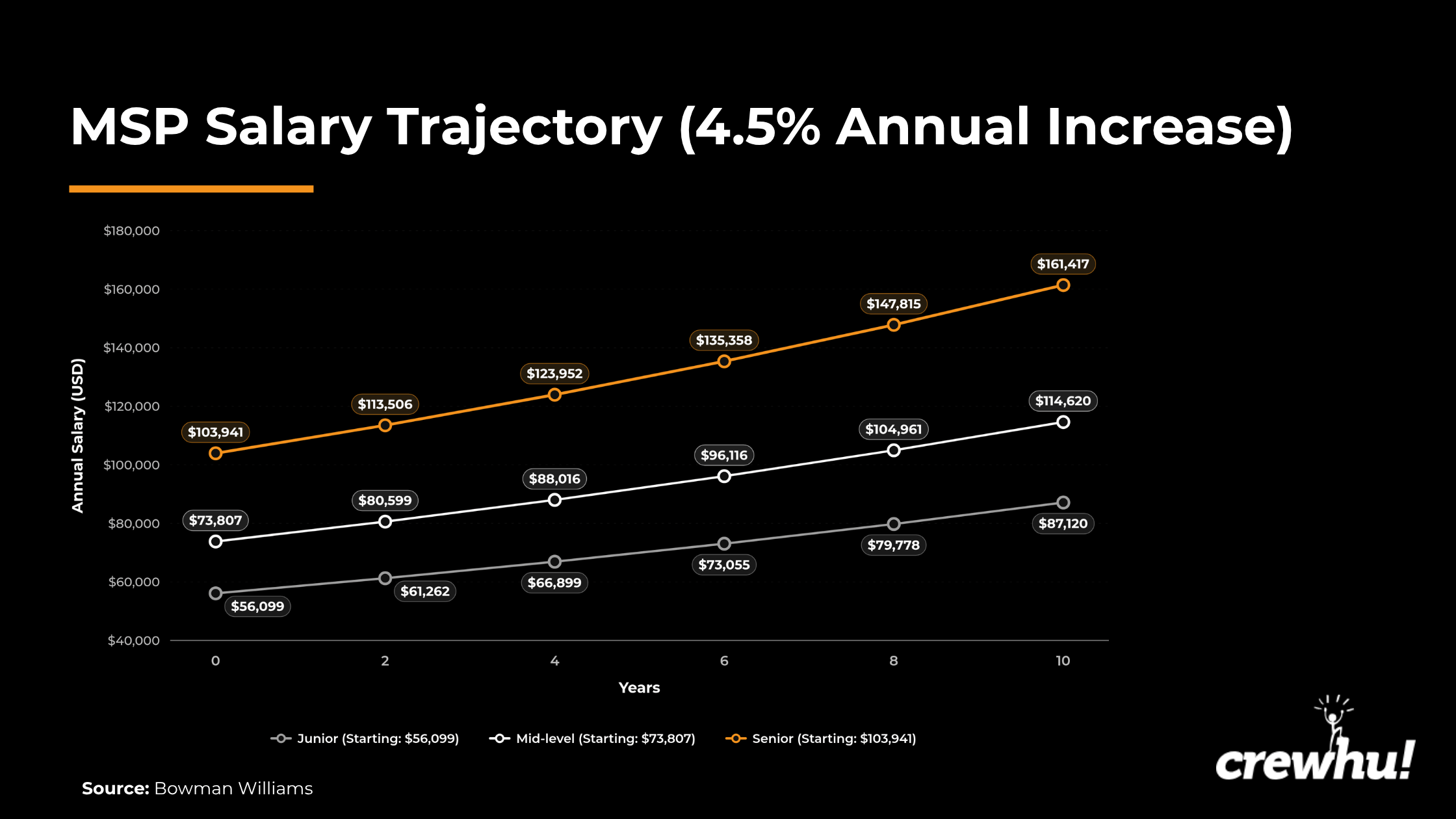
Start by regularly checking your pay scales against current market data. Bowman Williams, for example, analyzed salaries in different U.S. states and revealed the following averages:
|
Career level |
Roles included |
Starting salary |
|
Junior |
Level 1 Help Desk + Level 1.5 Help Desk/Jr. Sys Admin |
$56,099 |
|
Mid-level |
Tier 2 Sys Admin + Tier 2.5 Sys Admin/Projects |
$73,807 |
|
Senior |
Tier 3 Sr. Sys Engineer/Escalations + Tier 3 Projects/Solutions |
$103,941 |
For MSPs specifically, ConnectWise shows the most common range for salary increases is between 3.1% and 6% (4.5% average). Be aware, this can differ between companies, positions, and seniority.
Transparency about salaries and raises can greatly improve trust. Zenodo revealed that companies that introduced open-pay policies reported about 17% higher trust from employees than those working under confidential pay systems. They also noted a 9% greater performance. Consider adopting an open-pay policy to give employees visibility into how their pay is determined and how they can increase it.
If the job isn’t keeping up with expected increases, your employees will leave.
Financial benefits
Financial flexibility matters, too, especially when it comes to benefits. A decent package provides the stability and support your employees need to decide to stay. It’s also useful to introduce some level of flexibility within that package. For instance:
Financial Benefit |
What the MSP Offers |
Benefit to Employees |
Benefit to the MSP |
|
401(k) Matching |
Matches a percentage of employees’ retirement contributions |
Builds long-term financial security and increases total compensation |
Strengthens the compensation package and can encourage retention |
|
Health Insurance and HSA Contributions |
Covers/Subsidizes health insurance and contributes to HSAs |
Reduces healthcare costs and financial uncertainty |
Improves employee satisfaction and can make them more likely to stay |
|
Certification and Education Reimbursement |
Pays for relevant certifications, exams, renewals, and training |
Removes the cost of professional development and supports career progression |
Builds a more skilled technical workforce while giving technicians another reason to stay |
|
Performance Bonuses/Profit Sharing |
Provides bonuses based on team or company performance |
Allows employees to benefit financially from strong performance |
Can increase motivation and align employees with company goals and profitability |
So, you could add flexibility through a certification and education reimbursement. Or, you can give employees an annual development allowance and let them choose from approved certifications, courses, conferences, exam fees, or renewals relevant to their role and career path. The employee gains something relevant to their career, while your company develops skills it can actually use.
Where Crewhu Fits Into the Picture
Most employee retention strategies hinge on catching good work as it happens and making it visible before problems snowball. That's the gap Crewhu is built to close. The platform ties customer feedback directly back to the specific employee and what they did. That way, a manager can quickly spot and reward a great save or a smooth handoff, instead of that moment disappearing into a dashboard no one visits.
Layer in rewards and gamified metrics, and that positive feedback becomes an effective way to reinforce the behaviors a company wants more of. By tying CSAT and NPS feedback directly to the technician who earned it, Crewhu hones in on great work the moment a client rates the interaction, turning recognition into rewards your team actually engages with.
A happy employee is a healthy business
A company can pay generously but still lose people to burnout. Likewise, you can build a warm, tight-knit culture and still watch your most driven employees leave the moment they hit a ceiling with no growth path in sight. Real retention comes from balancing appropriate compensation, growth opportunities, and healthy management with a positive workplace culture and flexibility. When these components reinforce each other rather than operate as separate initiatives, you give your employees more reasons to stay and fewer to leave.
It also requires regular review and refinement though. Expectations shift, labor markets change, and a benefit that felt generous a few years ago may become the baseline to offer. Companies need to revisit their approach consistently to make sure their employees are heard and feel satisfied.
The payoff of a strong employee retention strategy isn't just fewer resignations. A workplace built on fair pay, open opportunities, competent management, honest recognition, and respect for people's time also encourages greater productivity. Employees who feel secure and genuinely valued will show up, and that shift ripples out to customers, teammates, and the bottom line.
Is your employees’ efforts being fully recognized and appreciated? Book a demo with Crewhu today to keep the experts you've worked hard to develop.
FAQs
How Do You Calculate Employee Retention Rate?
To calculate your employee retention rate, divide the number of employees who remained employed for the entire measurement period you chose by the number of employees you started with. Then, multiply the result by 100 to get a percentage. You should aim for a retention rate of 85%–90%.
What are the top five employee retention strategies?
The top retention strategies are competitive pay and benefits, strong manager relationships, clear growth and career paths, meaningful recognition, and healthy work-life balance. Most turnover traces back to one of these breaking down. Combine metrics (turnover by team, exit/stay interviews) with consistent one-on-ones and recognition to catch problems before employees start job-hunting.
What are the three R's of employee retention?
The three R’s are respect, recognition, and reward. Respect encompasses fair treatment and being heard; recognition means acknowledging good work regularly, not just at review time; and reward covers compensation, benefits, and growth opportunities. The framework argues that retention fails when any one of the three is consistently missing, even if the others are strong.
What are the 5 C's of employee retention?
The five C’s are care, connect, coach, contribute, and congratulate. Caring means showing genuine concern for well-being; connection builds relationships and belonging; coaching offers ongoing feedback and development; contribution entails giving employees meaningful, purpose-driven work; and congratulating is recognizing achievements. It's a broader people-management framework than the 3 R's, emphasizing relationship-building over transactional rewards.