
Ditch the fluff. Recognition only works when it means something. Tie every award to real wins: measurable performance, clear KPIs, and business outcomes that actually move the needle. Celebrate what drives results, not just what looks good.
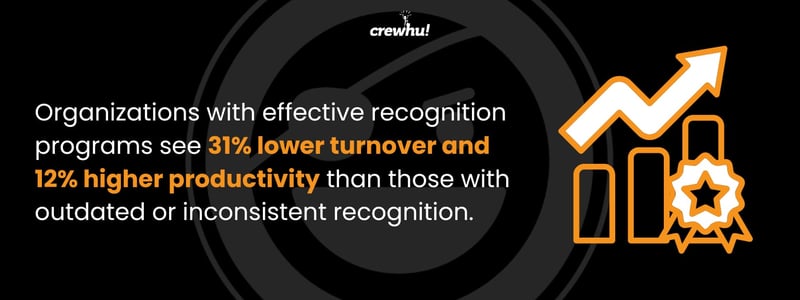
That approach comes at a cost. Organizations with effective recognition programs see 31% lower turnover and 12% higher productivity than those with outdated or inconsistent recognition. When recognition isn’t tied to meaningful results, employees don’t know what earned it, what should be repeated, or how their work connects to outcomes like CSAT, SLA performance, utilization, or retention.
Improving business recognition isn’t about giving out more awards. It’s about making recognition relevant and tying it directly to performance. This article explains how MSP leaders can modernize recognition awards by linking them to measurable KPIs and using automated, real-time recognition to reinforce what actually drives the business forward.
Link recognition directly to business outcomes
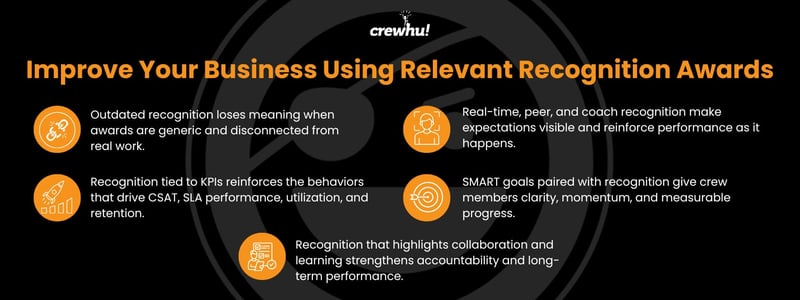
Recognition that actually drives performance doesn’t reward popularity. It rewards measurable impact. MSP leaders can make recognition meaningful by tying awards to business metrics that matter, including:
- Customer satisfaction (CSAT)
Celebrate crew members who consistently earn strong CSAT scores. Recognizing excellent client interactions reinforces the importance of service quality and supports a customer-first culture. - SLA compliance
Reward those who meet or exceed response time and resolution goals. Highlighting SLA performance encourages crew members to prioritize efficiency while maintaining high standards. - Utilization
Recognize techs who maximize billable hours efficiently without sacrificing service quality. When employees see that effective productivity is valued, they are more likely to optimize their workflow and contribute to profitability. - Retention and growth
Highlight contributions that strengthen client relationships, reduce churn, and support business growth. Acknowledging these efforts helps crew members see how their work connects directly to revenue and long-term success.
Tying employee recognition to measurable outcomes reinforces high-impact behavior and builds a culture focused on accountability, motivation, and results.
Real-time, peer-to-peer, and coach-to-crew recognition
Traditional recognition programs are often slow and hierarchical, relying on quarterly reviews or occasional management shoutouts. This approach leaves employees feeling undervalued and disconnected from their day-to-day impact.
Modern recognition focuses on speed, visibility, and relevance. Key components include:
- Real-time recognition
Celebrate achievements as they happen to reinforce positive behavior while the effort is still fresh. Immediate acknowledgment helps employees feel seen and encourages continued strong performance. - Peer-to-peer recognition
Enable crew members to recognize one another’s contributions. Peer recognition strengthens collaboration, builds trust, and supports a culture of shared accountability. - Coach-to-crew recognition
Managers provide targeted recognition tied directly to performance metrics. This reinforces behaviors that drive business goals and helps employees understand how their work contributes to company success.
When recognition is timely, visible, and tied to meaningful outcomes, it creates a continuous feedback loop. That loop motivates employees and supports a culture of accountability and consistent performance.
SMART goals + recognition = next-level performance
“Setting goals is the first step in turning the invisible into the visible.”
— Tony Robbins
SMART goals, specific, measurable, achievable, relevant, and time-bound, give crew members clear expectations and visible growth paths. When recognition connects directly to those goals, performance stops feeling abstract and starts feeling achievable.
For example, a technician working through a ticket backlog can receive a SMART goal focused on reducing resolution time while maintaining quality. As milestones are met, automated recognition, such as digital badges or leaderboard points, reinforces progress. Crew members see immediate results from their effort, stay motivated, and understand how their work supports the MSP’s broader goals.
Over time, this approach turns recognition into a structured, game-like system. Completed goals earn points, badges, or rewards that create healthy competition. Performance improves without adding manual tracking or extra overhead for managers.
Recognition that fosters team collaboration
High-performing MSPs don’t succeed in silos, and recognition programs should reflect that reality. When awards celebrate collaborative achievements, employees understand that teamwork is valued just as much as individual accomplishments.
A good example is how a cross-functional team resolving a complex client issue can be recognized publicly. This emphasizes how coordination, clear communication, and shared problem-solving drive superior results.
Acknowledging collaboration encourages employees to:
- Share knowledge across teams: When team members exchange expertise, problem-solving becomes faster and more effective.
- Support and mentor peers: Recognition motivates seasoned staff to guide newer employees, creating a culture of engagement and continuous learning.
- Celebrate joint successes tied to business metrics: Achievements related to SLA compliance, project deadlines, or client satisfaction highlight that collaborative efforts have a measurable impact.
Embedding team achievements into recognition programs reinforces the idea that collective effort drives tangible business outcomes. Peer acknowledgment strengthens trust and accountability, turning cooperation into a core part of daily operations.
Over time, this approach boosts morale, performance, and employee engagement, proving that shared success is as critical as individual achievement.
Recognition that drives continuous learning and skill growth
Besides promoting high performance, recognition can also inspire employees to pursue learning and skill development. When employees are acknowledged for expanding their expertise, they are more likely to invest time and energy in growing their capabilities.
For MSPs, this can include completing advanced certifications, mastering new tools or technologies, or introducing innovative process improvements that boost team efficiency.
Publicly celebrating these achievements signals that continuous learning is valued as much as results. Real-time recognition for learning milestones keeps motivation high and encourages employees to take on challenges, explore new solutions, and mentor peers.
When recognition is tied to measurable outcomes, such as completed certifications, improved efficiency, or shared knowledge contributions, it reinforces behaviors that benefit both individuals and the organization. Eventually, this strategy promotes a culture of growth, curiosity, and accountability, driving employee development and long-term business success.
Recognition that drives results
When recognition ties directly to KPIs, culture, and measurable outcomes, it stops being a nice gesture and starts driving real results. MSPs that use automated, gamified, and peer-driven recognition see stronger engagement, better retention, and higher client satisfaction.
Crewhu makes this shift easy. With real-time recognition, digital badges, gamification, and performance insights, MSP leaders motivate their crew without adding manual work. Recognition reinforces the behaviors that matter, supports company values, and keeps performance and engagement moving in the same direction.
Ready to turn recognition into a real growth driver? Book a demo with Crewhu and see how everyday achievements translate into long-term business impact.
![10 Peer & Manager Recognition Awards [Free Download]](https://no-cache.hubspot.com/cta/default/445399/629bbf46-2971-4412-b186-c21a44e08778.png)