-1.png)
Key Takeaways
- MSP growth requires a strategy that balances acquisition, revenue expansion, retention, and operational optimization.
- Retention and account expansion are often the fastest paths to sustainable MSP growth because they increase revenue without requiring the high cost and uncertainty of acquiring new clients.
- Platforms like Crewhu empower MSPs to capture real-time customer feedback and transform high satisfaction scores into referrals and long-term client relationships.
Many MSPs recognize the need to grow but struggle to determine which tactics will move the business forward without overextending their team.
However, scaling an MSP doesn’t require launching a ton of strategies at once. Successful growth starts with identifying opportunities and expansion constraints, then addressing them systematically.
Growth builds around four pillars: acquisition, revenue expansion, retention, and operational optimization. They drive initiatives like vertical specialization to attract "sticky" clients, quarterly business reviews (QBRs) to stay embedded in your customers’ goals, and AI-driven automation to streamline operations and increase productivity.
WHY NOW IS THE BEST TIME TO GROW AN MSP
Businesses are increasingly relying on digital infrastructure, with many small and mid-sized companies choosing to outsource IT management rather than build internal teams.
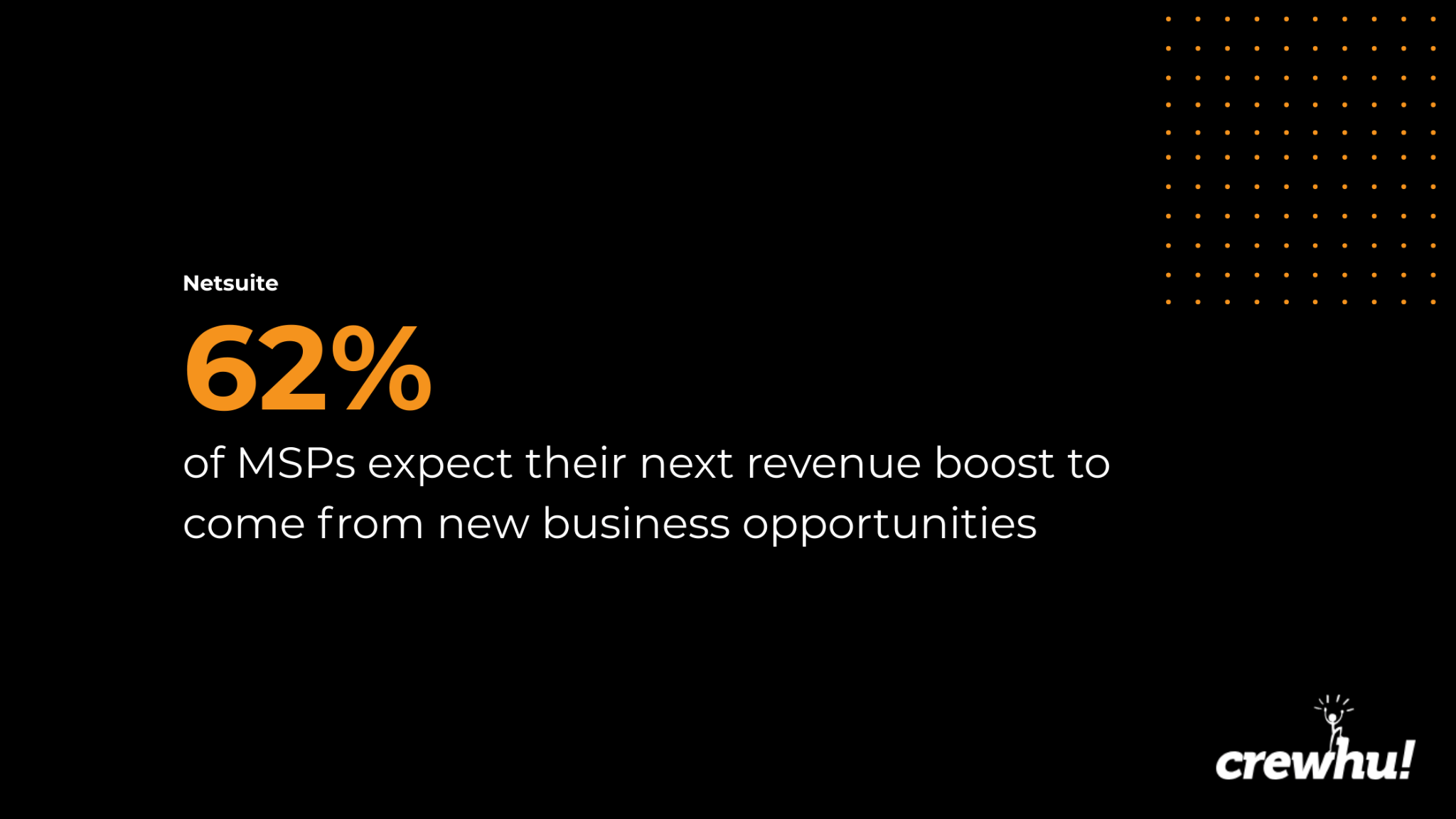
Sixty-two percent of MSPs now expect most of their new revenue to come from new business opportunities. This reflects a broader shift toward outsourced IT and cybersecurity services as organizations struggle to keep up with rapidly evolving technology.
Several factors are driving this trend:
- Cloud adoption has increased the complexity of IT environments. Businesses now rely on multiple SaaS tools, cloud platforms, and security layers that require continuous monitoring. For many organizations, partnering with an MSP is the most efficient way to manage this complexity.
- Cybersecurity threats are becoming more frequent and sophisticated, so businesses expect MSPs to provide proactive protection rather than reactive support.
- Advances in remote monitoring and automation tools have made scaling easier, so MSPs can manage thousands of endpoints across multiple client sites from a single interface.
For MSP leaders willing to invest in the right strategies, the current market presents a rich opportunity.
12 PROVEN MSP GROWTH STRATEGIES TO SCALE FASTER
To help you identify the most relevant opportunities for your business, the following strategies are organized around four growth levers: attracting the right clients, expanding revenue within existing accounts, retaining satisfied customers, and optimizing internal operations.
Acquisition Strategies
These strategies focus on helping MSPs draw in qualified clients and build a predictable pipeline.
EMBRACE VERTICAL SPECIALIZATION
Trying to meet every IT need makes it difficult for an MSP to stand out in a competitive market. When services are too broad, prospects see providers as interchangeable.
Niching down allows you to differentiate yourself in a crowded market. By concentrating on one or a few sectors, you can develop deeper expertise in the tools, compliance requirements, and operational challenges that matter most to those industries.
Specialization also strengthens marketing efforts. Instead of competing for generic IT support searches, a specialized MSP can position itself as the go-to provider for a unique audience, such as “IT services for law firms.”
When selecting a vertical, consider factors such as regulatory complexity, technological dependence, and willingness to invest in security and compliance. Industries with higher technical requirements often offer stronger margins and longer-term client relationships.
OFFER CYBERSECURITY-FIRST SERVICES
Cybersecurity is no longer an add-on; it’s a top criterion for businesses seeking MSPs.
Many organizations actively search for partners that can help them meet regulatory requirements or qualify for cyber insurance. This is an opportunity to attract high-intent clients by positioning integrated cybersecurity and compliance management as core services.
Managed security offerings can include:
- Security monitoring and threat analysis
- Managed detection and response (MDR)
- Compliance readiness for frameworks such as SOC 2 or HIPAA
- Security awareness training
The goal is to integrate security into every layer of service, increasing both the perceived value and revenue potential of your MSP.
BOOST YOUR AUTHORITY ACROSS SOCIAL CHANNELS AND AI SEARCH
Decision-makers now research vendors independently before initiating contact. Studies show that 70% of B2B buyers complete the majority of their research before ever speaking to a sales representative, making early-stage visibility critical.
You can establish authority by publishing thought leadership content related to cybersecurity trends, compliance updates, and IT risk management on platforms like LinkedIn.
Consistency is key, so post weekly to stay visible to decision-makers researching vendors. Over time, consistent output will better position your business as an industry leader and turn LinkedIn into a reliable inbound lead channel.
However, authority building no longer stops at social platforms. MSPs should also optimize for answer engines (AEO), as more buyers rely on AI-powered tools and zero-click search results to evaluate vendors. This means structuring your content to provide clear, direct answers to common questions about specific industry problems (e.g., "How does SOC2 affect Texas law firms?" or, “What cybersecurity requirements do healthcare companies face?”).
To strengthen credibility further, integrate feedback from happy customers into your content. Real-world validation acts as social proof, helping prospects trust your expertise before they ever engage with your team.
RUN LOCAL SEO CAMPAIGNS
Local search visibility is an important component for MSPs whose clients are predominantly within their immediate geographic region.
MSP services are often tied to a smaller region, and local SEO helps you appear in search results when businesses look for nearby IT services. Key strategies to strengthen your position include optimizing your Google Business Profile, collecting local reviews, and creating location-specific landing pages.
Effective local SEO tactics combine geographic targeting with vertical specialization. For example, instead of targeting “IT support near me,” an MSP might optimize for phrases like “IT services for accounting firms in Dallas.” So, when a business owner in your city searches for "IT support for accounting firms near me," your firm is one of the first they see.
LEAN ON SOCIAL PROOF TO BOLSTER YOUR REPUTATION
When it comes to business credibility, your word holds little weight for potential customers. A great way to boost your MSP’s reputation is to have your current customers do it for you. According to MSP Global, customer reviews are the most influential evidence when buyers put together their shortlist of vendors, with expert recommendations following close behind.
The more feedback you have, the more credible you appear because you have a large pool of testimonials to draw on and prove your value. Real experience with your company also gives prospects a concrete idea of what to expect if they choose you, which eliminates doubts contributing to buyer hesitation.
Social proof is an undeniably powerful growth strategy, so you need to collect as much of it as you can. Send CSAT surveys to capture client feedback in real time, automate follow-up emails after a ticket closes, or give your happiest customers a brief interview questionnaire and write a success story based on their answers.
Then, broadcast the good word on your website, social media, and other platforms where your MSP has a presence. Consider dedicating a section on your home page or an entirely separate page to client testimonials. You could also publish positive feedback on social media through customer shout-outs on a weekly, bi-weekly, or monthly basis.
Your existing customers are your greatest advocates. Put them in the spotlight and watch your business cred grow.
Revenue Expansion Strategies
These tactics increase revenue from existing accounts through higher-value services and strategic positioning.
ADOPT CONSULTATIVE SELLING
Many businesses still see IT services as a utility bill to minimize, so MSPs that are seen as simple help desk providers may struggle to justify higher prices.
Providers need to move towards consultative selling by reframing their business as a knowledgeable advisor rather than a mere technical vendor. This means offering add-on vCISO (virtual CISO) services such as conducting cybersecurity risk assessments, developing security policies and governance frameworks, and advising leadership on long-term security approaches.
When clients come to rely on your MSP for strategic guidance, the relationship becomes too valuable to replace. A client might fire a help desk provider to save $500, but they’re much less likely to let go of a partner who manages their SOC2 compliance or ensures they stay eligible for cyber insurance.
IDENTIFY UPSELL OPPORTUNITIES USING QBRS
QBRs are where you review system performance, security posture, and service outcomes with the client. These check-ups excel at strengthening client relationships while identifying growth opportunities.
QBRs clearly convey to the client the value you deliver and provide the chance to discuss future technological needs. You can also recommend proactive improvements such as additional security layers, cloud migrations, or backup solutions based on areas that could use a lift.
DESIGN SERVICE PACKAGES AROUND SLAS
Clear SLAs define what clients can expect in terms of response times, monitoring coverage, patch management, and security oversight. They’re an important component of a scalable MSP business model because they help customers understand the true value of the services you provide.
Structure your service tiers around support scope rather than just a flat price. For example, a "Basic" tier may offer standard monitoring and ticket support, while a “Standard” tier might add faster response times and enhanced security monitoring. A "Premium" tier, meanwhile, could incorporate a guaranteed one-hour response time and vCISO advisory.
Standardizing services this way simplifies the sales process and makes it less likely for clients to request custom pricing, which can undermine profit margins.
Retention Strategies
Retention-focused strategies help MSPs reduce churn and turn satisfied customers into long-term partners.
IMPROVE CLIENT EXPERIENCE (CX)
Customer retention drives significant profitability, with research showing B2B companies that enjoy top customer-experience scores achieve 4%-8% revenue growth above the market.
For MSPs, delivering a strong client experience requires proactive communication and consistent service quality. Clients should feel confident that their IT environment is secure, stable, and continuously improving in accordance with their individual needs.
Implement real-time feedback loops. Automated customer satisfaction surveys allow providers to identify concerns early and address them before they escalate into larger issues. Instead of waiting for a quarterly review to uncover problems, MSPs can collect feedback immediately after service interactions.
DEVELOP A REFERRAL PROGRAM
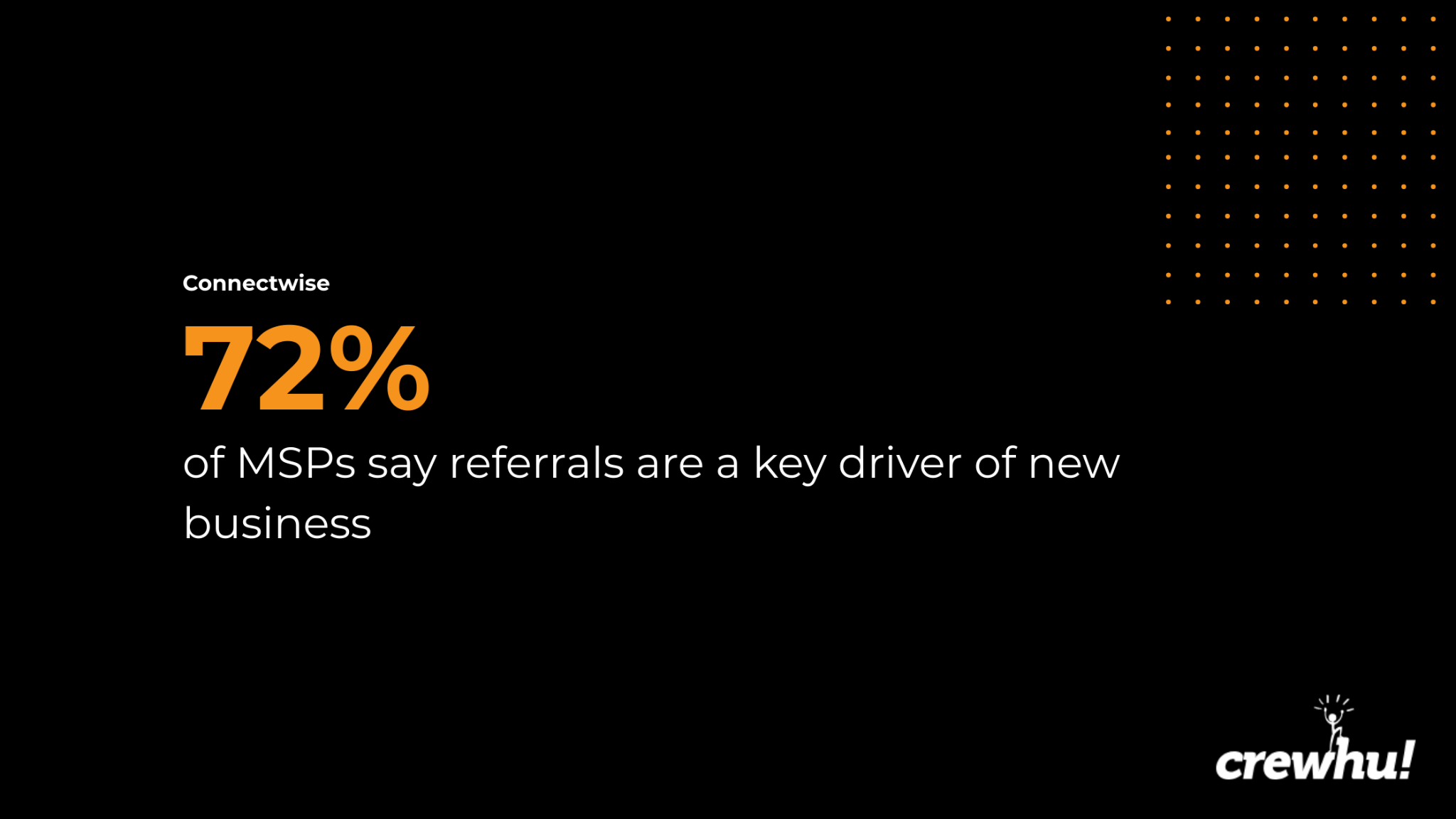
Nearly three-quarters (72%) of MSPs consider referrals to be a key driver of new business. Happy customers are often the most effective advocates for an MSP, yet many lack a formal program to incentivize them.
A structured referral program might include incentives such as service credits, discounts, or exclusive support upgrades for clients who introduce new customers. The goal is to encourage satisfied clients to actively recommend you within their professional networks.
You can even integrate your referral program into a feedback collection system to pinpoint strong advocates. For example, automatically send referral requests to clients who provide top satisfaction scores in post-ticket surveys.
Operations Optimization Strategies
Operational improvements allow MSPs to scale their client base without costs skyrocketing.
SCALE SERVICE HOURS BY OUTSOURCING TO A NOC/SOC
Providing round-the-clock monitoring can be difficult for smaller MSP teams because hiring staff for overnight shifts significantly increases labor costs while adding operational complexity.
Outsourcing certain responsibilities to a network operations center (NOC) or security operations center (SOC) helps mitigate this problem. The third-party provider will monitor systems, handle routine alerts, and perform initial troubleshooting, allowing your internal technicians to focus on higher-value work such as strategic consulting and complicated problem resolution.
Besides improving service coverage, outsourcing also converts fixed labor costs into variable expenses; your MSP only pays for the monitoring services used, which helps maintain profitability as your client base grows.
LEVERAGE AI AND AUTOMATION
Traditional MSP growth often follows a linear pattern: To support more clients, you hire more techs. This eventually squeezes your margins and makes scaling difficult.
Automation and AI tools allow you to decouple revenue from headcount. Modern RMM and PSA platforms can automate routine tasks like patch management, system health checks, and alert responses, while AI-driven monitoring tools can uncover potential issues before they impact users.
Along with boosting profit, this helps you reclaim more time. Automation lets you build a business that can run and grow without a 24/7 presence.
CONSOLIDATE VENDORS TO REDUCE COSTS AND BOOST EFFICIENCY
Many MSPs accumulate a large number of tools over time. While each platform may provide valuable functionality, excessive tool sprawl leads to inefficiencies.
Consolidating vendors simplifies operations while reducing licensing expenses. Evaluate your vendors based on factors like integration compatibility, performance metrics, pricing structure, and technician productivity. Prioritize platforms that integrate multiple capabilities into a single interface to dramatically streamline workflows.
A more integrated tech stack reduces costs and ensures your team doesn't waste time toggling between disconnected apps and, in turn, leads to better service quality for your clients.
KEY METRICS TO TRACK MSP GROWTH
Growth strategies only work if you can measure their impact. Tracking the right metrics helps MSPs understand what’s driving performance, where inefficiencies exist, and which strategies deserve further investment.
The most effective MSPs align their metrics with the four core growth pillars:
Acquisition
Cost per Lead (CPL)
Measures the efficiency of your marketing spend in generating new opportunities.
Formula:
CPL = Total marketing spend ÷ Number of leads generated
Why it matters:
CPL shows whether your acquisition engine is scalable. If it costs too much to generate leads, growth becomes expensive and unpredictable.
What to do:
- If CPL is high: Audit your channels. Double down on high-intent sources (e.g., referrals, SEO) and reduce spend on low-converting campaigns.
- If CPL is low: Validate lead quality by ensuring they match your ICP. Cheap leads are useless if they don’t convert.
Lead-to-Customer Conversion Rate
Tracks how effectively your sales process turns interest into signed contracts.
Formula:
Conversion Rate (%) = (Number of new customers ÷ Number of leads) × 100
Why it matters:
This metric reveals whether your issue is lead quality or sales execution. It’s often the fastest lever for improving revenue without increasing spend.
What to do:
- If conversion is low: Improve qualification, tighten ICP targeting, and refine your sales messaging.
- If conversion is high: It means your sales engine is working, so increase lead volume. More input = more revenue.
Revenue Expansion
Average Revenue per Account (ARPA)
Reveals the total revenue generated per client.
Formula:
ARPA = Total revenue ÷ Total number of active accounts
Why it matters:
ARPA reflects how well you monetize each client. Higher ARPA typically means stronger positioning, better packaging, and deeper client relationships.
What to do:
- If ARPA is low: Introduce bundled services, security add-ons, or vCISO offerings.
- If ARPA is increasing: Identify what’s driving it (pricing, packaging, upsells) and standardize that motion.
Expansion Revenue %
Tracks the percentage of new revenue coming from existing customers through upsells and cross-sells.
Formula:
Expansion Revenue (%) = (Expansion revenue from existing customers ÷ Total new revenue) × 100
Why it matters:
This metric shows whether growth is driven by existing relationships (more efficient) or constant new acquisition (more expensive).
What to do:
- If low: Implement structured QBRs and train teams to identify upsell opportunities.
- If high: Double down on account management and customer success, your strongest growth engine.
Retention
Customer Churn Rate
The percentage of clients lost over a given period.
Formula:
Churn Rate (%) = (Number of customers lost during period ÷ Total customers at start of period) × 100
Why it matters:
Churn directly erodes growth. High churn means you’re constantly replacing lost revenue instead of compounding it.
What to do:
- If churn is high: Investigate root causes, which are often poor onboarding, slow response times, or unclear value delivery.
- If churn is low: Build referral and expansion programs to leverage high retention as a strong foundation for growth.
Net Revenue Retention (NRR)
Measures the total change in recurring revenue from your existing customer base, accounting for upgrades, downgrades, and churn.
Formula:
NRR (%) = [(Starting MRR + Expansion MRR − Churned MRR − Contraction MRR) ÷ Starting MRR] × 100
Why it matters:
NRR is one of the clearest indicators of sustainable growth. An NRR above 100% means your existing customers are generating more revenue over time, even without new sales.
What to do:
- If NRR < 100%: Focus on reducing churn and increasing upsells.
- If NRR > 100%: You have a compounding growth engine, so invest in retention and expansion programs.
Customer satisfaction (CSAT)
Measures how satisfied customers are with your service.
Formula:
CSAT (%) = (Number of satisfied responses ÷ Total responses) × 100
Why it matters:
CSAT is an early warning system. Drops in satisfaction often precede churn.
What to do:
- If CSAT is low: Identify service gaps, such as response times, communication, or resolution quality, and fix them quickly.
- If CSAT is high: Trigger referral requests and testimonials, as this is prime advocacy territory.
Net Promoter Score (NPS)
Measures customer loyalty based on willingness to recommend your service.
Formula:
NPS = % Promoters − % Detractors
Why it matters:
NPS indicates long-term loyalty and growth potential. High NPS correlates with referrals and expansion opportunities.
What to do:
- If NPS is low: Follow up with detractors to understand friction points and address systemic issues.
- If NPS is high: Activate promoters through referral programs and case studies.
Operations
Revenue per Employee
A key indicator of overall business efficiency, scaling this number suggests you’re growing without just adding headcount.
Formula:
Revenue per Employee = Total revenue ÷ Total number of employees
Why it matters:
This metric shows whether your business model scales efficiently or relies too heavily on hiring.
What to do:
- If low: Improve automation, streamline workflows, or reassess service pricing.
- If high: Maintain efficiency by investing in tools and systems that support scale.
Technician Utilization Rate
Tracks the percentage of time technicians spend on billable or client-facing work versus administrative tasks.
Formula:
Utilization Rate (%) = (Billable hours ÷ Total available working hours) × 100
Why it matters:
Utilization directly impacts profitability. Idle or misallocated time reduces margins.
What to do:
- If utilization is low: Reduce non-billable work, improve scheduling, or increase ticket volume.
- If utilization is too high: It signals risk of burnout. Consider hiring, redistributing workload, or automating routine tasks.
HOW TO CHOOSE THE RIGHT MSP GROWTH STRATEGIES FOR YOUR BUSINESS
Although the strategies above are widely effective, success is easier when you focus on the initiatives that’ll have the greatest impact based on your operational realities.
The first step is defining a clear objective. Some MSPs prioritize acquiring new clients, while others may focus on increasing revenue within existing accounts or improving operational efficiency. What matters most is choosing strategies that address your current operational bottlenecks.
Here’s a framework to help you decide what to prioritize:
|
If your bottleneck is… |
Focus on |
|
Lead generation |
Acquisition strategies |
|
Low client lifetime value |
Revenue expansion |
|
High churn |
Retention strategies |
|
Overworked technicians |
Operational optimization |
ADOPT MSP GROWTH STRATEGIES TO SCALE YOUR BUSINESS
Growth entails choosing the strategy that fits your current bottleneck and pulling that lever until it moves. Evaluate your company against the four pillars of acquisition, revenue expansion, retention, and operational optimization to pinpoint where your efforts are most likely to pay off. Whether you decide to double down on vertical niching or implement high-ticket vCISO services, the only true risk is staying stagnant.
Sustainable growth also relies on customer retention, where loyal clients generate recurring revenue, referrals, and expansion opportunities that compound over time. Platforms like Crewhu act as the engine for this growth by helping you keep your customers satisfied and turning positive client experiences into measurable business outcomes.
If you're looking for a better way to track customer satisfaction and motivate your support team, book a demo with Crewhu today to see how we can help you scale.
FREQUENTLY ASKED QUESTIONS ABOUT MSP GROWTH
What is the fastest way to grow an MSP?
The fastest way to grow an MSP is by focusing on retention and account expansion. Increasing revenue from existing clients through upsells, cross-sells, and improved service delivery typically delivers faster and more predictable results than acquiring new customers.
How can MSPs attract more clients?
The most effective MSPs don’t rely on a single channel; they combine vertical specialization, local SEO, strategic partnerships, and authority building. Positioning your business as an expert in a specific niche makes it easier to stand out and consistently attract higher-quality opportunities.
What are the most important KPIs for MSP growth?
Key MSP growth metrics include customer churn rate, net revenue retention (NRR), revenue per employee, customer acquisition cost (CAC), and technician utilization rate. Together, these metrics provide a complete view of performance across growth, profitability, and operational efficiency.
Should MSPs focus more on acquisition or retention?
While both are important, retention often delivers higher ROI. Retaining and expanding existing accounts increases profitability without the high cost and uncertainty associated with acquiring new clients.
How can MSPs scale without hiring more staff?
MSPs can scale efficiently by leveraging automation, AI-driven tools, and outsourcing functions like NOC or SOC services. These approaches allow providers to support more clients without increasing headcount at the same rate.