-1.png)
Key Takeaways
- CSAT measures satisfaction with a defined interaction, product, or service.
- A CSAT assessment starts with a question about an experience, records each customer's rating and optional comment, and calculates the score from the distribution of valid ratings under a stated rule.
- The formula divides the number of satisfied valid responses by the number of total valid responses, then multiplies the result by 100 for a percentage. Participation, coverage, and respondent mix show how many customers contributed, who had an opportunity to respond, and which groups appear in the response base.
- Linking feedback to the service record, a clear owner, and the next action gives CSAT practical value.
CSAT summarizes customer ratings of a specific service moment.
Confusion starts when teams use CSAT to refer to the survey, rating, response, and final percentage at the same time. Those elements belong to one measurement process, but each plays a different role. Using the terms consistently makes the result easier to calculate, interpret, and connect with the next service decision. That consistency also helps managers compare periods and teams without confusing a change in customer sentiment with a change in the survey process.
What's CSAT?
CSAT (customer satisfaction score) measures how satisfied customers say they are with a certain product, service, or interaction. A short survey captures the rating and any written comment, while the scoring rule produces the aggregate result.
The survey ties the metric to the product, service, or interaction being evaluated. A support team asks about a recently closed ticket, while a project team asks about a completed milestone. In both cases, the survey defines the experience, the customer supplies a response, and the scoring rule converts a set of valid responses into an aggregate result.
The survey question, rating, response, and score
Each element plays a distinct role in the measurement process. The survey question defines the experience under review, while the rating records one customer's evaluation. A submitted response combines that rating with any written comment, then the response distribution shows how valid ratings are spread across the available options. At the end, the final score summarizes that through the mathematical calculation.
Take a closed support ticket as an example: The customer receives a short question, selects a rating of 4 out of 5, and adds a note about a slow handoff. Four is the individual rating, and that plus the note forms one response. When the team reviews the results, it calculates the aggregate score from the valid ratings and reads the comment alongside the relevant service record.
|
Component |
Meaning |
Short example |
What it helps the team do |
|
Survey question |
Prompt about one defined experience |
“How satisfied were you?” |
Set the experience being measured |
|
Individual rating |
Value selected by one customer |
4 out of 5 |
Record one evaluation |
|
Submitted response |
Valid rating plus optional comment |
4 plus written feedback |
Connect evaluation with context |
|
Response distribution |
Counts across rating options |
1:1, 2:0, 3:3, 4:8, 5:8 |
See how responses are spread |
|
CSAT score |
Aggregate result under a stated rule |
80% satisfied |
Track results over time |
|
Written comment |
Customer's own explanation |
“The handoff was slow” |
Identify what deserves review |
Separating those elements improves reporting. The team is able to trace an aggregate result back to the response distribution, then inspect the rating, comment, and service event behind an unusual result.
How do you calculate CSAT?
The CSAT calculation is the percentage of valid responses that meet the survey's “satisfied” threshold. Divide the number of satisfied valid responses by the total number of valid responses, then multiply by 100. On a 1–5 scale, many surveys count 4 and 5 as satisfied. The formula is as follows:
CSAT = (# of satisfied valid responses ÷ total # of valid responses) × 100
So, suppose a service team collects 20 valid responses on a 1–5 scale and treats ratings of 4 and 5 as satisfied. Sixteen responses fall into those two categories, meaning the calculation would look like this:
(16 satisfied responses ÷ 20 valid responses) × 100 = 80%
Blank or unusable submissions stay outside the calculation. A score of 100% means every valid response in the calculation met the “satisfied” threshold. Customers who didn't respond aren't part of that percentage.
Why CSAT calculations differ between platforms
“CSAT” doesn't guarantee one scoring rule. Some systems report the share of positive responses, whereas others use a mean rating, a top-box percentage, or a product-specific calculation. Record the calculation method beside the result whenever teams compare scores across tools or reporting periods.
At Crewhu, we do things a bit differently. We calculate CSAT by subtracting negative ratings directly from positive ones, treating “okay” responses as neutral. Why? Because a “meh” interaction is a missed opportunity to turn “fine” into “fueled.” This gives your crew an honest, crystal-clear picture of true client sentiment.
So, say a Crewhu response set of 20 included 16 good, 1 bad, and 3 okay ratings. Good responses make up 80% of the base, the bad one 5%, and the three okay responses remain neutral. The result of subtracting the two shares is 75%. The previous example also had 20 valid responses and 16 positive ratings, yet the traditional formula returned 80%.
Judging whether a CSAT score is good starts with comparability. Use your own stable trend first, then an external benchmark that matches the calculation, survey trigger, and service context.
When should you measure CSAT?
The survey trigger defines the experience the score represents. Support teams often ask customers after a ticket reply, resolution, or closure. Project teams use onboarding or delivery milestones though, while field-service businesses often ask as their visit ends.
A ticket-close survey measures one support interaction, and a milestone survey measures one stage of a longer project. A quarterly relationship survey has a broader scope and captures the customer's view of the relationship at that point.
Wording and timing work together here. A prompt about “your recent support experience” needs a fresh support event, while a question about an onboarding phase needs a clear milestone. To keep later comparisons meaningful, be sure to:
- Record the setup: Store the trigger and survey wording with the score.
- Keep different service moments separate: Track ticket-close and project-milestone results in different trend lines, even when both use a 1–5 scale.
- Ask while the experience is top of mind: Timing is everything when you manage a fast-paced service desk. Triggering a survey the instant a ticket closes catches clients while the interaction is fresh, giving your crew real-time recognition right when they earn it.
How should you interpret a CSAT score?
A useful CSAT score interpretation starts with four checks:
- Response count shows how many valid responses support the score.
- Opportunity to respond identifies which customers were invited and which service moments were eligible for a survey.
- Respondent mix shows which customer groups supplied usable feedback.
- Service context links the response to the ticket, project, account, team, or issue behind it.
Read the response base behind the score
Start with response count. Twenty valid responses give the team more customer input than five, even when both sets produce 80%. The count shows how much feedback sits behind the percentage.
Response rate places that count in the context of a defined base of invited or eligible participants. Interpreting the rate requires knowing how that base was defined and how the response set relates to the wider eligible group.
Three related measures clarify who the response base represents:
- Coverage shows whether the intended customer groups and service moments had a real route into the survey process.
- Respondent composition shows which eligible groups appear in the response base and how heavily each is represented.
- Non-response records invited or eligible customers who submitted no valid answer.
Use comments and service context to explain the result
The score and comment serve different purposes. The score summarizes the response distribution. In a post-care feedback study, written comments revealed concerns that rating items missed. That extra detail gives a team a better starting point for reviewing the experience.
Numbers tell you what happened, but written comments tell you why. When a client leaves a detailed note on a ticket, it's a gold mine for service leaders. It gives you the exact story you need to coach an engineer or celebrate a tech who saved the day.
One comment describes one customer's experience; a cluster of similar sentiments across comparable tickets gives the team a stronger pattern to investigate. Tags, dates, teams, issue types, rating distributions, and service records help locate the pattern across comparable work.
How service teams use CSAT
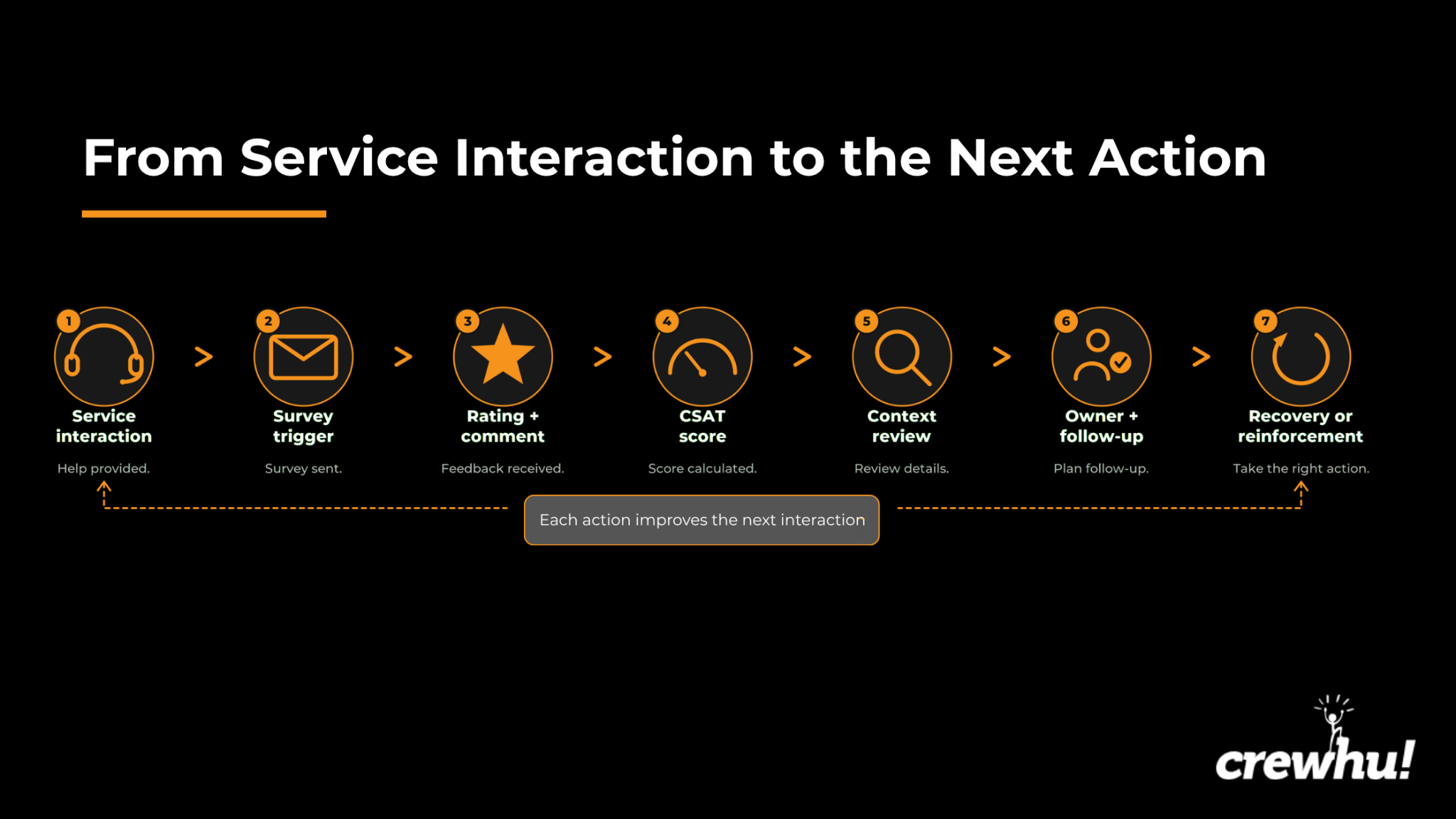
CSAT gives a service team a direct view of satisfaction levels with a specific experience. A response linked to the relevant ticket, project, or service record provides the necessary context to choose the next step. Common actions are customer follow-up, service review, coaching, recognition, and process improvement.
Customer support and service desk teams
A low rating tied to a closed ticket gives the service owner a specific case to review. The ticket record shows the issue, timing, handoffs, customer updates, and resolution path. That context helps the owner choose a reply, escalation, coaching conversation, or process check.
More than a feel-good pat on the back, positive feedback is fuel for your team. When a client praises a technician's calm communication, call it out immediately with real-time recognition. These micro-moments of appreciation set a clear standard for the rest of the crew and keep your workplace culture moving forward.
Repeated feedback calls for pattern review. Several low ratings around handoffs give the team a reason to inspect ownership, while multiple comments about missing updates point to the communication process. The team then compares similar tickets, reviews the affected workflow, and outlines a focused improvement plan.
Customer success and project-based service teams
Useful customer-success triggers include the end of onboarding, a completed project phase, or another defined touch point. Project teams take the same approach at a milestone or completed delivery. Name the experience clearly so the result keeps a uniform scope.
That score describes the selected touch point. A broader account view draws on relationship history, open issues, commercial context, adoption, and other customer signals. CSAT adds direct evidence about how a specific experience felt to the people who responded.
For MSP leaders, separating service desk tickets from major project milestones lets you celebrate quick, daily wins with your help desk crew while keeping your project engineers focused on high-stakes delivery. When both streams have dedicated feedback loops, your entire operation stays aligned.
Follow up on individual feedback and review recurring patterns
Service teams need two feedback routines:
- Case-level follow-up gives each response an owner and a time frame for action.
- Pattern review groups comparable cases so the team can decide whether a handoff, policy, or training issue needs attention.
The response window is critical; a response that sits unread loses context and delays a useful conversation with the customer or employee. A defined review routine keeps the service event fresh and clarifies responsibility.
Pattern review compares similar cases and looks for a repeated cause, behavior, or process gap. A complete customer feedback loop carries those cases through routing, follow-up, and organizational learning.
Teams have to define frontline authority and escalation rules for the patterns they identify. Employees need clear boundaries around the recovery steps they handle directly, the situations that require a manager, and the examples that belong in future training.
Recommended Watch:
In Episode 238 of the “Customer Service Revolution” podcast, Denise Thompson talks with John DiJulius about recurring service failures and frontline authority.
They examine which failures justify a defined recovery system, which recovery decisions frontline employees should own, and which situations require managerial escalation. Strong recovery decisions also give the wider team concrete training examples. Those examples then help service leaders define authority, escalation rules, and focused training around recurring low-score patterns.
Managers reinforce frontline authority by recognizing sound decisions and using recurring failures to shape training.
How Crewhu connects feedback to service action
Crewhu keeps CSAT feedback connected to the service context managers need for follow-up. Each response stays tied to the customer, ticket, employee, and issue behind it.
We collect transactional feedback after ticket replies, closures, and project work, keeping each response close to the service event it reflects. Our survey settings support “Resolved,” “Reply,” and “Signature” survey routes, helping service teams match the request to the event they want to evaluate.
Notifications bring a new response to the right people while the service context is still available. Our detailed CSAT reports let managers review feedback by time frame, customer, team, employee, survey type, rating, comment, and tag. Those filters enable the team to trace a low score to the relevant interaction and compare recurring patterns across similar work. Managers can then assign the review to the person responsible for the next step.
Positive comments follow the same operating path. Crewhu uses them to recognize and reinforce the service behaviors customers notice and bring concrete examples into coaching. That keeps the customer experience front and center in the team's next review.
Use CSAT to improve the next service interaction
A well-run CSAT program gives every result a defined meaning. The team knows what the customer evaluated, how the result was calculated, who responded, and which service record provides the relevant context. That discipline keeps the metric comparable and gives managers a reliable basis for action.
CSAT scores shouldn't sit quietly in a monthly report. Use positive feedback to set SMART goals, reward top performers, and turn routine ticket closures into long-term client trust. When you connect real-time feedback with crew appreciation, you go beyond fixing past mistakes to building a culture that naturally elevates every interaction.
Keeping the response, service context, and owner together makes that routine easier to sustain. Book a Crewhu demo to see how we connect feedback review with coaching, recognition, and follow-up in the same service workflow.