.png)
Key Takeaways
- Employee engagement and employee satisfaction describe different concepts. Although a satisfied worker may be comfortable at work, an engaged one is more likely to take ownership, contribute ideas, support teammates, and care about outcomes.
- For service businesses, engagement is visible in the customer experience. It affects communication, follow-through, service recovery, handoffs, peer support, and the consistency customers feel from one interaction to the next.
- Perks and one-off programs offer support but aren’t a comprehensive solution. Service leaders still need a practical management rhythm built around clear expectations, consistent manager check-ins and follow-up, employee feedback and specific recognition, growth paths, and workload visibility.
- Measurement needs to drive leaders to act on what they learn. Surveys, check-ins, customer feedback, recognition patterns, and manager observations should create a signal loop.
- A stronger engagement system connects employee voice, customer feedback, recognition and rewards, performance metrics, and manager visibility so service leaders can reinforce the behaviors that matter.
Employee engagement goes deeper than worker happiness or job satisfaction. It comprises employees’ involvement in and enthusiasm for their work and workplace. Engaged workers are emotionally connected and committed to their work. So an employee can be content in a role but still feel disconnected from their work, team, or business outcomes.
Service businesses see engagement through worker behavior. A satisfied employee will show up, complete assigned tasks, and avoid complaints. But an engaged one is more likely to notice when a customer issue is about to escalate, help a teammate during a difficult service window, document a problem clearly, or follow through after a handoff.
Engagement should be assessed through daily conditions like workload, leadership behavior, growth opportunities, team dynamics, and whether managers act on what employees say. Service businesses need to go beyond a simple, “Are our employees happy?” and ask if their personnel understand what good service looks like, feel recognized for the work that matters, and have enough trust and support to keep taking ownership.
Why employee engagement matters for service businesses
Employee engagement affects business performance because workers make daily decisions that shape the customer experience. It influences productivity, profitability, absenteeism, and turnover, even extending into safety incidents, quality defects, and customer loyalty.
Those outcomes show up when a customer receives a proactive update or a calm service recovery after getting frustrated, as well as when a handoff is clear enough for the next person to continue smoothly, or a team member notices a recurring issue needs attention from leadership.
Disengagement can also alert potential turnover through weak follow-through, poor communication, fewer ideas, less peer support, or a shift from owning the outcome to merely completing the task. Those changes give managers a reason to investigate earlier. By the time someone resigns, weeks or months of useful signals may already have passed. A broader employee retention strategy has to address pay, workload, scheduling, growth opportunities, and manager quality.
What improves employee engagement the most?
The most practical way to improve employee engagement is to build it into day-to-day management. Employees need clear expectations, useful check-ins, a say in how work gets done, specific recognition, room to grow, and leaders who follow up when they raise a problem.
Managers are central to that system. Gallup research revealed that managers drive 70% of the variance in team engagement, which is why training, clear expectations, and consistent check-ins matter so much. Engagement still remains a shared responsibility though; leaders set the tone, managers put it into action, and employees communicate what they need to stay engaged.
Service businesses should craft an engagement strategy that helps managers see what’s happening, gives employees a voice in their work, and recognizes the behaviors customers and teammates rely on. It also has to push leaders to act quickly enough that employees believe the system is worth participating in.
Tactics to improve employee engagement in the workplace
Set clear expectations around the behaviors that matter
Employees can’t fully engage with vague standards. They need a concrete definition of what good work looks like in a real service environment.
Tie expectations to observable behavior. That means sending proactive customer updates, documenting service notes clearly, and completing clean handoffs. The same standard should cover supporting teammates during busy periods, following through after a complaint, and escalating issues before they create larger failures.
Telling employees to care more or deliver excellent service is different from naming the behaviors the business wants repeated. Positive language isn’t enough on its own. A strong standard names actions employees can carry out, such as updating the customer before they ask, writing a note so the next person can act, checking whether the handoff landed, and closing the loop after service recovery.
Clear expectations also reduce uncertainty. Employees engage more readily when they know which behaviors matter, why, and how managers will evaluate them.
Train managers to run better check-ins
One-on-ones with managers are common, but the quality of those conversations varies. A useful check-in spotlights barriers, workload strain, growth goals, and early disengagement signals.
Useful service business check-in questions include:
- What’s making the work harder than it needs to be?
- Where are customer handoffs breaking down?
- What do you want to learn next?
- What part of the workload is becoming unsustainable?
- What would make this role easier to stay in six months from now?
These conversations reveal patterns a manager can see over time. Maybe the same process keeps failing, the same role absorbs too much pressure, an employee stops asking for growth, or the same customer issue keeps creating stress.
Act on employee feedback before trust erodes
Asking for feedback creates an expectation, but it only gains credibility when employees trust the follow-up. If people previously answered surveys and never saw change, they learn to treat the next request as another HR exercise. Managers can eliminate that skepticism by asking specific questions, watching for repeated patterns, and coming back to the team with what they heard, what will change, and what can’t change yet.
Companies can make feedback even more useful by connecting employee input to operational signals. If workers say they’re overloaded, compare that with overtime, missed breaks, customer escalations, schedule changes, and recurring handoff problems. If people feel unrecognized, look at whether customer praise reaches the team or disappears after a ticket closes.
The feedback loop gains credibility when employees can see what changed. Leaders don’t need to promise that every issue will be fixed immediately. But they do need to show they listened, what they’re doing about it, what can’t change yet, and when the issue will be revisited.
Recognize specific efforts
Recognition drives engagement by spotlighting valuable behavior. Generic praise is easy to ignore, while specific recognition tells employees what the business notices and wants repeated.
Recognition belongs inside the regular management rhythm. Occasional appreciation campaigns can support that cadence, but efforts should occur regularly, be specific, and happen close to the behavior it reinforces. In a service business, that entails naming the customer-facing action worth repeating, such as someone calming an upset customer or keeping them informed during a delay, catching a problem early, helping a teammate through a work rush, or following up after a service failure.
If a customer praises a technician, support specialist, dispatcher, account manager, or service coordinator, that signal shouldn’t stay trapped in an inbox, ticket comment, or manager’s memory. Make it a teaching moment, a team win, and a clear benchmark for what good service looks like.
Create visible growth paths and autonomy
Employees disengage when they feel stuck. Growth doesn’t always mean a promotion to management though. In a service business, it may look like becoming a trainer, owning more complex customer issues, specializing in a higher-value service area, earning a certification, mentoring newer employees, or gaining more control over scheduling and prioritization.
Development is important because engagement weakens when employees can’t see a future in their current role. That’s why engagement has to include favorable working conditions, professional development opportunities, meaningful work, supportive leadership, and acknowledgement of employee input.
Make growth visible by detailing which skills matter, how advancement decisions are made, and what the next level of contribution could look like. A path that lives only in the owner’s or manager’s head is invisible to personnel.
Autonomy matters too. Give workers appropriate control over how they solve problems, communicate with customers, manage their work, or improve a process. Engagement grows when people see that their judgment matters.
Reduce workload friction and strengthen peer connection
Engagement is difficult to sustain when work is harder than it needs to be. That strain often shows up in service businesses through unclear ownership, repeated escalations, too many communication channels, inefficient tools, and pressure that lands on the same reliable people over and over.
Service businesses should inspect friction directly by asking:
- Which roles absorb every difficult customer?
- Which employees always cover gaps?
- Where do handoffs fail?
- What tools slow people down?
- What processes create rework?
- Which employees are quietly carrying the team?
Peer connection is crucial as well, since employees are more likely to stay engaged when they trust the people around them and believe effort is shared. That can come from better onboarding, buddy systems, cross-training, shared wins, or clearer norms for helping during busy periods.
A practical way to translate engagement advice into service behavior
Broad engagement advice can sound reasonable but still fail if it doesn’t tell managers what to do differently inside the work. Service businesses need to synthesize general ideas into actionable habits.
|
Generic engagement advice |
Service-business version |
Why it matters |
|
Improve communication |
Define when customers get updates, who owns handoffs, and how managers spot silence |
Communication is both a team-culture and a service-reliability issue |
|
Recognize employees |
Recognize specific service behaviors customers and teammates rely on |
Recognition reinforces the work that protects customer experience |
|
Ask for feedback |
Close the loop on recurring friction from check-ins, customer feedback, and workload patterns |
Employees trust feedback systems when they lead to action |
|
Offer growth opportunities |
Show what better contribution looks like by role, skill, and customer impact |
Growth becomes visible even in smaller teams |
|
Measure engagement |
Combine surveys with manager observations, recognition trends, and service feedback |
Leaders see behavior patterns alongside sentiment scores |
This translation prevents employee engagement from becoming abstract. It connects the internal worker experience with the external customer experience.
Why employee engagement programs fail and what works instead
Employee engagement programs lose momentum when useful activities remain disconnected from day-to-day management. A survey may reveal workload pressure, a check-in may expose a broken handoff, and customer feedback may highlight strong service behavior. Problems persist when no one owns the next decision, managers lack the authority to remove an obstacle, or employees never hear what happened after they spoke up. The business collects signals while the underlying work stays the same.
What works is a repeatable operating rhythm. Leaders decide which issues require structural change, managers act on the problems within their control, and unresolved issues have a clear escalation path. Employees can see what was heard, what will change, who owns the action, and when progress will be reviewed. That visible follow-through gives leaders something concrete to measure across employee feedback, manager observations, service delivery, and customer experience.
How to measure employee engagement and close the loop
Measure employee engagement by comparing what employees say with what’s happening in the work. Surveys, pulse checks, and manager conversations matter, but so do recognition patterns, turnover trends, customer feedback, and recurring service problems. Close the loop by acting on repeated patterns and telling employees what changed.
Those signals can include:
- eNPS or engagement survey trends and pulse survey comments
- Manager check-ins and one-on-one notes
- Turnover rate, absenteeism, and other attendance patterns
- Productivity or service-throughput trends
- Quality, rework, escalation, or follow-through issues
- Customer feedback, CSAT, NPS, and review themes
- Recognition patterns by team, manager, or behavior
- Training participation and internal movement
- Recurring workload, scheduling, or handoff friction
These numbers shouldn’t be treated as direct proof of engagement though. Turnover, absences, and productivity can all shift for reasons that have little to do with how connected employees feel at work. But when those patterns appear alongside employee comments, manager observations, recognition gaps, and recurring service friction, they give leaders a better place to investigate.
Engagement measurement determines if the business is learning anything useful over time, so the goal is to spot repeated patterns early. Leaders should notice unclear expectations, weak recognition, workload pressure, customer-service friction, and teams that don’t believe feedback leads to action.
Customer feedback is especially useful in this setting because customers often observe behaviors that managers miss, such as patience, clarity, responsiveness, follow-through, and recovery after a problem. When those comments are visible to managers and workers, they move beyond satisfaction data to become engagement and coaching signals.
Measurement is credible only when managers close the loop though. Rather than a bland, “We ran a survey” message, a useful follow-up sounds more like, “We saw this friction, we heard it from multiple places, and this is what we’re changing.”
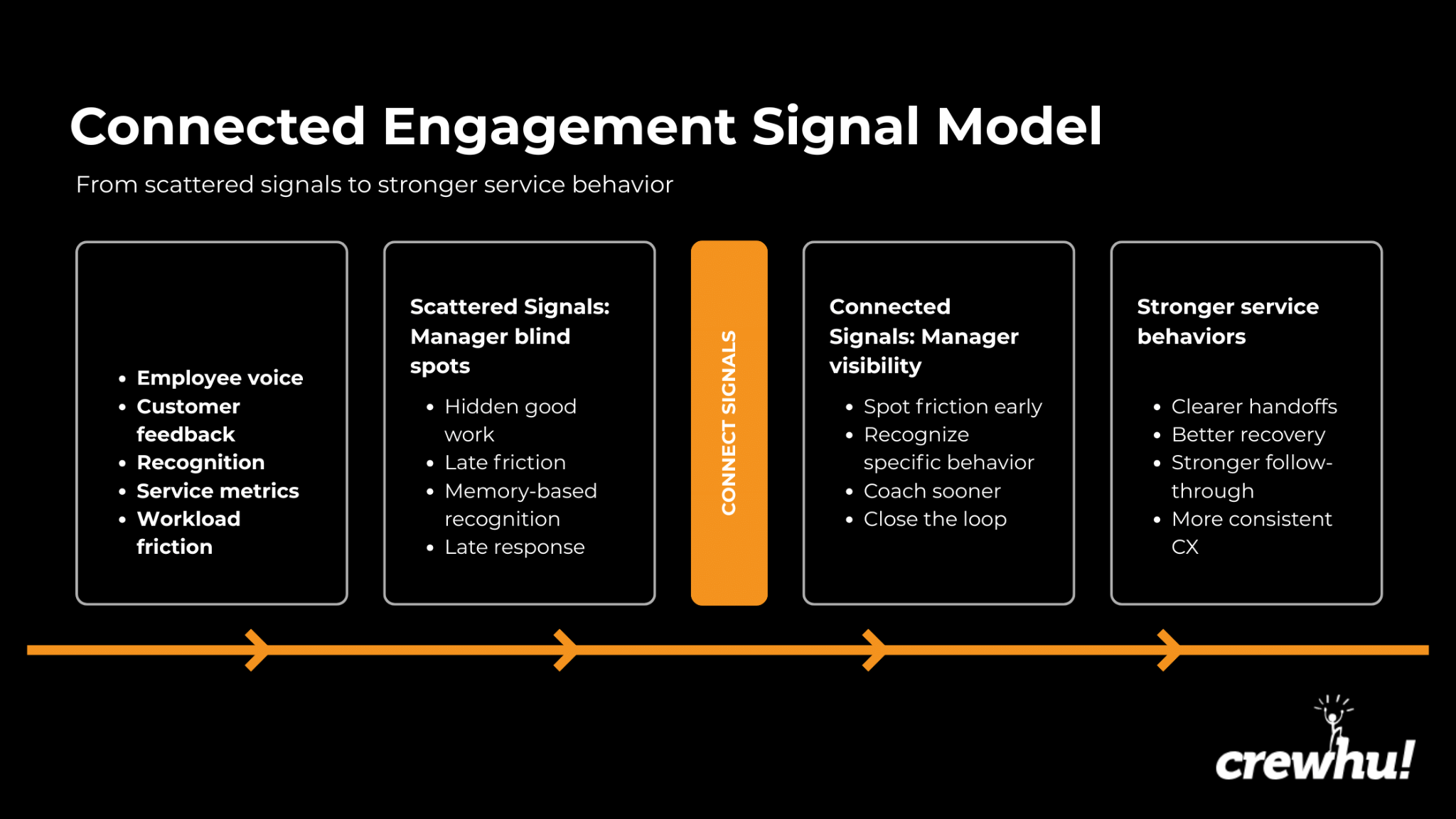
When signals stay scattered, managers react late. Connecting employee voice, customer feedback, recognition patterns, service metrics, and workload friction gives managers earlier visibility. They can then spot problems sooner, recognize more specific, useful behavior, and give coaching before disengagement balloons into a service problem
Early signs that employees are disengaging
Disengagement often appears as behavioral drift before resignation.
Service businesses need to watch for employees who stop raising issues or volunteering ideas, avoid difficult customer situations, give shorter updates, document work less carefully, support teammates less often, or are quiet during check-ins. None of those signs proves disengagement by itself. But when they appear together, they suggest the worker may be withdrawing from their role.
Research has found a distinction between engaged employees and those who are present but psychologically unattached, who put in time without energy or passion. That distinction helps managers look for observable drift instead of waiting for resignation, absenteeism, or customer complaints as the first clear signal.
Managers should respond with curiosity before judgment. Start with better conversations that ask:
- What changed?
- What’s getting harder?
- Where do you feel stuck?
- What support is missing?
- What would make this work more sustainable?
Early signals are useful only if leaders act while the employee is still reachable.
Recommended Listen: The Middle Management Crisis: How Untrained Managers Are Quietly Killing Employee Engagement
In this KeyHire Small Business Podcast episode, host Corey Harlock talks with Emma Rose Connolly of Conversant about why middle managers are often the missing link in employee engagement.
The lesson is useful for service-business leaders because it turns engagement into a management practice:
- Notice when performance or trust starts drifting
- Have the easier conversation before the problem becomes a crisis
- Give managers the skills to create clarity, feedback, trust, and recognition
Boost employee engagement with Crewhu
Service leaders have a hard time managing engagement when the signals that reveal it are spread across different parts of the company. Employee voice only shows up in check-ins, customer feedback appears in tickets, surveys, emails, or service notes, and recognition may happen in a chat thread, team meeting, or not at all. Even performance metrics live in PSAs, CRMs, documentation, and reporting tools. These siloes separate rewards from the behaviors customers actually value.
Crewhu is designed to connect those dots. Managers need a clearer way to link together employee experiences, customers observations, behaviors that deserve recognition, and the points where the team is losing momentum.
Crewhu incorporates those signals into the service workflow through several features:
- Customer feedback brings the customer’s experience into the engagement loop. When CSAT, NPS, and service-interaction feedback are connected to ticket, project, or customer workflows, managers gain a clearer understanding of what customers noticed. That can cover clarity, responsiveness, patience, ownership, recovery, and follow-through. Feedback is more useful than a score when it shows which service behaviors strengthen the customer experience.
- Recognition turns those signals into internal reinforcement. Strong work shouldn’t depend on manager memory or informal praise. Recognition that happens close to the work and across the communication channels teams already use enables the business to pinpoint repeatable behaviors like fast ownership, clear communication, calm recovery, peer support, documentation quality, and reliable follow-through.
- Rewards add weight to that reinforcement. Points, personalized rewards, and transparency about where rewards come from help a team view customer service, core values, and meaningful metrics as components of what defines “good work.” That avoids them being ignored as abstract slogans.
- Gamified metrics keep attention on the behaviors and outcomes that matter. Once a service business has defined the habits it wants to improve, metric selection, SMART goals, contests, and KPI tracking help the team maintain focus. The contest itself is only the mechanism. The real prize is sustained attention to the work the business has deemed important.
- Dashboards, reports, and workflow integrations make the loop manageable. Service leaders shouldn’t have to reconstruct engagement signals from scattered tickets, survey comments, chat messages, spreadsheets, or memory. The more those signals sit near the operational tools the team already uses, the easier it is to coach earlier, recognize specific actions, and see if the system is reinforcing the right work.
For service businesses, a strong engagement model is a practical operating rhythm that connects what employees experience to what customers notice and what managers reinforce. Morale campaigns, disconnected recognition programs, and survey rituals don’t create that model on their own.
Employee engagement is more influential than you realize
When service leaders make strong work visible, act on feedback, and reinforce the behaviors that shape customer experience, employee engagement improves. Clear expectations, better manager conversations, specific recognition, growth paths, and connected service signals all help employees stay closer to the work that matters.
For service businesses, this goes beyond a soft culture project. It’s part of how customers experience communication, follow-through, service recovery, peer support, and consistency.
Book a demo to see how Crewhu helps connect customer feedback, recognition, rewards, gamified metrics, and team visibility to construct a stronger operating rhythm for service teams.
FAQ
What is the best way to improve employee engagement?
The best way to improve employee engagement is to build a consistent management rhythm instead of depending on any one tactic. Employees need clear expectations, useful manager check-ins, real feedback loops, specific recognition, growth opportunities, and visible follow-up from leaders. That rhythm should connect directly to communication, handoffs, customer recovery, peer support, and the behaviors customers experience every day.
How do managers affect employee engagement?
Managers affect employee engagement by shaping workers’ daily experience. They set and clarify expectations, notice workload pressure, coach performance, recognize good work, and decide whether feedback leads to action. When managers lack time, training, or support, engagement drops because employees lose clarity, trust, and confidence that the company will respond before problems become larger issues.
How do you measure employee engagement?
You can measure employee engagement with surveys, pulse checks, eNPS, manager check-ins, stay conversations, recognition patterns, absenteeism, turnover risk, and customer feedback. More data won’t improve engagement. You have to connect signals to action. A service business should look for patterns that show whether employees have clarity, voice, support, growth, trust, and enough visibility into what good work looks like.
What are signs of low employee engagement?
Signs of low employee engagement often appear as behavioral changes. Employees may communicate less, stop suggesting ideas, avoid difficult customer issues, document work less carefully, withdraw from teammates, miss follow-through, or stop speaking during manager check-ins. None of these signs proves disengagement alone. Repeated patterns can still show an employee pulling away from their work, which needs further conversation.
How does employee engagement affect retention?
Employees are more likely to stay when they feel connected to their work, supported by managers, recognized for meaningful contribution, and able to grow. Engagement helps prevent drift. It works alongside the broader retention conditions that determine whether reliable employees can stay long term, including pay, workload, advancement, scheduling, manager quality, and whether the business makes good work visible without burning people out.
Can employee recognition improve engagement?
Employee recognition improves engagement when it’s specific, timely, and connected to work that matters. Generic praise may feel nice, but it rarely changes behavior. Recognition works best for service businesses when it highlights actions customers and teammates depend on, such as clear communication, calm recovery, strong documentation, peer support, reliable follow-through, and the small service moments that deserve to be repeated.