Key Takeaways
- Gamification for employee engagement borrows points, badges, levels, and leaderboards from games and attaches them to actual work. Its purpose is to shift technician behavior toward desired outcomes, such as documenting tickets properly, completing certifications, or following up on client feedback.
- Gamification works because it taps into basic psychology. Instant feedback confirms good work the moment it happens, visible progress turns vague targets into reachable ones, and peer recognition spotlights colleagues’ contributions in a way annual reviews rarely do.
- MSPs can apply gamification in several ways, from onboarding paths, contests, and certification tracks to wellness challenges, feedback follow-up, and public recognition. Which option fits depends on the problem you want to solve.
- A program you don’t measure is just a hunch. Record baseline numbers before launch, then track participation, completion, behavior change, and business outcomes such as CSAT or SLA compliance.
- Keep rewards light, pair speed with quality, and remember that no game mechanic will repair a broken process or a strained culture. It can only amplify what’s already in place.
Service work can feel like an endless treadmill. Resetting passwords, clearing printer queues, and answering the same user questions day after day can wear down even your sharpest engineers. When the ticket queue never ends, your team's motivation quietly takes a hit.
This is the mountain MSP managers have to climb when trying to boost employee motivation and productivity. While there are several ways to do so, one stands out in terms of effectiveness and overall reception by employees: gamification. It can turn a KPI spreadsheet from a nagging document that the manager waves around into something a team wants to check of their own free will.
Gamification to boost employee engagement isn’t just a matter of introducing a leaderboard and then going back to running the company. It requires you to understand why your people aren’t as productive as you want them to be and what problem gamification should address.
The Psychology Behind Gamification
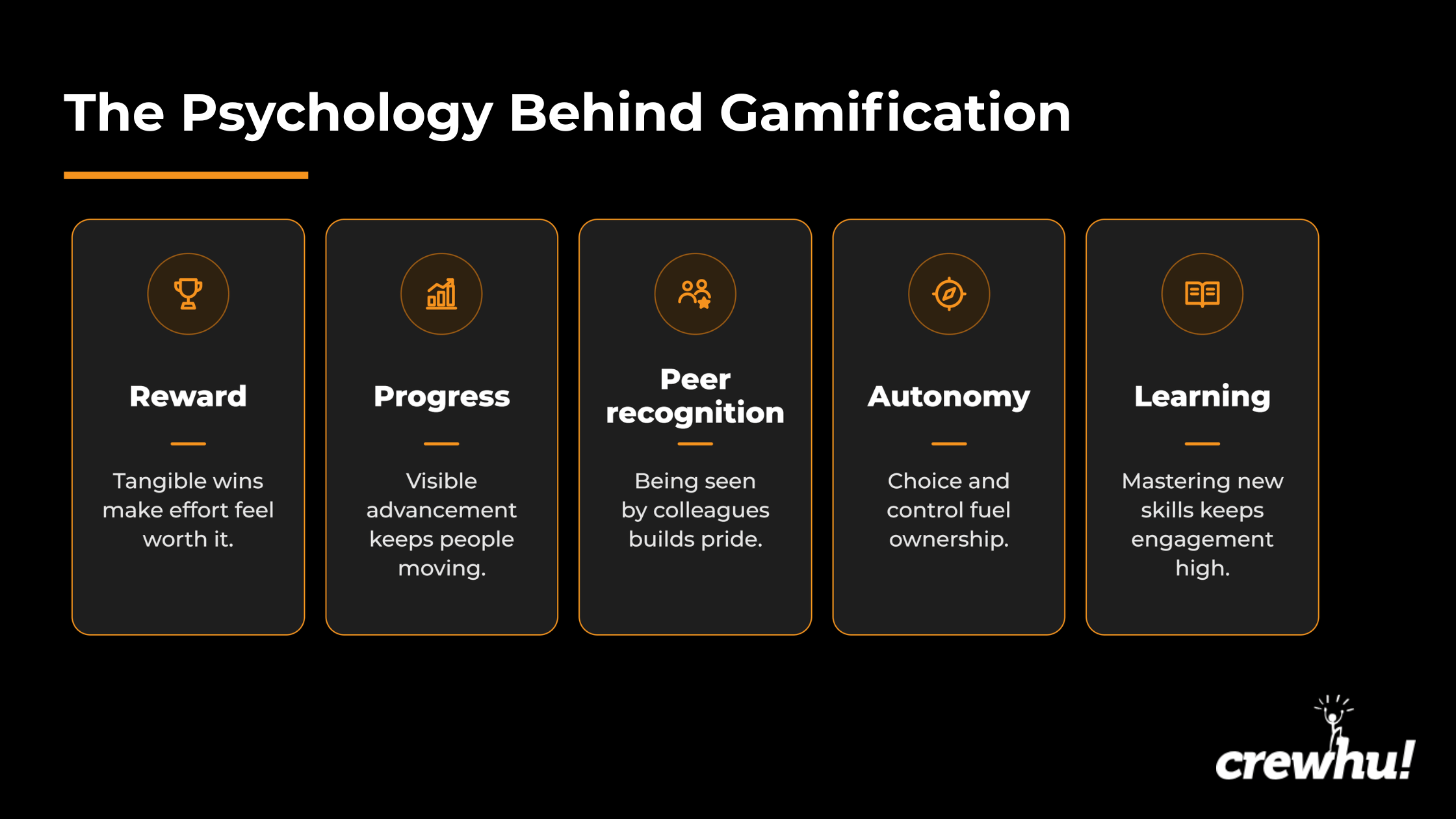
Gamification takes video game mechanics like scoring, badges, tiers, and competitive rankings and applies them to work tasks and related achievements. A service desk technician might earn points for every ticket resolved, or a new certification might come with an unlockable badge once someone finishes the coursework for it. A live leaderboard can also track renewals and upsells for account management.
Why gamification and employee engagement pair so naturally comes down to psychology and organizational reasoning:
- A tangible sense of reward: We like it when we win. As research in the Journal of Medical Education and Development found, we get a rush of dopamine from gamification. When a technician knocks out a complex escalation, watching their points tick upward or unlocking a badge gives them an instant hit of satisfaction. That immediate payoff sets a clear standard for what great work looks like.
Instead of waiting six months for a performance review just to hear "good job," real-time recognition reinforces great habits the exact moment they happen.
- Give progress a physical shape: Nobody likes working toward an invisible target. When a tech sees a visual progress bar sitting at 80% though, finishing that final stretch becomes a fun challenge. Clear, visible milestones take your crew from “meh” to “motivated.” In fact, research published in Acta Psychologica has even shown that participants given a progress bar generated about 118% higher contribution scores than those who received gamification.
Once progress becomes something employees can see, the work stops feeling mindless and turns into a shared goal they actually care about hitting.
- Peer recognition: Peer recognition from coworkers boasts a high extrinsic value. Public leaderboards, shoutouts, and earned badges speak directly to that desire for status among colleagues, something an annual review buried in a private conversation can't replicate.
- Frictionless learning: Gamified training programs lead to noticeably better knowledge retention than standard formats. In fact, compared to traditional learning, gamified training increased employee knowledge retention by 40%, according to Shift Learning.
Practical Ways to Apply Gamification for Employee Engagement
Different gamification elements work better for different companies. What returns the best results depends on your team, the nature of their work, and the specific outcome you're chasing. For MSPs, that might mean encouraging technicians to document tickets properly, helping new hires get up to speed, or recognizing employees who consistently deliver excellent customer service.
The key is to reward behaviors that contribute to a meaningful outcome, rather than simply giving people more activities to complete. Here's how different gamification methods work in practice.
Structured Onboarding Paths
Break new-hire onboarding into a sequence of achievable milestones, with badges, points, or small rewards marking each completed stage. For example, an MSP could turn its first 30 days of technician onboarding into three levels:
- Level 1: Getting Started – Complete PSA/RMM training, learn internal procedures, and demonstrate how to categorize and prioritize incoming tickets.
- Level 2: Learning the Ropes – Shadow a senior technician, observe several client interactions, and practice documenting resolutions.
- Level 3: Working Independently – Resolve five supervised tickets, provide appropriate client updates, and document solutions correctly.
Each stage has clear completion criteria, and a manager or mentor confirms the technician has demonstrated the required skills before awarding the badge.
For each level, the employee could also earn a digital badge displayed on their profile. Then upon finishing the entire onboarding path, they could receive a tangible prize, such as a gift card or team lunch. Points could even accumulate toward prizes in a company reward store.
Make progress visible and recognize learning milestones rather than encourage new technicians to race through training.
Metric-Based Leaderboards and Contests
Well-designed leaderboards introduce friendly competition by ranking employees or teams according to specific goals. They're particularly useful in MSPs because many service activities are already tracked through PSA systems and customer feedback.
However, the choice of metric is crucial. A contest rewarding only the number of tickets closed might encourage technicians to rush resolutions or prioritize easy requests. A better approach is to combine output with quality.
For instance, a service business could launch a four-week "Clean Ticket Closure Challenge" where technicians earn points for closing tickets with complete resolution notes and appropriate customer communication. Managers would also monitor reopened tickets to ensure faster closures aren't sacrificing service quality. Separate categories or team goals would keep the competition fair for employees handling different workloads.
As for rewards, the business could offer points for every qualifying closure, a "Documentation Champion" badge, a $50 gift card for the monthly winner, or a team lunch if the entire service desk reaches its target. Employees who meet a personal improvement goal could also earn rewards, rather than reserving everything for first place.
XL.net leveraged this method after struggling to get an engineer to consistently complete an end-of-project procedure. The employee was supposed to email clients explaining what their problem was and how it was resolved but repeatedly failed to do so despite managerial intervention.
XL.net then introduced a "100% Closings Contest" through Crewhu, and that same engineer ended up taking first place. When asked what changed, he explained the contest had made the task fun. It was a simple, yet powerful fix.
Certification and Skill Tracks
Technical employees need continuous learning, but long certification programs can feel like another obligation competing on top of their regular workload. One way MSPs can encourage ongoing development is to organize training into tiered skill tracks, where completing one challenge unlocks the next.
For example, a service company developing its cybersecurity capabilities might introduce a three-stage security track:
- Security foundations: Complete introductory training and pass an internal knowledge assessment.
- Practical application: Participate in a simulated phishing incident or another supervised security exercise.
- Certified specialist: Earn a relevant certification, such as CompTIA Security+, and demonstrate how the knowledge applies to client environments.
Employees could see their progress through badges, achievement levels, or a visual progress tracker. Managers would then verify course completion, practical exercises, and certifications before awarding points.
A fairly easy reward here would be to include paid study time, certification exam reimbursement, redeemable points, or a larger reward for completing an entire learning track; a technician who finishes the security track might also gain the opportunity to participate in more advanced security projects.
Kraft Technology Group used Crewhu to reward certification achievements. When employees earned a qualifying certification connected to a business partnership, they received points redeemable for badges, prizes, and other rewards. This connected professional development to a tangible incentive, reinforcing the company’s emphasis on building the skills needed to support its clients securely.
Wellness-Based Challenges
Not every gamification program needs to revolve around productivity. Wellness challenges give employees opportunities to take a break and participate in something unrelated to work. These can be particularly useful in MSP environments, where technicians spend long hours at their desks or deal with stressful incidents and demanding clients.
Research published in Healthcare (Basel) found that even 15 minutes of exercise per day can increase employee energy, health, sleep, and mood by 7%–14%. So, a service business could organize something like a voluntary six-week movement and recharge challenge, where participants choose activities like taking a short walk, stretching between tasks, or spending part of their break away from screens.
Rather than competing over who walks the most steps, employees could earn a weekly participation badge for completing their chosen activity. The company might also introduce a collective goal, allowing participants to work toward a shared reward.
To incentivise this, you might offer wellness-related prizes (e.g., a nice water bottle, a spa certificate), an extended team lunch, or a donation to a charity chosen by the participants. Employees could also collect points toward a larger reward without having to compete against coworkers.
Supporting employee well-being also supports fiscal health. In fact, Deloitte estimated an average return of £4.70 in improved productivity for every £1 invested in employee mental-health support.
Rewarding Feedback Participation
Gathering client feedback is great, but acting on it is where MSPs win or lose renewals. When a 5-star CSAT review rolls in, celebrate the assigned tech right away. If a negative survey hits, reward the crew member who steps up to reach out to the client and resolve the issue. Turning feedback loops into a rewarding habit builds accountability and keeps your client retention high.
For example, when a customer submits a negative survey response, an MSP could reward the assigned technician or responsible manager for reviewing the comments, recording an appropriate follow-up, and documenting any corrective action. Completing the process correctly might earn points or an achievement badge.
Public Recognition Feeds
A whopping 80% of IT pros say they simply don’t get enough recognition for their daily grind, according to ITSM. A public recognition feed changes that by turning everyday wins into micro-moments of appreciation. When peer shoutouts flow freely inside your platform's shared feed, techs start actively looking for the good in each other's work. That simple habit builds serious cultural momentum across both remote and co-located teams.
Recognizing your team members is non-negotiable if you want them to feel appreciated. A way to start would be to create three recognition categories based on company values, such as:
- Customer Hero: For someone who went above and beyond to help a client
- Team Player: For an employee who helped a colleague resolve a difficult issue or shared useful knowledge
- Problem Solver: For someone who identified a recurring issue and contributed to a lasting solution
Employees would submit a short description of what their coworker did and why it mattered. The recognition then appears on a shared feed, such as the company's recognition platform or a dedicated Teams or Slack channel. When verified, you can reward the employee and the coworker who recognized them with company prize store points or a featured shoutout during the weekly team meeting. Managers might also give larger rewards for particularly meaningful contributions.
ACE IT Solutions learned the efficacy of this tactic by tying recognition to company values and letting employees recognize one another for a job well done. According to the company's Director of Service and Culture, employees enjoyed receiving recognition from coworkers and found the experience motivating.
This approach also creates opportunities to recognize work that doesn't always appear in productivity reports. A NOC engineer preventing a recurring incident or a senior technician patiently mentoring a new hire deserves appreciation, even if neither achievement adds much to their ticket count.
How to Measure If a Program Is Actually Working
A gamification initiative that isn't tracked is just a guess about what motivates your crew. It deserves the same scrutiny as any other operational investment. So, to ensure clear, reliable results, define what success looks like before launching a program, then measure it consistently.
Collect baseline data
Begin with basic activity levels. Participation rates, completion rates, and how often people come back to engage again tell you if the system is even being used. A sharp drop-off two weeks in is a warning that something about the design isn't sticking.
Tie metrics to outcomes
Gamification should serve your business goals instead of running parallel to them. If your closed ticket count skyrockets but your CSAT score takes a dive, your game is rewarding speed at the expense of client satisfaction. Make sure your scorecards balance velocity with quality metrics like first-contact resolution and survey scores. That protects your client relationships while keeping your technicians focused on what truly matters.
|
Metric |
What it tells you |
|
Participation rate |
Are employees actually engaging with the program? |
|
Completion rate |
Are employees finishing challenges rather than dropping out? |
|
Target behavior change |
Is the behavior you're trying to encourage actually improving? |
|
Business outcome |
Is it improving CSAT, SLA compliance, resolution time, sales, or another real KPI? |
|
Sustained behavior |
Does the improvement remain after the challenge or reward ends? |
Ask for employee feedback
Ask people what they think and feel about the program. You can use pulse surveys to capture sentiment and reveal problems that raw numbers won't. A leaderboard can look great on paper while quietly making team members feel worse about coming to work, so don’t trust numbers alone.
Test variations
Run variations of the gaming mechanics you use. That could be individual scoring versus team scoring, points versus badges, or public recognition versus private. Different structures land differently with different groups. Testing alternatives helps identify what drives lasting behavioral change.
Look for fall-off moments
Pay attention to where people drop off in the program. This entails pinpointing where engagement collapses. A steep decline right after the first week might mean early milestones aren't compelling enough. Meanwhile, a drop-off concentrated in one team or shift could point to unequal access or an uneven playing field.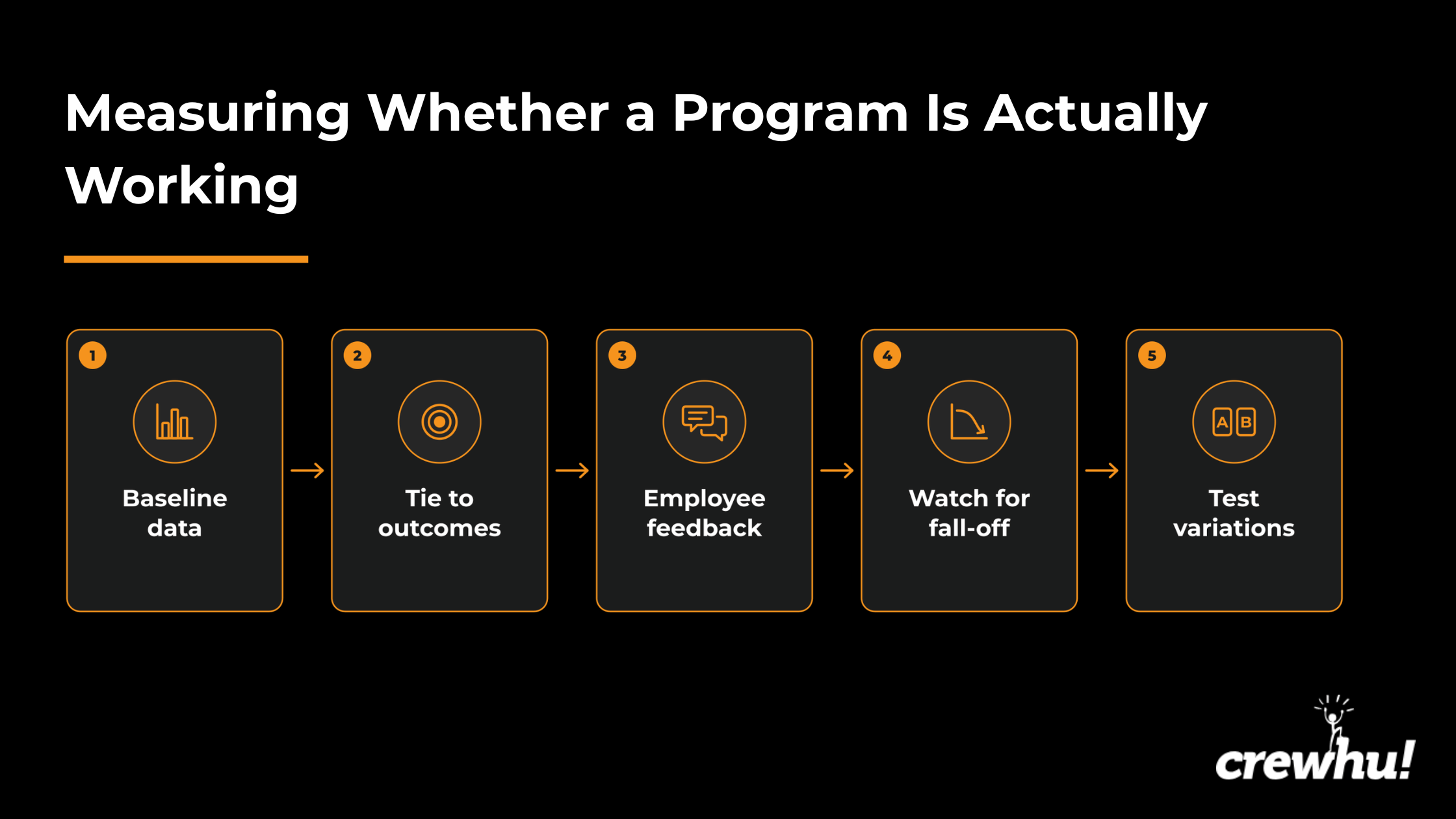 The companies that gain the most value from employee engagement gamification treat it as something to revisit regularly, rather than a program to launch once and never touch again. They check the data on a set schedule and adjust accordingly.
Where Gamification Can Go Wrong
For every gamification win, there's a program that was quietly retired after a disappointing quarter. Many of those failures come back to a series of recurring mistakes.
Treating gamification as just “playing a game”
Gamification isn’t about turning a job into a video game. Its goal is balance. Too little reward, and points and badges feel like decoration that nobody cares about. Too much though, and the game becomes the main focus, with technicians chasing scores instead of solving client problems. If you reward the wrong thing, people will deliver exactly that, even at the expense of quality and productivity.
To get results out of gamification, anchor every game element to a behavior that leads to a real business result. A live dashboard that recognizes technicians for first-contact resolution and strong client feedback counts as gamification. A random trivia contest disconnected from anyone’s actual job does not. It also helps to reward speed and quality together, such as pairing resolution time with reopen rate, to avoid cheating or gaming the system.
Overfocusing on praise and achievements
Leaderboards cut both ways. When there's a big, obvious gap between the top performer and everyone else, the people near the bottom often disengage rather than feel motivated to climb. After all, why bother if you’re never going to catch up? If a leaderboard is part of your plan, pair it with team scoring or improvement-based metrics to keep it from turning into a one-person spotlight.
For social recognition, encourage specific, meaningful praise without turning the number of shoutouts an employee receives into another competitive ranking. Workers should also have the option of receiving appreciation privately.
Rewards becoming more important than work quality
Some people get hooked on winning and start fixating on their leaderboard spot. As a result, they act just to raise their score instead of improving their work. For a service desk, that can appear as closing tickets early and watching them reopen, cherry-picking easy tickets, splitting one issue into several, or rushing clients to shave resolution time. Teammates can start to feel like competitors, and unrewarded work like documentation and mentoring gets neglected.
To address this, keep the rewards light but valuable enough to be enticing. That makes recognition feel like a nod to good work rather than the sole reason for doing it. It also drives intrinsic motivation; people need to feel a sense of purpose when they do good work, so points and badges should reflect that purpose back to them. When the game supports the work, it adds energy and makes progress visible.
Gauge the Practicality First
Before you jump on the gamification bandwagon, run a quick gut-check to see if it’s the right step for your company:
- What behavioral gap exists that needs closing?
- Can that behavior be tracked in a way that's consistent and fair?
- Does the behavior actually matter to the business, or is it just easy to measure?
- Will the reward structure hold up over time?
- Are the surrounding process and culture capable of supporting the behavior you're trying to drive?
Clarify those answers before badges and leaderboards go live.
Make Employee Engagement Fun and Fruitful
You can't build a great client experience on the backs of unengaged, exhausted team members. Gamifying employee engagement works especially well when it's wired directly into the metrics a business already tracks. For MSPs and similar service businesses, that usually comes down to resolved tickets, response times, and customer satisfaction scores. All these are indicators of good work by technicians, and it’s important that their efforts are recognized.
Crewhu handles this by linking customer feedback and service-system activity to gamified leaderboards, badges, and recognition. That way, the person who earned a great review or pushed through a tough ticket is acknowledged while it's still fresh, not months later during a review cycle. Ready to turn daily metrics into lasting team momentum? Book a Crewhu demo today and see how easy it is to fuel your crew's performance.
FAQs
What does gamification for employee engagement actually mean?
Gamification for employee engagement is the practice of layering gaming elements (e.g., points, badges, tiers, leaderboards) onto real workplace tasks to drive motivation, participation, and performance. Its goal is to target measurable behaviors and business results. Gamification fosters motivation and better work among employees by making everyday tasks and milestones fun.
What are some fun activities for employee engagement?
Fun activities that companies can introduce include team challenges, volunteer days, lunch-and-learns, themed social events, group wellness activities like yoga or step contests, peer recognition rituals, and creative projects such as hackathons. Mixing in-person and low-key options helps every personality feel included and keeps people connected beyond daily tasks.
Why do so many gamification programs fail?
Most gamification programs collapse due to the same handful of reasons. Those include leaderboards that discourage people rather than motivate, overreliance on prizes eroding genuine motivation, and game mechanics layered on top of a process or culture that's already broken. This tactic is meant to improve an existing system; it’s not a cure-all for poor worker sentiment.