Key Takeaways
- Customers can give the same low rating for very different reasons. Read each comment alongside the service record to understand what happened and how it affected that customer.
- Make successful fixes easy to reuse. Explain when each one applies, how to verify the result, and how employees should flag faulty steps.
- When a case changes hands, name who owns the next technical step and who is responsible for the promised customer call.
- Coach the skills people need to practice. Missing access, decision-making authority, or staff coverage calls for an operational change.
- Tell employees which contributions earn recognition, and let them say how they’d prefer to receive it.
- Check both whether the team used the new practice and whether customers reported a better experience. Compare similar cases with the same survey and scoring method.
Two customers give your support desk the same low rating. One has reported the same fault three times. The other got a successful repair but spent days chasing updates. Same score, two different headaches. One needs a fix that sticks. The other needs your team to call when it says it will.
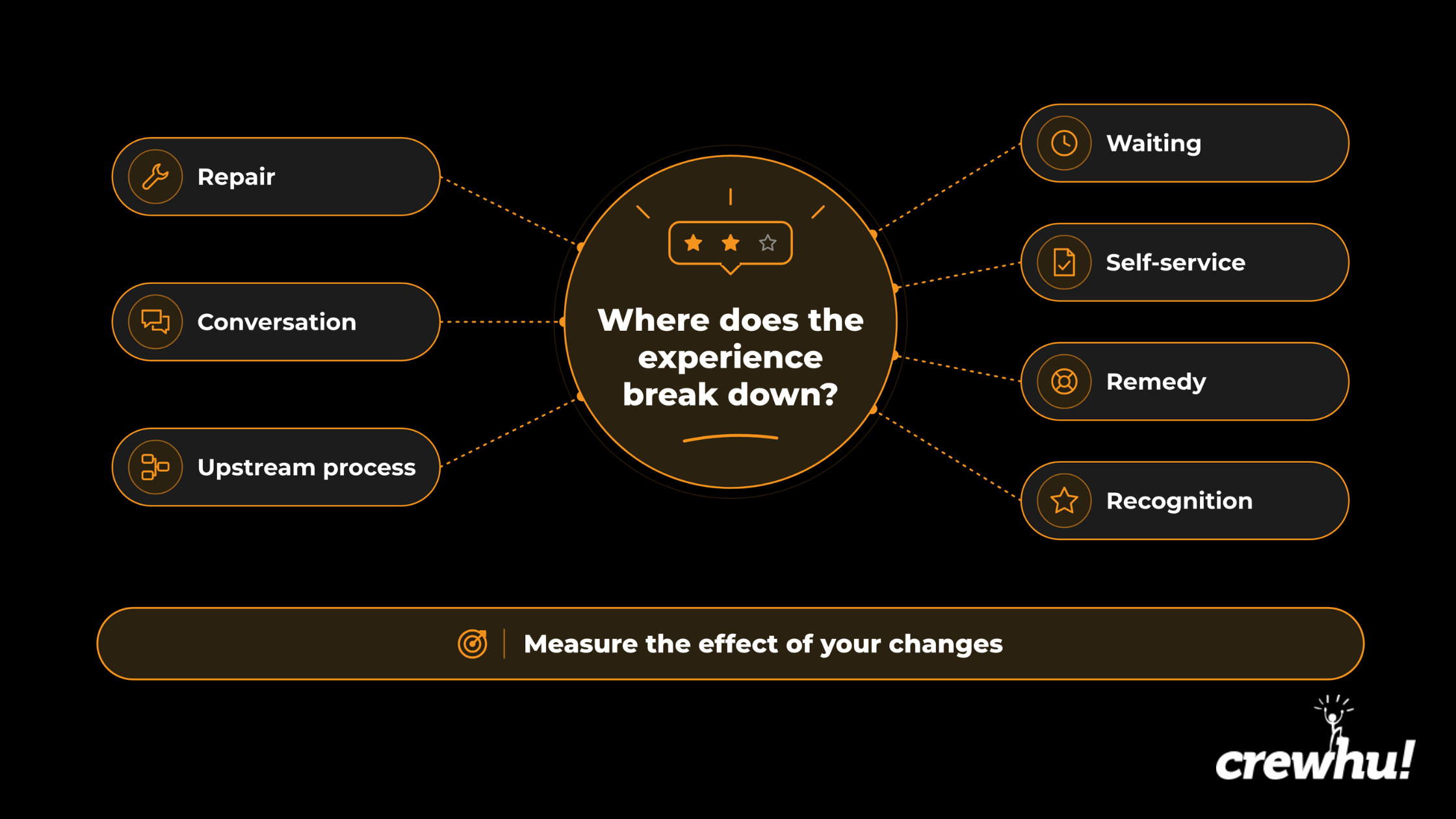
Chasing a higher customer satisfaction (CSAT) score won't tell you which part of the service needs work. Start with the problem a customer describes. Work out what's behind it, choose the relevant move from the seven below (or combine a few), and put the team that can change that part of the service in charge. Then check later cases. Did the fix hold? Did the promised call happen?
Build your first CSAT survey around one service event
Start with one type of service event, such as a support visit. After every visit, invite customers to rate the support they received, even if the problem is still open. One clear question is enough to begin:
“How satisfied were you with the support you received during this visit?”
1. Very dissatisfied
2. Dissatisfied
3. Neither satisfied nor dissatisfied
4. Satisfied
5. Very satisfied
Give customers space to explain what shaped their rating: “What most affected your rating?” Keep the comment optional, and connect every response to its visit and service date. Use the same question, five answer choices, and invitation rule when comparing similar visits. To calculate positive-share CSAT, count ratings of 4 or 5 as satisfied, divide by all valid ratings, and multiply by 100.
Find the service problem behind a low rating
A problem doesn’t have to happen often to deserve attention. A rare failure that puts payroll at risk may matter more than a frequent minor inconvenience. Weigh how often each issue occurs against what it costs the customer. Then trace the problem to the decision or service step causing it and give responsibility to someone who can change that step. If two departments control it, put one lead in charge of coordinating the work.
A customer says you missed a deadline, and the service record shows an approval sitting untouched for two days. Read the customer’s account alongside the service record to work out what happened. If something is missing or the details don’t match, ask the customer or employee a follow-up question.
For each case, find out:
1. What the customer needed to get done and what your team promised?2. What the customer and employees tried, and what happened after each attempt?
3. Where work stalled, information went missing, or the customer had to ask again?
Several customers might describe a transfer as “unhelpful,” but they may mean different things. Read each ticket with the handoff messages to understand what that customer experienced.
|
What the case shows |
Where to act |
Lead |
|
Reset repeated because the earlier result was missing |
Handoff records and next steps |
Support lead |
|
Customer had to chase an update |
Update plan, clear messages, or call coverage |
Support lead |
|
Employee can’t access account details |
Appropriate access or authorized help |
Service manager |
In a small team, the lead can go through the customer’s account and the service record with the employee who handled the request. Larger operations can group responses by service and send each group to the lead who owns that work.
1. Make successful fixes repeatable
Start with the task the customer couldn’t complete. If the problem was a login, make sure they can access the application they need. If it was an equipment fault, test the repair under the conditions that triggered it. The fix should hold after the interaction, and the employee closes the request once the customer can do the task that was blocked.
Write instructions the next employee can use. Explain when the fix fits, what access or preparation it requires, and how to verify the result.
Good instructions begin with the problem as the customer actually describes it. The Knowledge-Centered Success (KCS) Practices Guide recommends recording those words while you work, so the next employee can find the answer when the same symptoms show up. Reuse the article on a live case and check whether its steps hold up. Correct any gaps in the instructions you’re authorized to change, or flag the rest for the guide’s owner while the details are fresh. If no article fits, use the customer’s case notes to start one. Add the steps that work and the conditions for using them as the investigation continues.
Jack Lincourt had a useful puzzle. On How to MSP, the VP of Service Delivery at Microtime Computers recalled a technician from an earlier employer who handled a certain type of problem far faster than his colleagues. Had he found a smarter method, or was the speed hiding a fix that wouldn’t last? To help tell the difference, Lincourt checked whether the same customer reported the same issue again weeks or months later. He then worked with technicians to put the effective steps into ConnectWise templates that appeared on matching tickets.
The templates faced another test when newer staff started following them. They found gaps in the instructions. If a prescribed step caused trouble, Lincourt was prepared to explain it to the customer himself and have the procedure corrected.
2. Reduce delays and keep customers in the loop
A delay can throw off the customer’s plans as well as your team’s work. Find out what’s holding the request up, get the right person working on it, and give the customer a reliable update they can plan around. Their deadline helps you decide when that update needs to come.
Find the cause of the delay
A ticket can get stuck for different reasons. It landed in the wrong queue. It reached the right queue when no specialist was available. Or it’s waiting for an approval. Check when it last moved and ask the people on that shift what held it up. If routine approvals are the recurring bottleneck, the decision-maker can spell out which routine requests support agents may approve themselves and which exceptions still need review.
Fix the hold-up you actually found. If the routing rule sent the ticket to the wrong queue, correct it. If a specialist is on duty but keeps getting pulled away by routine questions, have a colleague cover those questions for a block of time. And if no qualified specialist works the shift when requests pile up, change the schedule or train someone to cover the gap.
Give customers updates they can use
When a job is stuck with a supplier, don’t leave the customer guessing. Put someone in charge of checking with the supplier, then explain what the answer means for the customer’s plans.
Payroll is due at 4 p.m., and the payroll administrator calls support because they can’t get into the application. The password reset goes through. Access is still blocked. The support agent asks how long the customer can wait before switching to a backup plan. They agree on a call by 3 p.m., leaving time for that decision. An access specialist takes the case and agrees to send the agent a status report by 2:45.
“Your password has been reset, but access is still blocked. Our access specialist is checking your permissions. I’ll call you by 3 p.m. so you can decide whether to use your backup plan. You’ll hear from me even if we haven’t restored access.”
The specialist’s 2:45 status report may have no new findings. The agent still makes the promised call at 3 p.m. They tell the payroll administrator what’s confirmed, what’s still open, and agree on when they’ll speak again. The customer can make the backup-plan decision before payroll is due instead of chasing the desk for updates.
When a customer has to chase an update, find out where the communication broke down:
- Was there an agreed next step and contact time? → If not, the support lead establishes both.
- Was the plan clear but the message hard to follow? → Review what the employee knew and practice the explanation if the problem was a skill gap.
- Was the promised call missed? → Check workload, reminders, and shift cover.
3. Help customers get support without starting over
Give customers useful instructions, a clear route to support, and a way to carry over the steps they’ve already tried.
Help customers complete the task on their own
Lead with a problem customers recognize. Put any preparation or permission requirements up front, give them current steps they can follow, and show them how to tell whether the fix worked.
A printer guide can finish with a test page and one optional check: “Did the test page print?” A “no” can open a support form asking which step failed and what error appeared. Send those answers with the request so the support employee can see where the customer got stuck. When the same step keeps showing up in reports, the guide’s owner has a clear instruction to test.
Silence doesn't tell you whether the fix worked. A reader who leaves without answering or asking for help might have fixed the printer or given up. Keep the outcome marked as unknown. And if a step calls for administrator access, put the contact route beside it so someone with permission can take over.
Keep the case moving when it changes hands
The payroll case reaches the access specialist with the history they need: the password reset is complete, access is still blocked, and the customer has a deadline for deciding whether to use a backup plan. That gives the specialist a clear starting point for checking permissions. The support agent who took the call receives the specialist’s progress report and calls the customer by 3 p.m.
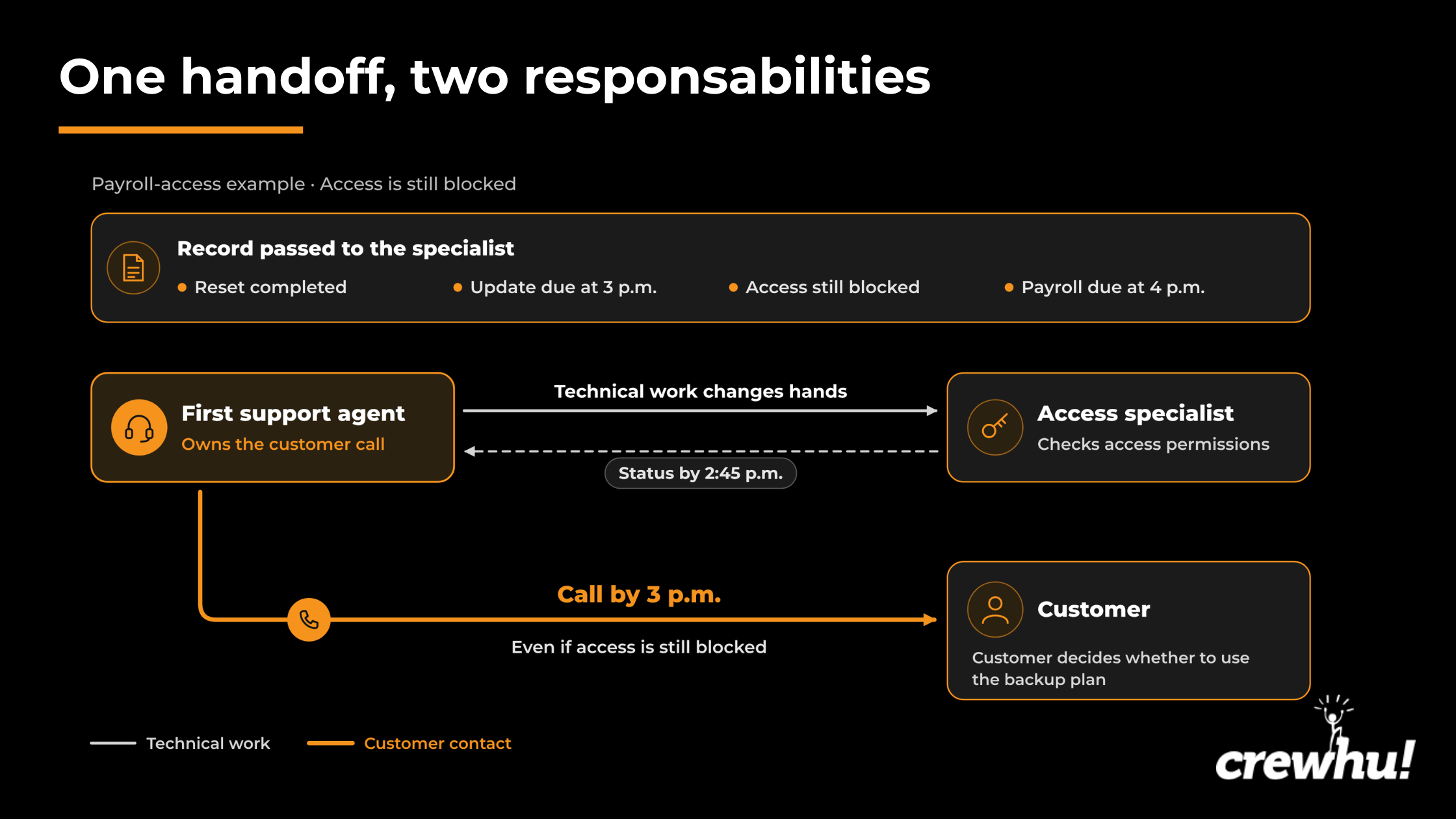
A shift change doesn’t cancel a promise to the customer. Before the handoff, get a covering colleague to accept responsibility for the call. Record who’s calling, when, what the specialist still has to do, and who will send the findings.
A ticket can change hands while the customer’s problem is still open. The receiving employee needs the relevant history and must accept the next action before the internal handoff is complete. Keep the customer’s request open until the team checks with them that the repair restored the access they needed.
4. Give employees better skills and fewer roadblocks
You can’t coach someone into having access they were never given. Start with what the employee knew, could see, and was allowed to do. If they had what they needed but struggled with the response, practice that skill. If access, approval authority, or specialist cover was missing, fix the way the work is set up.
Practice how to guide the conversation
Take the moment the employee struggled with and turn it into a coaching exercise. Maybe the employee gave a fuzzy explanation, didn't ask how urgent the request was, or promised something without checking first. Go back to what the customer said and the information available to the employee at that moment. Then rehearse a clearer response.
A 2026 study in Production and Operations Management examined online service chats and follow-up experiments. Customers were more satisfied when employees gave direction to those seeking guidance and left more room for customers who took the lead. Calm replies also supported satisfaction whether customers sounded relaxed or tense.
One customer proposes a workaround. The other asks where to start.
|
What the customer says |
Example response |
|
“The export failed twice. My meeting starts in 20 minutes. Can you send me a PDF instead?” |
“I’ll check whether I can send the PDF before your meeting.” |
|
“I’ve never exported this report. Where do I start?” |
“Open the report and tell me whether you see an Export option.” |
The first customer already has an idea: send a PDF instead. The employee takes it seriously without promising to send one before checking whether they can. The second customer wants a starting point, so the employee gives one and asks what the customer sees on the screen. Both replies stay calm.
Use the next relevant customer exchange to check progress and give the employee feedback. Did the employee respond to the suggested workaround and the deadline? When someone asked where to start, did they give a clear first step and check what the customer could see?
Give employees access and a clear approval route
An employee may know how to answer a billing question but still be stuck without access to the account terms. The service manager works with the system owner to arrange appropriate access or bring in an authorized colleague on that shift.
An approval can stall when nobody knows who can give it. The manager names the approver on duty and agrees how soon agents should expect an answer. On the next request needing approval, the employee checks that the route works.
5. Match the remedy to the customer’s deadline
A fix that turns up after the deadline isn’t much of a fix. First find out what the customer still needs to get done and how much time is left.
Picture a cleaning company leaving an event space unfinished, with guests due that afternoon. The manager finds out exactly which rooms must be ready. If another crew can finish in time, they get a list of unfinished areas, and the manager arranges to walk through those rooms with the customer before the crew leaves.
If the company’s crew can’t finish before guests arrive, the manager checks whether it can cover the cost of the cleaner the customer has already found.
According to research by Fürst and colleagues, explaining the reasons behind a service failure differs from clarifying the rationale for selecting a specific remedy. The event won’t wait while the manager investigates what went wrong. If the outside cleaner is available and the company approves the cost, paying for that cleaner gets the rooms ready in time. The manager can work out why the first crew didn’t finish once the immediate plan is in place.
The manager puts a practical option on the table: “Our next crew can’t arrive until two. You said a local cleaner can finish before noon for $180. I can approve that cost now and email you confirmation before you book.” Follow through by checking that the cleaner is available, sending written approval before the customer books, and making sure the company pays.
After arranging the outside cleaner and payment, the manager checks with the customer that the rooms are ready before the event. Then comes the question that helps prevent a repeat: what kept the first crew from finishing? If those rooms were missing from this crew’s work order and earlier crews’ orders, the next fix belongs with whoever prepares the orders.
6. Stop the same problems from reaching support again
Sometimes support hears about problems another team set in motion. A booking team might promise a visit before the required parts are available, or a project process might send routine setup work to a service desk that’s already overloaded. The team controlling that booking or project decision needs to change what keeps causing the complaint.
XL.net heard from customers who weren’t happy with workstation setups. According to CEO Adam Radulovic, the MSP introduced a new team and process to take pressure off its service team. He reported a better project experience for customers and employees.
Consider a field-service business that keeps postponing visits because the required parts haven’t arrived. Support records the affected bookings and how the delays affect customers. Dispatch keeps each visit provisional until inventory confirms that the parts are available for that job. Dispatch adds that confirmation to the shared booking record before promising a firm date.
If stock availability changes, dispatch revises the visit and tells the customer before they take time off or prepare the site. Check later bookings and feedback to see whether the same postponements continue.
7. Recognize the people behind better service
People should know what they’re getting credit for. Name the action an employee took and how it helped a customer or the next colleague. That could be frontline work, specialist support, or fixing a process that kept causing trouble.
A customer praises a technician’s explanation. That’s a useful lead, but what made the explanation work? The team lead reviews the exchange for an approach others could use.
Once the request is resolved, the employee sends a final email explaining what was fixed and what the customer should do next. Recognition for that message depends on three checks:
- The explanation matches the completed work
- Any remaining limitation is clear
- The next step is usable
The lead checks the email against the case and names the employee’s specific contribution when awarding recognition. A high customer rating is useful feedback, but it doesn’t show what each person contributed.
The Incentive Research Foundation surveyed 400 U.S. reward-program participants. Reward value mattered to participation, but fair and consistent rules for earning rewards also shaped the program’s credibility. Preferences for public and private recognition differed. Ask your own team what rewards they value and how they’d like their work acknowledged.
Let employees choose among rewards where possible. Set clear recognition criteria for documentation fixes and specialist help, too. Employees who don’t send final customer emails should know which contributions can earn recognition.
One XL.net engineer had been missing required project-completion emails explaining the problem and how it was resolved. Radulovic says the engineer later won XL.net’s “100% Closings” contest and told him the contest made the task fun.
Measure the effect of your changes
To check a handoff change, compare similar transfers. Include cases where the first agent tried a fix and a specialist had to decide what to do next. Use the same rule before and after the change, and leave out requests one agent resolved alone. Suppose earlier records show specialists repeating resets because the first attempt’s results never reached them.
Now look at 12 later transfers that meet the criteria. The records confirm use of the new handoff procedure in eight. For the other four, the records don’t confirm whether the procedure was used, so don’t count them as failures to follow it. Ask the agents and specialists what happened and check other channels. If one shift couldn’t access the handoff field, restore access and find out whether the information was shared another way.
Review what happened across all 12 transfers, not only the eight with confirmed use. If those eight no longer show repeated resets but customers still call asking for updates, keep the technical handoff and investigate communication separately. Did the team agree on an update plan? Was it explained clearly? Did the promised call happen?
Of the 12 transfers, five received valid ratings: three positive, one neutral, and one negative. Both CSAT calculations use those same five responses.
|
Calculation |
Result from these five ratings |
|
Positive-share CSAT |
3 ÷ 5 × 100 = 60% |
|
Crewhu CSAT |
(3 − 1) ÷ 5 × 100 = 40% |
Positive-share CSAT counts positive ratings. Crewhu subtracts negative ratings from positives before dividing by all five valid responses. The neutral rating stays in both denominators.
For a useful comparison, keep the survey question, rating scale, invitation trigger, and scoring rule the same across periods. Check all 12 service records for repeated troubleshooting and missed updates. The five ratings describe satisfaction among respondents. The records can’t establish how satisfied the others were.
Overall CSAT also covers customers whose requests never required a transfer. If higher-rated simple requests make up more of the returned ratings, overall CSAT may improve while customers with transfers still chase updates. Check the transfer records for repeated steps and missed updates, then look at ratings returned by that group.
Use Crewhu to link customer feedback with recognition
Suppose a customer says their final service email left them unsure what was fixed. The service lead opens the comment in Crewhu Pulse and, where a ticket link is available, compares the email with the work recorded in the ticket. They identify what wasn’t explained clearly and help the employee revise that part.
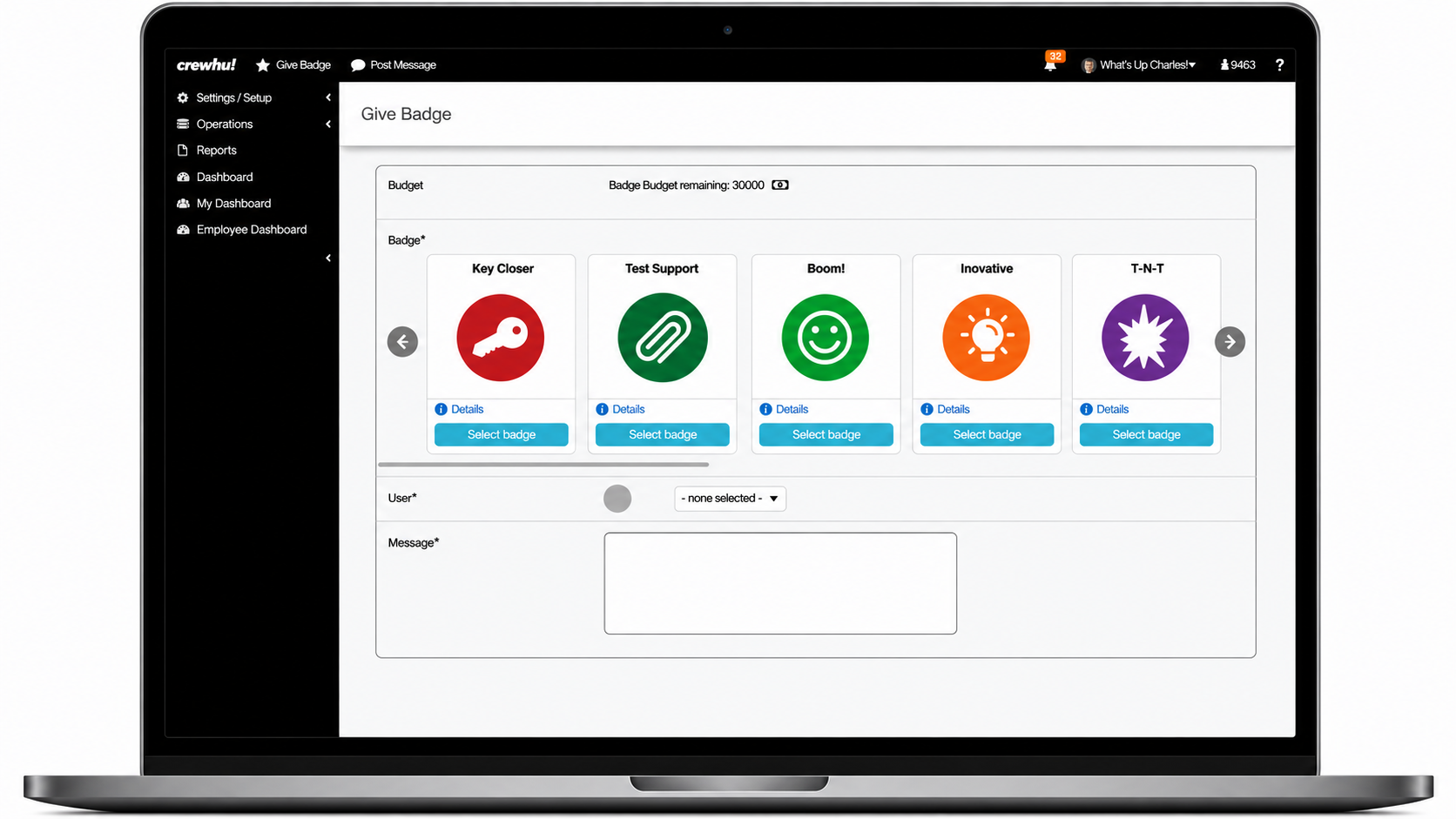
If a later final email accurately explains the repair and gives the customer a clear next step, the lead checks that message before awarding a recognition badge. The badge names the action worth repeating.
Next, the lead reviews later final emails against the same criteria, even when no survey response came back. They use each ticket’s service date and the email itself to find cases that used the revised approach. Pulse’s date filter reflects when feedback arrived, not when the service took place. The lead then reads related feedback for signs that customers understood the explanation or still had questions about what happened.
Our XL.net case study reports 95% CSAT and a 20% increase in employee engagement while the company used Crewhu for feedback, recognition, and contests.
Your next step
A recurring fault, a missed update, and a remedy the customer can’t use call for different changes. Start with the problem customers describe. Give the responsible team what it needs to fix the problem, then check later service cases. Use records and comparable feedback to see what improved and what still needs work.
Book a Crewhu demo to see how your team can review customer feedback and recognize the work behind better service.
FAQs
How long should you wait to assess a CSAT improvement?
Check the change when customers first experience it. For a promised callback, review whether the call happened at the agreed time. For an issue that recurs during monthly payroll, check the fix at the next payroll run. Compare ratings from those service events with ratings from the same type of earlier events, and show how many customers responded alongside each score.
What if very few customers respond to the survey?
Start with the feedback you received: investigate the issues customers described, then keep surveying the same type of service event. If six customers qualified and five replied, the main limitation is the small number of service events. If 60 customers qualified and only five replied, check how many invitations reached customers. If delivery is confirmed, test the survey link and remove unnecessary questions. Put the five responses beside the score and look for the same pattern in later feedback before claiming a broader improvement.