.png)
Key Takeaways
- Managed service provider (MSP) business development sits between visibility and sales conversion — turning fit, credibility, proof, and relationship signals into qualified commercial conversations.
- Daily service work already supplies many of the strongest business development inputs: resolved problems, customer feedback, technician performance, quarterly business review (QBR) insights, reviews, and referral-ready trust. Service inputs only matter once someone captures and routes them.
- A repeatable system needs more than activity volume. Right-fit targeting, visible proof, intentional relationship surfaces, a clean sales handoff, and opportunity-quality measurement all have to work together to produce results.
For many MSPs, the right buyers may already know they exist. The buyers still fail to see why the MSP is credible, where it fits into their broader company, or why a sales conversation is worth having.
More marketing or referral asks won’t fix that by themselves. An MSP may already have loyal clients, capable technicians, and strong response habits. But a few happy referrers and scattered outbound activity can still sit around the edges without contributing to real business development (BD).
The service is strong. The proof, though, stays trapped inside tickets, QBRs, customer comments, and founder memory. Customer trust is real, but no one is translating it into qualified opportunities with enough context for sales. MSP business development closes that gap, turning fit, credibility, proof, and relationship signals into sales-ready conversations.
What does managed service provider business development mean?
Managed service provider business development helps a provider decide which markets, accounts, relationships, and existing-client signals are worth developing into qualified commercial conversations. The discipline clarifies where opportunity should come from, why the firm is credible for those buyers, and which proof or relationship context should reach sales before a conversation begins.
The term gets messy, though, because people use "business development" for almost any growth activity. With MSPs, that loose usage creates real operational confusion. Treat every lead like a sales deal, and weak-fit prospects enter the pipeline before anyone establishes fit — then the team starts chasing them. When visibility is the only goal, marketing activity can look productive without producing qualified conversations. Relying on referrals alone forces growth to depend on goodwill showing up at the right moment.
Growth is the business result the MSP wants, and it depends on several parts of the growth motion working in sequence. Marketing creates visibility and credibility. Lead generation reveals names and intent signals. Referrals and partnerships build relationship paths. Customer success protects and expands active accounts. Sales then converts the qualified opportunities that are ready for a serious commercial conversation.
MSP business development connects those pieces before sales takes over, turning fit, proof, relationships, and service signals into qualified commercial conversations.
|
Function |
Role in the growth motion |
How business development uses it |
|---|---|---|
|
Growth |
The business result the MSP is trying to create |
Business development gives that result a repeatable path by turning fit, proof, relationships, and service signals into qualified conversations. |
|
Sales |
Qualified opportunities, discovery, scoping, proposals, objections, and deal close |
Prepares the opportunity before handoff by giving sales the account fit, trigger, proof, relationship path, and context. |
|
Marketing |
Visibility, credibility, and assets that help the MSP be found, understood, and trusted |
Uses those assets selectively when they support a right-fit account or relationship path. |
|
Lead generation |
Names, inquiries, form fills, booked calls, and intent signals |
Filters those signals for fit, credibility, and readiness before they become sales conversations. |
|
Relationship avenues that create introductions, trust, and access |
Gives those relationships a right-fit profile, useful proof, and a clear reason to introduce the MSP. |
|
|
Customer success |
The active client relationship, including retention, expansion, feedback, QBR insights, and service proof |
Notices moments of trust, proof, and account insight that help shape a new commercial conversation. |
How is business development different from sales?
Business development covers everything before a lead is qualified — building relationships, identifying right-fit accounts, and making the managed service provider's proof easy to evaluate. Sales covers everything after — discovery, scoping, proposals, objections, and the close.
Business development also gives sales the context needed for a serious conversation. A weak BD handoff offers a cold name and a vague, “They might need IT.” A strong handoff provides a right-fit account, a known business trigger, a clear reason the MSP is credible, with enough relationship context to avoid starting from zero.
How is business development different from marketing and lead generation?
Business development differs from marketing and lead generation by deciding which of their outputs are worth pursuing, rather than creating those outputs itself. Business development checks whether the account fits the MSP’s service model and whether the buyer’s problem is one the MSP can solve profitably. The team also asks if there’s enough proof to make outreach credible, and which relationship path could move the opportunity forward.
Marketing is how an MSP gets found, understood, and trusted. Lead generation converts some of that visibility into names, form fills, inquiries, booked calls, or intent signals. Staying selective this way keeps MSP business development from turning into a channel checklist. SEO, LinkedIn, email, webinars, paid search, local pages, vendor events, and content can all support the motion — but none of them is the strategy on its own.
Why are referrals, reputation, retention, and customer success important?
Referrals, reviews, testimonials, customer feedback, QBR outcomes, account expansion signals, and retention all matter to business development in different ways:
- A strong client relationship can create referral potential.
- A good review can reduce trust friction.
- A useful testimonial can help a prospect understand the MSP’s service quality.
- A QBR can uncover business value.
- A service recovery story can show how the team behaves under pressure.
Business development uses these proof points to open and develop the right opportunities. The customer-success team still owns the client relationship. BD’s role is to notice which moments of trust, proof, and account insight are useful for a new commercial conversation.
The role of existing customer growth
There’s also room for development when an existing client’s needs begin to change. Ordinary service conversations stay focused on service. BD pays attention instead to moments when the relationship has outgrown the current model.
Expansion signals can come from QBRs, ticket patterns, feedback themes, security assessments, or compliance pressure. Other signals include user or location growth, aging infrastructure, or repeated requests that no longer fit the current service package. BD’s job is to clarify what’s changed, why the current model no longer fits, which pricing or service-package evolution would work, and which proof makes the recommendation credible.
Working this way keeps expansion tied to client value rather than opportunistic selling. Upsell, cross-sell, and pricing-model changes belong in the growth system when they solve a visible operational problem, reduce risk, or help the client standardize. Customer success stays responsible for protecting the relationship. Sales or account leadership owns the commercial process. BD helps identify when to develop the conversation, and what context should travel with it.
What are common managed service provider business development mistakes?
Managed service provider business development often fails in predictable ways:
- Mistaking motion for a system: Networking, email, LinkedIn posts, events, and referral asks make an MSP look busy. But they’re next to useless when fit, proof, relationship channels, handoff, and measurement are still unclear.
- Chasing every account that looks active: Poor-fit prospects drain technician capacity, weaken profitability, and pull sales away from better opportunities. Good business development sharpens selectivity instead.
- Letting service proof disappear: Many MSPs have strong customer stories buried in tickets, surveys, technician notes, QBRs, and informal client comments. Without a way to capture and organize those signals, BD ends up relying on vague claims instead of credible proof.
- Measuring meetings as if they prove progress: A calendar full of poor-fit conversations can make growth feel busy, even while sales and service capacity leak into the wrong accounts.
Why does managed service provider business development need a repeatable system?
Managed service provider business development needs a repeatable system because a system gives relationship work a clear operating rhythm. A business development system helps the MSP decide which markets to pursue, what proof to carry, and which relationships to develop. The system also clarifies how outbound and digital activity should support the motion, what sales needs to know, and whether BD is producing better opportunities rather than more noise.
Referral-led growth works well up to a point. Many MSPs begin with founder relationships, local reputation, channel contacts, and word of mouth — a powerful start, because trust is already present.
Scaling is the hard part. The MSP depends on who the founder knows, who remembers to refer, which client happens to mention the firm, and whether the referred account is actually a fit. The same motion can produce good opportunities one month and long periods of quiet the next. The same referral motion can also pull sales into poor-fit conversations with no clear way to build new commercial momentum.
Kaseya highlights customer acquisition, competition, security demand, automation pressure, and proof of value as major concerns for MSPs. ITPro adds pressure around budgets and shrinking deal sizes to the list. Together, this context supports a more disciplined opportunity-creation motion. No single tactic or tool guarantees growth.
The operating loop is straightforward, but it works best as a repeating system rather than a one-time checklist.
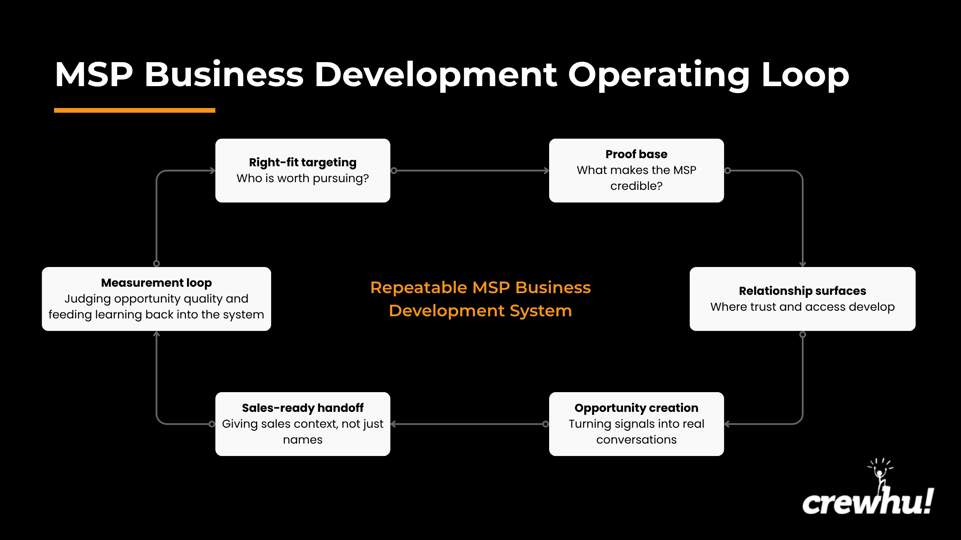
Start with right-fit targeting before chasing more activity
Right-fit targeting gives business development a filter before activity begins. The MSP can then decide which accounts, verticals, regions, company sizes, service needs, buying triggers, and risk profiles deserve attention. The same criteria also make it easier to turn away opportunities that look active but don’t fit the MSP’s operating model.
Business development weakens when an MSP treats every potential lead as equally valuable. A small professional-services firm with recurring compliance needs has very different demands from a multi-location healthcare practice, a manufacturer with uptime risk, or a one-off residential-style request. Each needs technological help. None of them is the same business development opportunity, though.
The practical question is, “Which accounts are worth investing time into before they’re ready to buy?” BD may develop a relationship with a vertical association, a local business group, a vendor partner, or a high-fit account long before a form fill appears. But that relationship work only makes sense if the MSP knows what right-fit looks like.
MSP fit goes beyond basic demographics. Uptime dependence, security posture, compliance exposure, internal IT maturity, number of users or locations, willingness to standardize, and budget realism all matter. So do decision structure and appetite for a recurring managed-service relationship. An account that’s technically possible isn’t always commercially good.
A universal vertical-specialization rule isn’t the point here. Clear fit criteria and clean disqualification rules matter more at this stage. BD activity improves when the managed service provider knows which accounts deserve development, and which ones to filter out before sales and service capacity get spent.
Turn service quality into proof buyers can evaluate
Strong service work only helps business development when buyers, partners, or referrers can see it clearly enough to trust it. Customer experience visibility turns excellent service from an internal belief into something the market can evaluate.
The visibility gap shows up often in MSPs. The team resolves a serious issue quickly, or a technician may handle a difficult client with unusual care. A customer might praise the MSP after a stressful outage, or a QBR could show better documentation, stronger security hygiene, or improved responsiveness. Without visible proof, BD has little to use beyond general claims about service quality.
Business development needs a library of evidence. The library includes reviews, testimonials, case studies, customer feedback themes, service recovery stories, QBR evidence, client quotes, referral-ready narratives, and concrete examples of the MSP’s behavior under pressure. MSPs can build the archive with a simple capture rhythm around service moments that already happen:
- Identify proof-worthy moments — fast escalation recovery, strong technician praise, measurable QBR progress, a successful security improvement, or a client comment that names a specific service behavior.
- Ask while the context is still fresh, and shape the request to fit the moment. A review, a testimonial, a short quote, a case-study note, and a referral conversation each fit different situations.
- Preserve the customer’s actual language where appropriate, because specific comments carry more credibility than doctored claims about “great service.”
- Route the proof into a place BD and sales can use later, instead of leaving it in tickets, inboxes, survey exports, or a manager’s memory.
- Connect each proof point to a buyer concern — responsiveness, security confidence, documentation quality, business continuity, or trust during stressful incidents.
The aim is to make credible service signals available when a buyer, referrer, or partner needs reassurance. Beyond evaluating tools, tickets, and response times, prospects are judging whether the provider will protect their business when things get messy.
Local review research supports how influential reviews are in making decisions. For MSPs, that evidence works as general trust context, not proof of complex B2B buying behavior. Crewhu supports this proof-capture layer. Crewhu helps MSPs collect customer feedback, discover service signals, and see patterns in customer satisfaction score (CSAT) and net promoter score (NPS) results, or custom survey responses where used. Crewhu can also support recognition for proof-worthy service behaviors, making customer-impact work easier to see and discuss.
Build relationships without relying on referral luck
Business development treats relationship channels as opportunity infrastructure. Current and former clients, strategic vendors, compliance consultants, and accountants can all play a role, as can local business groups, vertical associations, cloud or security partners, and peer networks. Each relationship becomes more useful when the MSP gives it a clear story, a credible proof point, and a right-fit account profile.
Building this structure starts with a clearer relationship motion. The managed service provider needs to know who can open doors, what kind of account those people should recognize, and what proof would make an introduction useful:
- Map the relationship sources that already exist, including current clients, former clients, vendor partners, local business groups, vertical associations, accountants, compliance consultants, and peer networks.
- Give each source a simple right-fit profile so they understand which companies are actually worth introducing.
- Equip the relationship with a specific proof point, such as a service recovery story, client quote, QBR result, review theme, or technician behavior that reflects the MSP’s quality.
- Create a follow-up rhythm after strong service moments, partner conversations, events, and client praise so referral potential doesn’t depend on memory.
- Track which relationships produce serious conversations, which only create noise, and which need a better proof point or clearer introduction path.
Many MSPs have clients who would recommend them, vendors who understand their work, local peers who trust them, and community relationships that occasionally produce opportunities. The issue is that those interactions often remain informal. Active relationships, needed proof, possible introductions, and follow-up after strong service moments end up scattered across memory, inboxes, and one-off conversations. Referrals rarely become repeatable when they depend on goodwill, recall, or the founder’s personal network.
Consider a client who praises a technician after a difficult security incident. If the MSP only says, “Glad we could help,” the moment is likely to disappear. A better response captures the feedback, asks respectfully for a testimonial or review where policy-safe, and identifies what the story proves. Online reviews and testimonials can then become part of the MSP’s visible proof base. With a clear right-fit introduction path, that same service moment can support future opportunity.
-1.png?width=969&height=545&name=CH11%20MSP%20Business%20Development%20How%20to%20Build%20a%20Repeatable%20Growth%20System%20(1)-1.png)
The service event creates a credible proof point. BD then uses that evidence responsibly when the right commercial conversation appears.
Use outbound and digital channels to support the system
Outbound and digital channels work best when each one has a clear job inside the business development system. Extra touch points are useful as long as they carry the right proof, message, or relationship path to a right-fit account at the right moment.
A practical plan starts by deciding what each channel should help BD accomplish:
- LinkedIn and direct outreach open or warm a relationship with a right-fit buyer when the message is tied to a business trigger rather than a generic IT pitch.
- Partner introductions borrow trust from a vendor, consultant, accountant, or local business relationship when the account matches the MSP’s fit profile.
- Local SEO, review profiles, and service pages help prospects validate credibility after hearing about the MSP from another source.
- Webinars, events, and educational content support accounts that are problem-aware but still too early for a sales conversation.
- Case studies, testimonials, review themes, and service-proof assets give sales or a referral partner a credible reason to continue the conversation.
Staying focused this way keeps channel activity connected to the system. Cold email, LinkedIn, webinars, and paid search only earn their place in business development when they reinforce fit, proof, timing, or relationship context.
Timing matters because many right-fit accounts aren’t ready to buy when the MSP first reaches out to them. Business development gives the relationship a reason to exist before the buying window opens and provides sales with better context when the opportunity becomes real.
Give sales context before the conversation starts
The handoff from business development to sales shows how disciplined the managed service provider’s growth motion is. An effective motion gives sales the account, fit, trigger, and any proof already shared. The handoff also names who influenced the relationship and what pain the buyer raised. Sales should know which risk the prospect wants to reduce and why the conversation is ready for discovery.
MSP sales conversations are context-heavy, which is why the handoff matters so much. The buyer may be dealing with downtime, cybersecurity concerns, vendor sprawl, or poor documentation. Frustrated staff, compliance exposure, bad incumbent service, unpredictable IT costs, and leadership change also shape the conversation. Sales needs to know what problems are present. Sales also needs to know why the MSP is a viable option for this account — beyond the simple fact that someone from the company agreed to talk.
Sales still owns discovery and conversion. Business development prepares the opportunity so that work can happen properly. The handoff should capture source, relationship path, fit criteria, stated pain, urgency, and decision context. The handoff should also show which proof has been shared, which objections were raised, and what the buyer expects next.
A clean BD-to-sales handoff protects the MSP from bad-fit growth as well. Meeting volume alone can push weak opportunities forward too easily. Opportunity quality, sales context, and fit turn BD into a filter instead of a noise machine.
The true test is whether sales can enter the conversation with a sharper opening than, “Tell me about your IT.” If the answer is yes, BD has done something useful.
Measure opportunity quality over business development activity
Business development measurement reveals whether the managed service provider is creating more right-fit opportunities. Activity volume is still useful because the team needs visibility into whether the motion is active. But the next question is whether that motion is producing serious conversations with accounts the MSP should pursue.
A useful BD measurement view separates three kinds of signals:
- Activity signals indicate whether the motion is happening. Activity signals include outreach volume, meetings booked, referral conversations, and partner introductions. Event follow-ups, review requests, proof assets used, and relationship touches also show whether the team is consistently working the system.
- Opportunity-quality signals show whether the motion is producing the right conversations. Opportunity-quality signals include source quality, account fit, and movement from early relationship to discovery. Partner-introduced opportunities should match the service model, proof assets should help prospects understand the MSP faster, and meetings should turn into qualified opportunities.
- Service-feedback signals point out which proof themes deserve attention in future business development. Strong feedback in one service area may point to a credible proof theme. Repeated praise for technician responsiveness strengthens referral readiness. Recurring complaints show where the MSP needs to fix the operating issue before using that claim commercially.
Together, these signals create a practical feedback loop. BD sees which sources, relationships, proof points, and service signals support trust, without reducing customer feedback to a direct revenue-impact claim.
Where does Crewhu fit in managed service provider business development?
Crewhu supports managed service provider business development by making service quality visible, credible, and easy to discuss. Customer feedback, team behavior, and service proof are the raw material Crewhu turns into that visibility, so the MSP can connect those signals to fit, relationships, and sales-ready context.
MSPs can use Crewhu to collect customer feedback, uncover service signals, and identify patterns in CSAT/NPS or custom survey responses. Dashboards and reporting help managers notice what clients are experiencing, while recognition can reinforce the service behaviors behind stronger customer trust.
Customer feedback in context Crewhu helps MSPs treat feedback as service intelligence, before it turns into a drawer full of nice comments. Watch: Taking CSAT and NPS to the Next Level with Stephen Spiegel from CrewHu
CSAT is useful close to the service interaction. NPS gives a broader view of the relationship. Together, they can help managers see where trust is forming, which service behaviors clients notice, and which feedback patterns deserve attention beyond a single ticket. A high score is only the beginning. The value comes from reading the pattern behind it and connecting it to the team behaviors that created the experience. That proof can then be used carefully when the right commercial conversation opens.
Make business development repeatable from the service work already happening
Managed service provider business development yields results when it develops the right opportunities. If referrals, outreach, events, and sales handoffs stay disconnected, growth depends too much on timing, memory, and chance.
The system starts with fit. The MSP needs to know which accounts to pursue, which signals show real commercial potential, and which opportunities should be filtered out before they drain sales or service capacity. The rest of the motion then has to support that fit. Visible proof, intentional relationship paths, focused outbound and digital support, clean sales context, and measurement beyond activity volume all play a role.
On the back end, QBRs, feedback, risk changes, package misfit, and service patterns can show when an existing client’s current model needs to evolve. In other words, the next business development opportunity may already be sitting inside the service work your team performs every day.
Client trust, technician praise, QBR insights, recovery moments, reviews, survey responses, and referral-ready stories all carry commercial worth. But that value disappears when those signals stay buried in tickets, private praise, scattered notes, or manager memory.
Crewhu helps MSPs bring those service signals into view. Crewhu's customer feedback, recognition, rewards, gamification, dashboards, and service-performance visibility help teams understand what clients are experiencing. Crewhu also helps reinforce the behaviors clients remember and supports a more repeatable service-to-referral loop. Book a discovery call to see how Crewhu can help your team make referral-worthy service easier to capture, repeat, and act on.
FAQ
What is managed service provider business development?
Managed service provider business development is the discipline that creates and develops right-fit commercial opportunities before sales conversion. It connects targeting, service proof, relationships, outbound and digital support, sales-ready handoff, and opportunity-quality measurement. Those pieces together give the MSP a more repeatable path to qualified conversations.
Is managed service provider business development the same as managed service provider sales?
No, managed service provider business development is not the same as managed service provider sales — sales converts qualified opportunities through discovery, scoping, proposals, objections, and closing. Business development works earlier. It identifies right-fit accounts, develops relationships, uses credible proof, and gives sales the context needed for a stronger first conversation.
How is business development different from managed service provider lead generation?
Business development differs from managed service provider lead generation by deciding which signals deserve pursuit, rather than generating the signals itself. Lead generation creates names, inquiries, form fills, booked calls, or intent signals. Business development also clarifies what proof makes the MSP credible, which relationships can develop the opportunity, and when the account is ready for a sales conversation.
Where should a managed service provider start with business development?
Begin by defining right-fit accounts and clear disqualification criteria. Then identify what proof those accounts need and where credible relationship channels already exist. From there, decide how outbound and digital activity can support those relationships, what sales needs in the handoff, and how the MSP will measure opportunity quality.
What's the difference between a customer satisfaction score and a net promoter score for a managed service provider?
A customer satisfaction score (CSAT) measures a single moment, since it works best right after a specific service interaction. A net promoter score (NPS) measures something broader — the health of the whole client relationship over time. Looking at both together helps a managed service provider see where trust is building, which service behaviors clients notice, and which feedback patterns need attention beyond any one ticket.
How is business development different from customer success for a managed service provider?
Customer success stays responsible for the ongoing client relationship — retention, expansion, and day-to-day satisfaction. Business development's job is different. Business development watches for moments of trust, proof, or account insight inside that relationship that are strong enough to support a new commercial conversation, then hands that context to sales.
What signals suggest an existing client has outgrown their managed service provider's current package?
A few different signals can point to this: patterns in quarterly business reviews, ticket trends, and feedback themes. Other triggers include new compliance pressure, growth in users or locations, aging infrastructure, or requests that no longer fit what the client is paying for. Any of these can mean the current service model needs to evolve into something broader.
What does a weak business development handoff to sales look like compared to a strong one?
A weak handoff hands sales little more than a name and a vague guess at the need — the kind of thing that leaves a rep starting from nothing. A strong handoff gives sales an account that's already been checked for fit, plus a clear business trigger behind the interest. The handoff also gives a reason the provider is credible to this buyer, and enough relationship context that the first conversation doesn't start cold.
How does upsell and cross-sell fit into managed service provider business development without becoming pushy or opportunistic?
The difference is what the change is solving for. A healthy business development motion welcomes upsell, cross-sell, and pricing changes for one reason: they fix a real operational problem, reduce risk, or help the client standardize their environment. When a change is pushed for revenue alone, without one of those reasons behind it, it drifts into opportunistic selling instead. Keeping that reason front and center is what ties expansion to the client's actual value rather than the provider's quota.