.png)
Key Takeaways
- MSP success isn’t measured by one number only. Revenue, ticket volume, retention, reviews, and productivity all need considered.
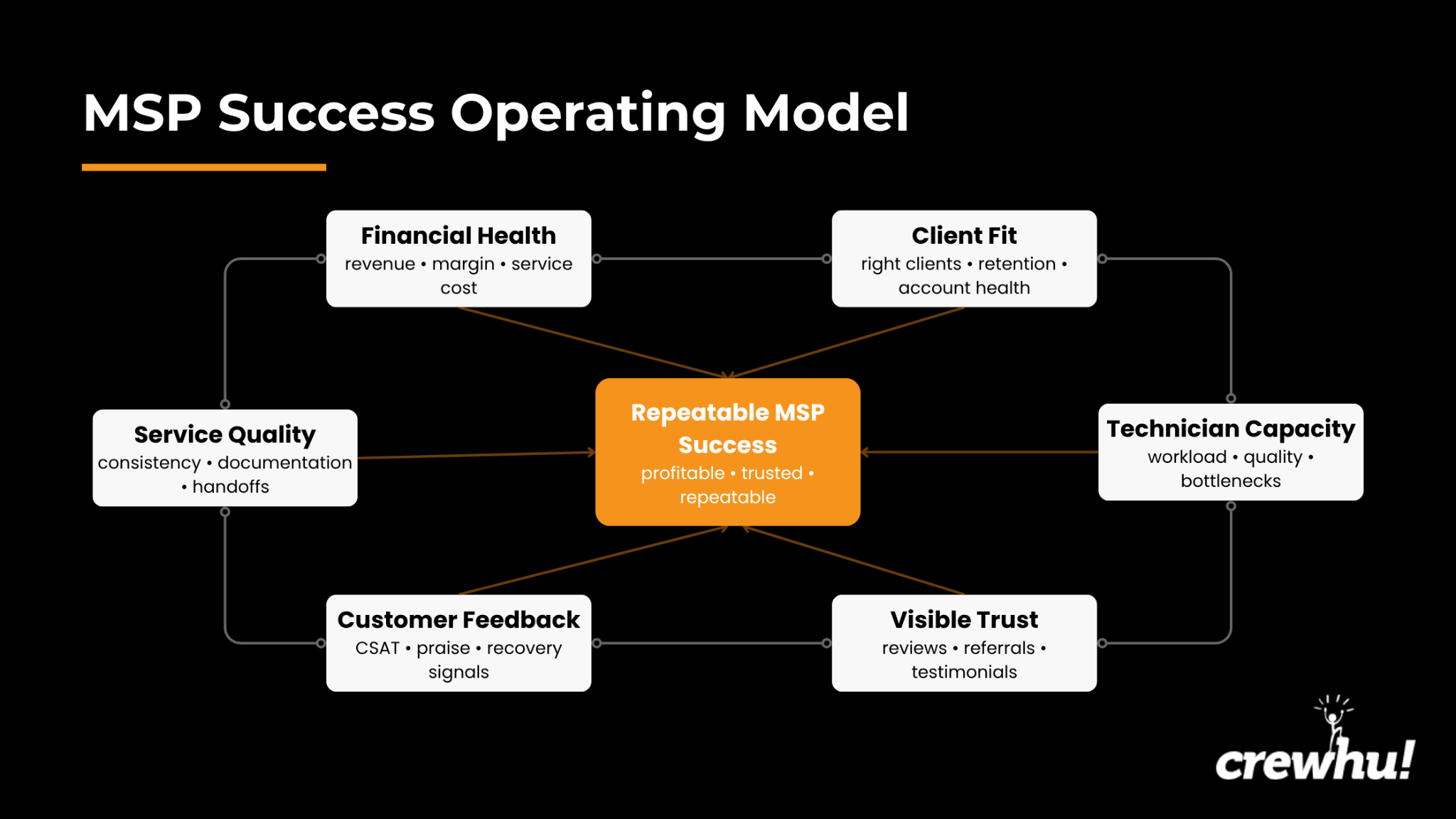
- Financial health, client fit, service quality, technician capacity, feedback visibility, and reputation signals are all important for building a profitable MSP.
- MSP growth becomes risky when poor-fit clients, margin leakage, overloaded technicians, or scattered account-health signals stay hidden.
- To read and understand those signals, MSPs need a success scorecard.
- Crewhu helps MSPs turn feedback, recognition, and proof-worthy service moments into visible signals they can manage and repeat.
A managed service provider may be adding clients, closing tickets, and collecting positive reviews while the business becomes harder to run. Margins can leak through poorly priced agreements, and technicians absorb the strain of noisy accounts. Clients may also feel unresolved friction even when service activity looks high.
The better question is whether the business is becoming more profitable, reliable, trusted, and consistent. Look at what profitable MSPs build, measure, and repeat so growth doesn’t outrun service quality.
What MSP Success Really Means
Success for an MSP is to generate financial return while clients experience consistent, trustworthy service.
Managed services are sold as recurring relationships rather than one-off transactions. Clients buy tools, response times, and technical expertise as part of that relationship. They also buy confidence that someone will notice risk early and communicate it clearly. They expect the MSP to resolve issues without drama and keep improving the environment over time.
MSP success isn’t one number
Revenue, profitability, retention, client satisfaction, reviews, referrals, technician productivity, and ticket volume all influence MSP success. The trouble starts when one of them is used to measure the whole business.
A high-retention MSP may still be carrying clients that drain senior engineering time, or a fast-growing one might be adding accounts that should never have passed qualification. A service desk could meanwhile close a large number of tickets as reopens, weak notes, and frustrated follow-ups quietly rise underneath.
A steady flow of positive reviews reflects good service, but it doesn’t prove the MSP has healthy pricing, clean documentation, strong account management, or enough technician capacity.
Don’t ask, “Which number proves we’re successful?” Ask instead whether those signals show the MSP becoming stronger, more trusted, and more consistent.
Why revenue growth can hide weak operations
Revenue growth can cover operational noise until the team has to fulfill the promises made to each new business. A freshly minted managed agreement may look healthy in the CRM, only to become expensive after onboarding because the client’s environment is messier than expected. A large account may produce attractive monthly recurring revenue while consuming disproportionate dispatcher attention, escalation time, and leadership involvement.
Recent MSP market coverage has indicated pressure around buyer budgets, smaller traditional deal sizes, and hiring, as well as pointed to AI demand and the need for efficiency. Growth can still work under those conditions, but if left unexamined, it becomes more dangerous. An MSP may not be able to see delivery cost, capacity strain, account health, or service quality clearly. When that happens, it confuses activity with progress.
A practical MSP success model connects profitable recurring revenue, the right clients, and reliable service quality. It also unifies efficient teams, useful feedback, and visible trust into a cohesive ecosystem. If one layer looks strong while the others weaken, the business may be scaling a problem.
Financial Health Comes First, But Don’t Forget the Bigger Picture
Financial health is the foundation of MSP success. A managed service provider can and should care deeply about service quality, client experience, and technician morale. But it still needs recurring revenue that pays for the team, tools, management time, process improvement, and growth.
Recurring revenue needs margin discipline
Recurring revenue gives an MSP predictability. Leaders have room to plan capacity, support the team, invest in tools, and create a steadier client experience.
That advantage depends on clear scope, healthy pricing, and consistent service expectations. An agreement should reflect both what the client pays and the real work required to serve the account well. That includes onboarding effort, documentation quality, escalation patterns, compliance requirements, account management time, and senior technical attention.
Don’t forget about tool costs. As the stack expands, subscription spend and operational complexity should be reflected in pricing, process, or service standards.
Client fit belongs in this financial conversation as well. A right-fit client gives the MSP a clearer path to deliver exceptional service and protect margins. A poor-fit client can look attractive on paper, then problems show up later through unclear decision ownership, chronic scope pressure, unrealistic response expectations, or resistance to standardization.
Those patterns eventually reach the service desk. They affect dispatcher load, ticket quality, escalation pressure, technician stress, and the client’s perception of value.
Service cost shows what revenue can hide
A healthy MSP watches service cost with the same seriousness it watches sales. That doesn’t require inventing a universal benchmark. Different MSPs have different verticals, contract structures, tool stacks, labor models, and service commitments.
The aim is to track patterns:
- Which agreements produce repeat work?
- Where do escalations pile up?
- Which clients need constant exception handling?
- Where is the team spending time that the contract doesn’t support?
Be careful to avoid the trap of revenue increasing while service costs rise even faster. Financial health becomes easier to protect when the MSP can see the service behaviors and account patterns behind the numbers.
Successful MSPs Know Which Clients They Should Keep, Grow, and Avoid
Customer retention is a success signal, but some clients can still be unhealthy partnerships. A client can renew and remain misaligned, stay quiet and be at risk, or buy more services while creating delivery problems that weaken the team. Successful MSPs treat their clientele as more than a uniform block. They separate customers by which they’ll keep, grow, recover, and avoid renewing.
Retention isn’t the same as account health
A renewal doesn’t always mean the relationship is valuable. Some clients stay because switching providers would be disruptive. Others renew because the internal team has no time to evaluate alternatives, or because dissatisfaction hasn’t yet reached a formal decision point.
Account health entails more than contract status. It should include service patterns, relationship signals, feedback, QBR quality, and escalation history. Project outcomes and whether the client trusts the MSP’s recommendations also matter. A client who praises clear communication and follows strategic advice is different from one who renews while resisting every standard.
Account risk usually appears before churn, but the signal is often scattered and missed, such as:
- A frustrated ticket reply stays in the PSA.
- A low feedback score reaches the service manager without reaching the account owner.
- A technician knows the client is difficult but has no clean way to turn that experience into account insight.
- A client stops responding to QBR invitations.
Each signal may look small alone, but together, they show the account is becoming unstable.
Succurri shows why visible customer feedback matters when account signals are scattered. Crewhu helped their leadership see customer input quickly enough to support recognition, performance reviews, and client follow-up. In Succurri’s case, transparent feedback also helped protect a $10K/month client relationship and strengthen other key relationships.
Growth from the right clients feeds a positive loop
Growth from the wrong clients can make an MSP slower, noisier, and less profitable. Lead generation should attract the right prospects, rather than more prospects by default. Sales should qualify for operational fit, as well as revenue potential. Account management should know which clients are ready to grow because the relationship is healthy and which clients are asking for more while already straining the service model.
Inside the MSP success model, the principle is simple: Growth should add clients who the MSP can serve profitably, consistently, and credibly.
Service Quality Is the Operating Core of MSP Success
For many clients, the service desk is where MSP value becomes visible. They may meet the owner during sales and hear from an account manager during QBRs, but most of the relationship still forms through everyday service moments.
Those moments include ticket updates, escalation handoffs, onboarding questions, backup restore concerns, security alerts, and calm explanations when something breaks. Consistent service helps the client see the MSP as organized, reliable, and easy to trust.
Clients experience the MSP through service moments
Service quality shows up in practical questions like:
- Did the technician explain the issue clearly?
- Did the client know what would happen next?
- Did the note help the next person understand the fix?
- Did the escalation save time or force the client to start over?
- Did the MSP recover well when the client was frustrated?
Those details shape trust more than a polished promise on the website.
An MSP can have strong technical talent and still produce a weak client experience if those moments are uneven. The client doesn’t see internal workload, tool complexity, or documentation debt. They only see whether the MSP is on top of things when they need help.
Repeatable service matters more than heroics
Successful MSPs turn good work into repeatable standards. They define what clear communication looks like and make documentation useful to the next technician instead of leaving it as a ticket requirement. They also turn service recovery from a personality trait into a discipline that can be repeated.
Every MSP has technicians who save the day, but good service shouldn’t depend solely on heroics. If there’s only one tech who knows the client’s environment, the business has a capacity problem. If praised behavior is never captured or shared, the team loses a chance to repeat it.
The most profitable work is often unglamorous (i.e., clean ticket notes, useful handoffs, and escalation context prevent rework). Clear follow-up reduces client anxiety and helps senior engineers solve faster.
These details affect cost, capacity, retention, and reputation. When service quality isn’t captured, management loses sight of the behaviors that protect trust. The MSP may recognize that clients like certain technicians or are unhappy with a certain service but miss why. Service quality has to become visible enough to manage.
Technician Capacity and Visibility Shape Profitability
Well-managed technician capacity boosts speed and gives technicians enough room to communicate clearly, document work, support handoffs, coach newer teammates, and solve problems without relying on constant heroics.
That affects profitability, because service quality and capacity are inextricably linked. Fewer repeat issues, cleaner notes, stronger handoffs, and better escalation paths help protect margin and give clients a steadier experience.
Capacity still needs visibility though. Ticket volume alone doesn’t show whether the team is overloaded, if documentation is useful, or if the same problems keep coming back. MSP leaders need to read workload, quality, escalation patterns, documentation, and service behavior together.
Industry reporting based on Auvik research points to similar management pressure. Tool sprawl, IT complexity, burnout, and visibility gaps can make technical capacity harder to protect. A thriving MSP uses capacity in a way that protects quality, margin, and trust.
Productivity metrics need quality context
Ticket volume, response time, and resolution time are useful in combination rather than standalone benchmarks. Successful MSPs add quality context to productivity metrics like reopens, repeat tickets, escalation patterns, documentation quality, customer feedback, and whether the work reduced friction. They also pay attention to behaviors behind the numbers, including clear communication, proactive updates, calm recovery, and peer support.
Fast closes with weak notes create future cost. Response targets can be met while clients still feel uninformed. High ticket volume may hide repeat issues that should have been fixed at the root. Data use and KPI discipline can support stronger MSP management when signals are connected. Isolated numbers can make the business feel informed while the real pattern stays hidden.
Managers need visibility into service behavior
Managers need to determine which clients produce friction and which issue types create poor feedback. They also need to learn which recovery moments go well and where positive service behavior deserves recognition.
Crewhu helps MSPs connect customer feedback, recognition, dashboards, tags, and team and member performance views to the service behaviors managers need to coach and repeat. That visibility keeps technician capacity from becoming a spreadsheet exercise and makes it part of the success model.
Customer Feedback Tells MSPs What the Numbers Miss
Customer feedback is vital because it turns the client’s experience into something tangible that an MSP can act on.
CSAT, NPS, comments, reviews, and survey responses become shallow if the MSP treats them as trophies or panic buttons. Feedback has more value when it’s close to the service moment, the account, the technician, and the management decision.
Feedback should lead to action
A ticket-close CSAT response can show whether a service interaction worked. A relationship-oriented, NPS-style survey can point to broader loyalty or confidence. The outcome depends on what the MSP does next:
- A positive response can confirm a behavior worth repeating.
- A negative response might trigger recovery before frustration hardens into account risk.
- A missing response should prompt investigation. Is the client satisfied, disengaged, fatigued by surveys, or quietly unhappy? No feedback is still a signal.
Feedback loses value once it’s too far from the original work. A manager may see an average score without being able to connect it to the ticket, technician, issue type, account, or service pattern. If the score shows something’s wrong, the manager needs to know what to repeat, coach, recover, or escalate.
Crewhu empowers MSPs to keep customer feedback close to the service work that produced it. Our integrations also help connect that feedback to the software MSP teams already use. Where configured, survey writeback can keep ratings, feedback, and survey details closer to ConnectWise, Autotask, or Zendesk service records.
Positive and negative feedback show what to repeat or recover
Positive feedback shouldn’t disappear after someone says “nice job.” Recognition is most useful when it names the service behavior. If a client praises clear communication during an outage or a smooth onboarding, the MSP should pinpoint which behavior created that confidence. Documentation discipline, proactive updates, and clean escalation all make service quality repeatable. Calm recovery, peer support, and clear client communication also go a long way toward supporting consistent, high-quality work.
Negative feedback deserves the same operational seriousness:
- A low score can show the client felt uninformed, even when the technical fix worked.
- A frustrated comment may reveal repeated context loss across handoffs.
- A pattern of negative feedback from one location points to possible onboarding, documentation, or expectation problems.
Good feedback systems shorten the distance between service friction and management action. Feedback belongs in the MSP success model as a working signal instead of a decorative customer-satisfaction number.
Successful MSPs Make Trust Visible Before They Need It
Reputation signals matter because buyers can’t see most MSP service quality before they commit. A prospect can review the website, talk to sales, compare offerings, and read case studies, but they can’t fully experience the service desk until they become a client.
Reviews, referrals, testimonials, and short proof assets help close that trust gap by making real service moments visible. They’re evidence that part of the system is working.
Reviews and referrals grow from earned trust
A strong review after a calm outage recovery or a testimonial after a smooth onboarding are meaningful because the service moment was specific. Reviews and referrals work best when they capture that concrete trust the MSP has already earned.
If the service desk is inconsistent and clients feel ignored, review generation and referral asks become cosmetic. Consistent service gives those asks a stronger foundation. When clients feel informed, helped, and respected, reviews and referrals become a natural extension of the relationship.
General local-review research from BrightLocal shows that review signals such as recency, star ratings, and responses influence consumer trust and decision-making. Although MSP buyers differ from local consumers, visible third-party proof still supports trust, especially when it reflects real service experiences.
Review and testimonial use also needs clean procedures:
- Google’s Business Profile guidance allows businesses to ask customers for reviews but cautions they should avoid incentives in exchange for said reviews.
- Google’s Maps user-generated content policy restricts fake engagement and manipulated review behavior.
- The FTC’s business guidance on endorsements, influencers, and reviews adds another legal layer around testimonials, material connections, and disclosure that can’t be ignored.
The safest approach is simple. Ask clients after real service interactions, avoid incentives or sentiment filtering, get permission to use testimonials, and keep named customer outcomes away from general promises.
Reputation is strongest when it reflects what the MSP can actually repeat.
Build Your MSP Success Scorecard
A useful MSP success scorecard should avoid trying to track everything. Its purpose is to connect the signals that show whether the business is becoming healthier or only busier.
It should help leadership see the relationship between financial health, client fit, service quality, and technician capacity. The scorecard also needs to connect feedback, reputation, and proof. Otherwise, it becomes a passive dashboard that everyone checks but no one uses.
Read success signals together, not in isolation
|
Success area |
What to watch |
What it tells the MSP |
Risk if ignored |
|
Financial health |
Recurring revenue, margin, service cost, tool cost, revenue per employee where trackable |
Whether growth is commercially healthy |
Revenue rises while profitability weakens |
|
Client fit and retention |
Renewal risk, account fit, QBR quality, expansion readiness, service friction |
Whether retained clients are actually healthy |
The MSP keeps clients that overload the team |
|
Service quality |
CSAT/NPS patterns, response and resolution behavior, reopens, repeat issues, documentation quality |
Whether clients experience consistent service |
Clients lose trust even while tickets get closed |
|
Technician capacity |
Workload, escalation pressure, bottlenecks, repeat work, quality-weighted productivity |
Whether the team can deliver its service promises profitably |
Burnout, weak notes, and senior-tech dependence grow |
|
Feedback visibility |
Positive, negative, and no-feedback patterns by client, technician, and issue type |
What to repeat, coach, recover, or escalate |
Feedback becomes a vanity score or arrives too late |
|
Reputation and proof |
Reviews, referrals, testimonials, case snippets, proof-worthy service moments |
Whether trust is visible to prospects and clients |
Good service disappears inside tickets |
Use the scorecard in management conversations as well as reporting meetings. A moving number should reveal the behavior behind it, while a missing signal should raise the question of whether the team has the right capture mechanism. Even if an account looks healthy, test it against feedback, service cost, and relationship quality.
Where Crewhu Fits in the MSP Success Model
Crewhu gives MSPs a clearer way to see and manage service signals. Those indicators often stay buried in tickets, feedback, praise, recognition, dashboards, and proof-worthy moments. Pricing, sales strategy, account management, documentation, service leadership, marketing, and operational process still need leadership discipline. Crewhu strengthens the visibility and reinforcement layer around that work, which helps good service behavior become easier to repeat across the system.
That’s crucial since many behaviors that protect client trust happen inside ordinary tickets, handoffs, and recovery moments. Ticket volume alone can’t tell whether a technician communicated clearly, recovered a frustrated client, or documented the fix. It also misses whether the tech supported a teammate or created a moment worth turning into public proof.
Crewhu’s product ecosystem connects customer feedback, recognition, rewards, gamification, reviews, testimonials, and service visibility. Those pieces work together as a critical service-performance layer. This helps daily service behavior become visible enough for managerial action, which in turn supports the MSP success model.
Feedback, recognition, and proof capture close the loop
Recognition is valuable when it reinforces the service standard. Clear documentation, strong routing context, and calm service recovery should be visible, along with customer praise, because it shows the team what good service looks like in practice.
Crewhu makes recognition more useful by tying it to the service behaviors that should be repeated. For MSPs, that means recognition can point back to the work that protects client trust. Clear communication, useful documentation, calm recovery, and strong handoffs all help show what consistently good service looks like.
Visible service behavior in context
Good service is easier to standardize when the team can see it.
Stephen Spiegel talks through how feedback, recognition, rewards, and gamification help MSPs bring daily service behaviors into view. Those signals show the team which moments clients remember so excellent work is easier to recognize and repeat.
Dashboards, reports, notifications, integrations, and workflow-connected feedback help managers pinpoint those patterns more quickly.
GO2 Tech and Kraft Technology Group made the most of that mechanism after struggling with review monitoring, CSAT tracking, internal visibility, and service-performance management. They saw firsthand how feedback and service-performance signals can become visible enough for an MSP to manage.
The MSP success model is undeniably linked to service behavior. Successful MSPs need to see service behavior clearly enough to recognize and coach it, recover from problems, and turn earned trust into proof where appropriate. With customer feedback, recognition, rewards, gamification, dashboards, and service-performance visibility, Crewhu gives MSPs more than a record of good service. It helps them reinforce the behaviors clients remember and turn earned trust into something the business can capture, repeat, and act on.
Successful MSPs Build Repeatable Trust
Successful MSPs understand which clients they should serve and how profitable those relationships really are. They know whether technicians have the capacity to deliver well and where service quality is consistent. They can also pinpoint where feedback signals risk or praise, and how trust becomes visible before it disappears inside closed tickets.
That expertise turns MSP success from a static slogan into an operating discipline.
MSPs have to build profitable client relationships, measure the service reality behind the revenue, reinforce the behaviors that protect trust, and repeat the work that makes their businesses thrive. Growth, reviews, referrals, marketing, and sales discipline all work best when they sit on top of a service model that clients can feel and the MSP can actually manage.
Repeatable trust is the real asset. The scorecard only matters if it helps the MSP protect it.
Your next growth opportunity may already be sitting inside the service work your team performs every day. Praise, feedback, recovery moments, and referral-worthy service often disappear into tickets, QBR notes, and private conversations.
Crewhu helps bring those signals into view. With customer feedback, recognition, rewards, gamification, dashboards, and service-performance visibility, Crewhu helps MSPs reinforce the behaviors clients remember and turn earned trust into something the business can capture, repeat, and act on. Book a Crewhu demo to see how your team can make referral-worthy service easier to recognize and repeat.
FAQ
What does MSP success mean?
MSP success means building a managed service business that’s financially healthy, operationally repeatable, and trusted by the right clients. It includes profitable recurring revenue, strong client fit, consistent service quality, and protected technician capacity. Useful customer feedback, visible proof, and disciplined decisions greatly support this model.
What metrics should MSPs track?
MSPs should track connected metrics across financial health, client health, service quality, technician capacity, feedback, reputation, and proof. Useful categories include recurring revenue, margin, service cost, renewal risk, and CSAT/NPS patterns. Reopens, documentation quality, escalation pressure, reviews, referrals, testimonials, and feedback-response behavior also belong on the MSP success scorecard.
Is revenue the best measure of MSP success?
Revenue is important, but on its own, it gives an incomplete picture of an MSP’s true success or failure. Revenue can rise while margins weaken, technicians overload, poor-fit clients consume too much attention, or service quality becomes inconsistent. A better measurement is whether revenue is profitable, repeatable, and supported by healthy client and service signals.